Memory, Change, and the Houses We Build
The human mind does not register time linearly; it registers it architecturally. We boast about moving forward, leaving the past behind, and of stepping into our bright future, somewhere over the proverbial rainbow. Yet, anyone who has survived a profound season of upheaval knows that memory behaves less like a straight highway and more like a traffic roundabout, a dizzying loop where the brain spins, overthinking and under-moving, willing to sell your very soul for an exit.
At all costs, one must yield to the oncoming traffic of old regrets, forgotten joys, and intrusive ghosts, those bastards (the good, the bad and the terribly ugly). To be caught in this loop is to experience a specific kind of cognitive bewilderment. You round the curve, scanning the exits, unsure if moving to the right signifies progress or if choosing the left will only lead to another close call, so much like what you are trying so hard to forget.
Life, in this state, feels volatile. It threatens to shape, unshape, or remake you according to which ghosts you choose to feed.
Feed the dead.
They are hungry too. Just make sure they are not poisoning you first.
The turning point of survival is not finding a magical emergency exit out of the roundabout. Instead, it is the deliberate choice to steer toward the edge, teetering, very near the ding-dong ditch.
Listen for the crunching gravel beneath the tires. That's the sound of leaving certainty behind. That's the sound of arriving in the middle-mix. It is messy, full of loose stones and uncertain chemistry.
Navigating this space requires intense caution as you pour your hope into the mixture and trust that it will hold. Each step must be placed with care. It is a slow, methodical masonry of the self. You cannot rush the drying process of a new foundation.
Once the ground solidifies, the true work of reclamation begins. To move forward, up the drive, is to claim excellent purchase over your own life. It is the realization that if memory can unshape you, then intentional action can remake you. We begin to build a house, not out of metaphor—that's what the poems are for—but out of boundaries, routines, and hard-won resilience.
A reclaimed life requires an intentional layout with firm walls, boundaries that say no to the notions that knot our last nerves. Walls, not to hide behind, but to protect our internal space from hurtful outside elements. Where there is smoke, there is usually a great deal of fire.
A solid roof is necessary: an overarching, unflinching belief system that shelters us from the weight of the world and covers those we love most.
A dry basement is necessary too: the subconscious place where we store what is worth keeping and leave the rot behind.
But a house is not a fortress designed to keep things out. Life and light must get in, perhaps through the addition of a four-season porch where there is the capacity to grow, a space that welcomes in the light, and marks the changing seasons from winter's frost to summer's blooms. Protected within, the cold and scorching heat held at bay, clocks become unnecessary as there is no such thing as time, only ongoing change and remembrance.
We do not cure memory. We cannot outrun it, but we can build a structure large enough, and strong enough, to hold both our scars and our blossoms at the exact same time.
And if there's any wood and nails left … I recommend a treehouse and a few carefully placed bird feeders.


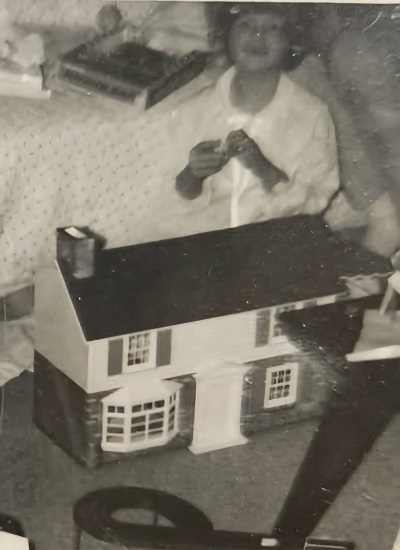



I wanted to be an architect and was able to design and build my own home in 1980. But circumstances prevented me from living in it, so I have settled where I am for the last 45 years and modified it to meet my disabled needs.
That's all one can do when life throws you towards the ding dong pit (I really love that phrase I had never heard before. Thank you!").
Ron