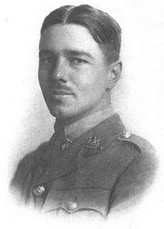
Owen's poems reflect the depth of psychic pain he felt during his service in World War I. He died 7 days before the Armistice ended the war.
DULCE ET DECORUM EST
Bent double, like old beggars under sacks,
Knock-kneed, coughing like hags, we cursed through sludge,
Till on the haunting flares(2) we turned our backs
And towards our distant rest(3) began to trudge.
Men marched asleep. Many had lost their boots
But limped on, blood-shod. All went lame; all blind;
Drunk with fatigue; deaf even to the hoots(4)
Of tired, outstripped(5) Five-Nines(6) that dropped behind.
Gas!(7) Gas! Quick, boys! – An ecstasy of fumbling,
Fitting the clumsy helmets(8) just in time;
But someone still was yelling out and stumbling,
And flound'ring like a man in fire or lime(9) . . .
Dim, through the misty panes(10) and thick green light,
As under a green sea, I saw him drowning.
In all my dreams, before my helpless sight,
He plunges at me, guttering,(11) choking, drowning.
If in some smothering dreams you too could pace
Behind the wagon that we flung him in,
And watch the white eyes writhing in his face,
His hanging face, like a devil's sick of sin;
If you could hear, at every jolt, the blood
Come gargling from the froth-corrupted lungs,
Obscene as cancer, bitter as the cud(12)
Of vile, incurable sores on innocent tongues,
My friend, you would not tell with such high zest(13)
To children ardent(14) for some desperate glory,
The old Lie; Dulce et Decorum est
Pro patria mori.(15)
(Translation of title: It is right and fitting to die for one's country.")
Futility
Move him into the sun —
Gently its touch awoke him once,
At home, whispering of fields unsown.
Always it woke him, even in France,
Until this morning and this snow.
If anything might rouse him now
The kind old sun will know.
Think how it wakes the seeds —
Woke, once, the clays of a cold star.
Are limbs so dear-achieved, are sides
Full-nerved, — still warm, — too hard to stir?
Was it for this the clay grew tall?
— O what made fatuous sunbeams toil
To break earth's sleep at all?
Wilfred Owen was one of the many poets turned soldier for World War I. This book, THE COLLECTED POEMS OF WILFRED OWEN, provides the reader with the changing attitudes of the poet towards the impossible war.
The bitterness of "Dulce et Decorum Est" reflects the final nauseating reflection of men sent to death for a false ideal. The images are harsh, realistic, disgusting. They appeal to the senses of touch, sight, sound. The poem is a sad commentary of what becomes of the living boys sent into this hell as bodies are "flung" one atop another into a body wagon.
This contrasts with a favorite poem by Owen, "Futility." After encountering this poem on a midterm exam at UCLA, I made somewhat of a life's project to understand its nuances and beauty. Owen writes of someone, evidently a fallen comrade, who has just died. He urges that the boy be moved into the sun, that continuing beacon which shines even here in France where there are no fields still fit to plow, where death overrides life. The "kind old sun" the men have known all of their lives as a force of giving life is turned by poem's end into "fatuous sunbeams" whose life-giving properties are no match for death on the battlefield. Lives left unlived, fields, left unplowed, the body a "cold clay" which can no longer grow to adulthood nor live another day. The sun itself is defeated by the evil and darkness of war.
|


War is glory and war is hell. I think more the latter than the former.
Ron