This is an introduction to Kagura, a dynamic form of Japanese folk theater.
It is a shame, for theatre lovers in general, and fans of Japanese theatre in particular, that Hiroshima is such a long way from anywhere. Even within the country, this vibrant city of more than one million people is sufficiently removed from Tokyo, Kyoto and other major centers that it receives negligible press, outside the realm of car exports, agricultural production, and peace studies. Yet, if theatre critics were willing to take the road less traveled (or the bullet train in this case), they would discover a vibrant and sophisticated re-imagining of one of the oldest performance traditions in the world.
Kagura is an artistic expression of the Shinto religion. In Japanese, the term is written with two ideograms, suggesting the concepts of “God(s)” and “Entertainment”. Kagura performers take their inspiration from the myth of the loss and recovery of the Sun Goddess: Shinto texts dating back more than a thousand years describe how the Patron Goddess of Dancers lured the Sun out of a rock cave by creating an impromptu stage from an overturned wash basin, and bearing it all in a bawdy and provocative display. The Myriad Gods were provoked to laugher, and when the Sun Goddess peered out to see what all the fuss was about, light and warmth were restored to the universe.
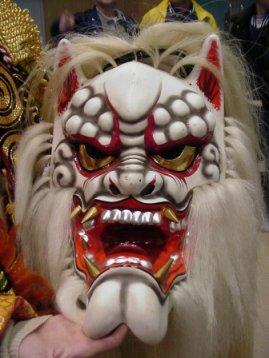
The paradigm for Kagura is thus socially-motivated physical entertainment, with recognition of spiritual forces as audience. This template is flexible enough to have endured for a millennium, while renewing itself in countless variations. Some contemporary forms are essentially “pure” dance, with choreography based on long-forgotten principles of spatial mysticism. Other Kagura are more operatic, combining mime, recitatives, and mythological storytelling. An official court-sanctioned version was established in the Japanese Middle Ages and has continued with virtually no changes to present. There are also three major unofficial styles, incorporating local legends and folk deities, as well as acrobatics, Chinese lion dances, processional elements, and more recently, stagecraft from the conventional theatre.
“Hiroshima-style” Kagura is perhaps the hippest, most secular, crowd-pleasing style of Shinto performance in the country. This art is epitomized by the taikai, a semi-annual gathering of actors from all over west-central Japan. Taikai combine elements of both western fringe theatre and the theatre sports motif. Each troupe is given forty minutes or so to present a classical mythological story, a quasi-contemporary 19th or 20th century play, or a completely new work. Most of the presentations consist of a two-act dance/drama fueled by an epic confrontation between the forces of good and evil. The lyrics are arcane, but the boom of the taiko drums is accessible to everyone. So too is the surreal atmosphere, which relies on judicious use of dry ice, fireworks, and other imports from the Kabuki stage. Most of the performers are technically amateurs, although this is hard to believe given the dedication to their craft. The choreography is fast-paced and meticulous, right down to the synchronization of wrist and finger movements. The dances also carry an element of danger, particularly when hero and villain spar with javelins, daggers, or broadswords.
The taikai is an opportunity for excellence, and an illustration of how heritage can retain its relevance even in an ostensibly urban setting. The day-long event is well-attended by a net-savvy fan base, who blog between conventions, share trivia and memorabilia, and cheer on their “home town” favorites with the kind of fervor one would expect at a rock concert. The audience also includes a panel of experts, who provide each troupe with feedback on their costumes, masks, special effects, and dance technique. And some would say that the kami (spirits) are in attendance as well, particularly during the highest-energy passages.
Hiroshima taikai became my entry point into “Kagura culture” during a four-year stay in the city. After a few such gatherings, I was hooked, and began traveling to rural townships on the weekends, attending more homespun agricultural performances, and learning the tricks of the trade through discussions with troupe leaders. Eventually, I ended up several hundred kilometers to the northeast, at the start of what is known locally as the Kagura Trail.
Ground Zero turns out to consist of two important Shinto shrines. One established the regional focus on theatricality through exchanges with Kyoto, the performance capital of the Japan, during the 17th century. (Intriguingly, this is the same shrine from which Izumo-no-Okuni, the founder of Kabuki, made her way east a century or so earlier.) And the neighboring shine was the first to apply the techniques of the Noh stage as the basis for an overnight performance marathon, a step that became the template for Kagura throughout this part of the country.
There is no doubt that the very public process of artistic competition has taken Hiroshima Kagura in a distinctive direction. A sense of disapproval is tangible at some of the more traditional performances in nearby townships. Village Kagura is “true ” Kagura, I have been told, not the flashy, Kabuki-esque spectacle found in the big city. Certainly it could be argued that in honing their crowd-pleasing technique, Hiroshima performers have lost touch with the recognition of spiritual forces that has always defined Shinto theatre. And yet the palpable sense of community that both nurtures and is nurtured by this art form is also surely a “spirit” worth recognizing.
|