AuthorsDen.com   Join | Login    
Where Authors and Readers come together!

SIGNED BOOKS    AUTHORS    BOOKS    SAMPLE CHAPTERS    AUDIOBOOKS    eBOOKS    STORIES    ARTICLES    POETRY    BLOGS    NEWS    VIDEOS    SUCCESS    TESTIMONIALS

Featured Authors:  Tichaona Chinyelu, iRobert Liu, iAnn Marie Hannon, iTeresa Walker, iR.E.E.S Blogs Linda Smith, Publisher, iWilliam Potter, iDavid Arthur Walters, iSergio Serrano, Ph.D., iLaura Cavanaugh, iLisa DAnnolfo Levey, i

  Home > Essays > Articles Popular: Books, Stories, Articles, Poetry      Authors: A B C D E F G H I J K L M N O P Q R S T U V W X Y Z     

Paul JJ Payack

 Follow Me  

· Contact Me
· Books
· Articles
· News
· Stories
· 41 Titles
· Save to My Library
· Share with Friends!
·
Member Since: Before 2003

Paul JJ Payack, click here to update your pages on AuthorsDen.


History of the Infinity Symbol by Paul JJ Payack
by Paul JJ Payack   
     
Recent articles by
Paul JJ Payack

• Number of Words in the English Language
• The Ten UnCommandments of Corporate Communications By Paul JJ Payack
• Dispatch From the Front Lines
• Top Ten Words of 2002: Don't misunderestimate Bushisms
• Marginalia: The Careless Steps of a Gull by Paul JJ Payack
           >> View all

The Dustbin of History
or How the Infinity Symbol Came into Existence

John Wallis (1616-1703) possessed no knowledge of the mathematical arts at the age of fifteen, yet he later went on to become the Savilian professor of Geometry at Oxford, the friend and teacher of Isaac Newton (he was the first to charge that Leibnitz had stolen his ideas for the calculus), and a charter member of the Royal Society. Yet his place in the history of mathematical thought is, perhaps not unjustly, obscure (and oftentimes, simply, ignored). A list of his major formulations would serve, merely, as an esoteric series of footnotes to the said compilation, which would interest, it should be stated, rather few. For example, Wallis discovered that, in all such operations, it was mass times velocity (mv) that was conserved and not, as it was widely held, merely velocity (v). However, he fell short of unsecreting the laws of motion (which Newton would later publish). He also, at one time, theorized "that for the purposes of calculation, the earth and moon can be treated as a single body, concentrated at their center of gravity …" but stopped short far short of formulating the basis for the Laws of Universal Gravitation. It can also be noted that Newton borrowed his system of fluxional notation (in which the fluent of was represented by , and the fluent by and so on) yet this, too, was swept into the dustbin of history when it was later replaced by that system developed by Leibnitz. His significant work still owed a heavy debt to the Greeks and the most notable of these was Arithmatica Infinitorum sive Nova Methodus Inquirendi in Curvilineorum Quadraturam aliague difficilora Matheseosos Problemata (1673), which is more often recalled for its title rather than for the fact that it introduced to mathematics the idea of 'limit'. It is often opined that a man might fulfill the secret purpose of his existence in the doing of a seemingly trivial deed such as a word said in passing or, perhaps, an action not acted upon (the significance of which, more often than not, is forever hidden from the doer). In the case of John Wallis it can be said that he, quite possibly, achieved his destiny with the few simple strokes of his quill with which he, in 1656, modified a Roman variation for 1000. This was to serve him simply as the notation for a very small quantity, but, in centuries to come, was to serve the world as the symbol (and signature) of INFINITY: .


Want to review or comment on this article?


Need a FREE Reader Membership?
Popular Essays Articles
  1.  Where Have All the Authors Gone?
  2.  The Advent of ALICE 1.0 Advanced Logis
  3.  War and the Earth we need to live on.
  4.  An Era of Stupidity and the Challenge
  5.  Down with Group Chat
  6.  Critical Race Theory & the 1619 Projec
  7.  Needed: A Progressive Grand Strategy t
  8.  Less Words, More Results
  9.  Takeaways from Adam Smith's The Wealth
  10.  Mr. Trump, have you no sense of decenc
  11.  The Crisis of Opioid, Fentanyl, Cocain
  12.  Verifying Ones Self
  13.  Where, oh where, has my Porsche dream
  14.  Critical Race Theory
  15.  Just a Kid
  16.  Super Spreaders Disguised as Congressm
  17.  Daylight Saving: Stop Legislating the
  18.  Are You Writing for Me?
  19.  The Compassion of Christ
  20.  Why Excessive Inequality Matters
  21.  Bone-headed Supreme Court Decisions
  22.  Rhode Read: RI’s Tobacco-Based Wealth
  23.  Genghis Khan Rides Again!
  24.  The Cozy Mystery: Death by a Thousand
  25.  American Fascism and the Bush Administ

Free Book Review Program
Select a book to read and review today!

RAM: Random Articles and Manuscripts by Jay Dubya

RAM: Random Articles and Manuscripts, a non-fiction collection of 38 stories and essays, is author Jay Dubya's 32nd book.  
Member BookAds

RAM: Random Articles and Manuscripts by Jay Dubya

RAM: Random Articles and Manuscripts, a non-fiction collection of 38 stories and essays, is author Jay Dubya's 32nd book.  
Member BookAds

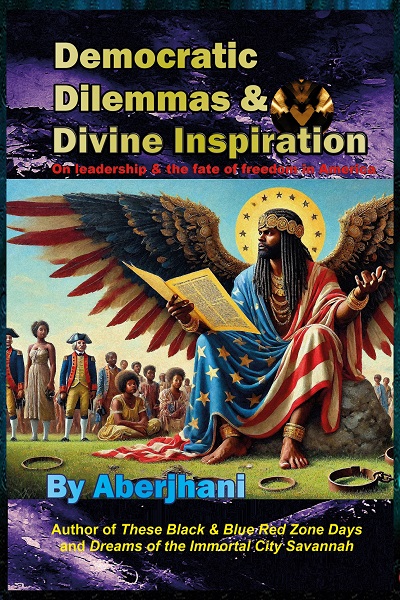
Democratic Dilemmas and Divine Inspiration (A Kindle Short) by Aberjhani

Democratic Dilemmas and Divine Inspiration examines the significance or relevance of the idea that the U.S. Constitution was, as many believe, divinely inspired. How much did that belief matter to founders of the nation and how much does it matter no  
Member BookAds