Keith John Paul Horcasitas, click
here to update your pages on AuthorsDen!
A SWOT Analysis of our FAITH by Keith John Paul Horcasitas
Rated "G" by the Author.
Last
edited: Monday, January 19, 2009
Posted: Monday, January 19, 2009
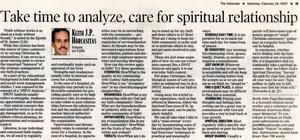
"Faith without works is as dead as a body without breath," is noted in the Epistle of St. James (Jas. 2: 26). While this very Scriptural citation has been the source of some controversy in varying Christian denominational emphasis, it can serve as a great starting point to review the important "business" of the strategic management of our faith practices.
As a part of my educational background in both health care and social work management studies, I was exposed to the concept of a "SWOT Analysis." It will be reviewed in this column to help individuals determine "where they're at" in their own private and affiliation spiritual journeys. Also, some practical daily prayer techniques to helping one's spirituality will be suggested from retreat experiences.
SWOT Analysis usually refers to Strengths, Weaknesses, Opportunities, and Threats - four central concepts that are used for review in strategic management, so as to facilitate critical planning, implementation and evaluation/control. Likewise, in our individual and communal faith emphasis, we all need to regularly and continually make such an appraisal of our lives.
Strengths (S) and Weaknesses (W) usually refers to internal concerns for a business. In the case of a hospital, its Strengths may pertain to its favorable reputation for providing quality care or its high occupancy rate; its Weaknesses may relate to poor relationships between the administration and the medical staff or unclear lines of authority/communication throughout the organization.
How can this review apply to my faith? S1. How/What is the quality of my relationship with God/ my faith practice? S2. How/What is my "occupancy rate" at my church/synagogue/temple/other? W1. How/What is my relationship with my God and my faith community? W2. How/What are the boundaries/lines of authority with my God and/or community of faith?
Opportunities (O) and Threats (T) mainly relate to external concerns for a business. In the case of a hospital, its Opportunities may be in networking with the community - private/public relationships or expansion of services/market share; its Threats may be the increased expectations from accreditation, patients and doctors or high employee turnover rates and nursing shortages.
How can this review apply to my faith? O1. How/What is my evangelization like in my faith community? O2. How/What are the fruits of my efforts within and without? T1. How/What am I doing to stand up for my faith and draw others to it? T2. How/What am I doing to keep my faith community in order and/or to motivate others to stay and get more involved in ministries?
These are just some examples of how we can use a business concept like a SWOT Analysis and apply it to our everyday faith context. For many Christians, the upcoming Liturgical Season of Lent provides an enhanced way to do a SWOT Analysis of our faith in action. Going away for a brief retreat experience, like that offered at Manresa - where the Spiritual Exercises of St. Ignatius are used - can also be particularly helpful.
We can all take what I like to call a “mini-retreat” every day by incorporating some of the principles from the Spiritual Exercises' techniques in practical and meaningful ways:
1. Schedule Daily Time: it is imperative for us to mark out time each day for some form of prayer;
2. Be Consistent: any meaningful relationship (God, spouse, family, friends, co-workers) requires a commitment;
3. Just Show Up: whatever mood or feeling we may have is acceptable - and will not keep us from coming before God; He accepts us as we are and not as we think we “should be;”
4. Find a Quiet Place: a silent environment may be difficult to find, but is essential;
5. Journaling: putting your thoughts and feelings into writing can be a great way to communicate with God and provides a way to look back at your growth;
6. Spiritual Direction: meet regularly with a specific Clergy member or peer for feedback and sharing;
7. Group Sharing: usually a Parish will have some type of prayer groups or “Small Christian Community” gatherings on a regular basis that can be helpful.
In conclusion, one can see the importance of applying a SWOT Analysis to one's faith, as well as spiritual exercises, that are vital to effective and healthy communication and living. Guided retreats also provide an opportunity to grow deeper in our relationship with God and our fellow man. Whether we're dealing with the business world or our everyday life, it is imperative that we continually take a spiritual inventory. May we follow God's Spiritual Direction: "Survey the path for your feet, and let all your ways be sure. Turn neither to right nor to left, keep your foot far from evil." (Proverbs 4: 26 - 27)
Keith John Paul Horcasitas, LCSW, MHA is a Licensed Clinical Social Worker and a volunteer at the National American Holocaust Memorial (www.cpforlife.org/memorial), khorcasitas.yahoo.com.
This book chronicles an infinite allegoric odyssey of Absolute Awakening in which a learned man, a mute man, and a recluse woman are the principal players. The mute and the recluse are the learned one's Teachers and Guides on his journey of Enlighten
This book is about a radical transformational Way of Insight, Awakening and Realization to transcendent Self of Nondual Consciousness. If your're interested in transcendental Enlightenment, in Awakening to Nondual Self of Wisdom and Compassion, then