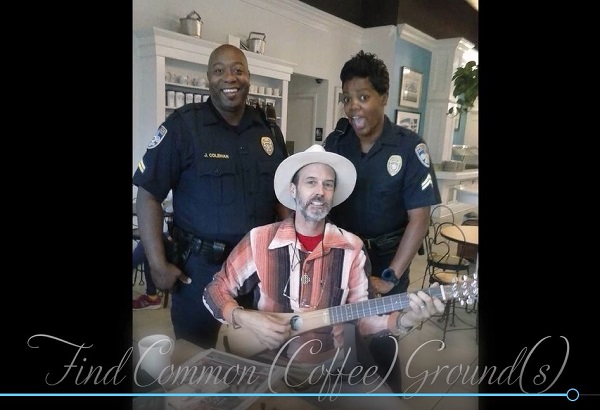
Finding Common Ground With Other Diversified Thinkers tied in with Memories from Loyola University in New Orleans with the Jesuits, particularly, Fr. Dan Berrigan, SJ, at a local tavern, Cooter Brown's.
Pic: Keith With Baton Rouge Police . Coffee Call, 2017.
Right now, with so much divisiveness and polarity in society as evidenced daily in print and social media and even in our families and work places, it almost seems impossible for us to find common ground or to treat each other civilly and without violent episodes resulting when expressing our free speech and varying opinions about anything.
As a Licensed Clinical Social Worker who always strives to be a good listener and follow our motto of "starting where the client is" - even if s/he is diverse and/or not like minded - it can also help to incorporate the following "Conversation Rules of Engagement" when ever discussing hot topics with others:
1. Have No Hidden Agenda.
2. Have No Goal To Change The Other's Opinion.
3. Make The Encounter A Chance To Listen & Learn From Each Other.
And watering holes can provide a great backdrop for discussion and understanding between people with varying opinions and even over serious matters.
Who can forget this from some bar scenes on episodes of Cheers or the encounters at the improvised and manufactured distillery of Hawkeye and Trapper John on M*A*S*H. Even President Reagan and House Speaker Tip O'Neill found that an evening cocktail helped in resolving some of their bitter partisan differences.
One memorable experience that I had with this goes back to the summer of 1983 before I got married to Maria, my college sweetheart in New Orleans. Besides working at the Loyola University Bookstore, I would answer phones and do housekeeping on weekends at Thomas Hall, where the Jesuit priests resided.
Well that summer, the late Fr. Daniel Berrigan, SJ, was in New Orleans for an Institute on Peace and Justice. He and his brother, Fr. Philip Berrigan, a Josephite cleric, were renowned American peace activists called the Berrigan Brothers, whose leftist civil disobedience records included pouring their own blood onto Selective Service Records and even hammering US nuclear missiles per their "Plowshares Movement."
So one day, as I was busy handling phone calls at Thomas Hall, I had to relay a message to Fr. Dan. He was very engaging and asked about routine New Orleans tourist spots to check out. When he found out that I had been in the Jesuit Volunteer Corps in 1981, he was curious as to if I had been involved in any civil disobedience activities for social justice issues. When he heard that I had participated in some peaceful pro-life activities at abortion clinics, he asked if we could discuss this further over a beer or two to find some common ground.
After work, I took Fr. Dan over to Cooter Brown's Tavern, a local watering hole in the Uptown area by the Mississippi River where St. Charles and Carrollton Avenues merge. It was a very popular place with live music at times and good greasy food. For our oyster meal, I recommended that he try a Dixie (Faubourg) long neck beer, a local tradition.
While Fr. Dan expounded over his views and made points that I could appreciate that tied in well with the Church's historical record of always siding with the marginalized in society, he also recognized the clarity of how that same approach applied to my own defense of the unborn. I was also spell bound when he shared with me some of those first-hand civil disobedience experiences he had for his beliefs.
By the time we finished our second Dixie (Faubourg) beer, it was clear that we both sought to live out the Gospel message—however divergent in our emphasis and approaches— particularly as it related to the Sermon on the Mount's message, the Beatitudes.
While we may have not been fully converted to each other's opinions, we certainly better respected and understood each others beliefs.
Micah 6:8 certainly summarized what we had learned more about from the encounter: "Do justice, love mercy, walk humbly with your God."
|



My encounter with a psychiatrist activist, Dr. Oliver B Henderson, when I picked him up hitchhiking in the morning on the California coast outside of Arcata and drove him to his home in Palo Alto where his wife made me and him a chicken dinner was very agreeable. We both believed that the war in Vietnam and especially the use of Agent Orange and napalm were war crimes. And needed to stop.
Unfortunately, I have found that pro-life people today are very rigid and will not discuss anything other than defending their cause, including the Supreme Court, based on the Bible and a Constitution that doesn't give rights to women.
There is much more towards saving healthy babies in family planning clinics. Abortion is a health and that includes mental health of the mother and/or a baby that may be disabled or ostracized for their entire life. Abortion is a necessary tool in making sure that the health and wealth of all citizens have a more equal chance at life.
Ron