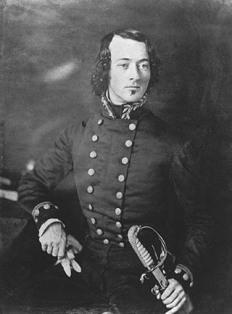
Adventure, Fame, and an Early Death:
The Life of a 19th Century American Celebrity
Dianne K. Salerni
In today’s world, it doesn’t take much to become a celebrity. A brief marriage to a popstar or a last name belonging to a hotel empire seems sufficient cause for celebration. Yet, the 21st century is not unique in conferring celebrity status based on personality and chance. In the mid-19th century, one famous but fleeting celebrity—so revered that his funeral procession ranks as the second longest in American history—was a charismatic adventurer named Dr. Kane. This man, for whom a bay in Greenland and a crater on the moon are named, was one of the most beloved personalities of the 19th century, a man who combined the flair of Indiana Jones with the scientific reputation of Jacques Cousteau. Before he died at the premature age of 37, he would lead an expedition to the Arctic Sea, spark a scandal romancing a fellow celebrity, write a national best-seller, and inspire Americans to lead the way in global exploration.
Elisha Kent Kane was a doctor, an explorer, a scientist, a writer, a world traveler, and a military hero. Born into an illustrious Philadelphia family in1820, Kane nearly didn’t make it to adulthood: rheumatic fever almost carried him off in his late teens. Doctors informed him that the resulting infection in the lining of his heart was certain to condemn him to an early grave. Kane’s reaction was to throw himself headlong into a life of adventure and romance worthy of a dime novel.
After graduating from the University of Pennsylvania with a medical degree, Kane joined a diplomatic expedition to China. Once abroad, he traveled extensively in Asia and Africa. It was in the Philippine Islands that he performed his first feat of derring-do—rappelling down the gaping mouth of a live volcano. Upon his return to the U.S., Kane secured an officer’s commission and an assignment in the Mexican-American War. While on the field, Kane helped defeat a Mexican detachment, but afterward found himself facing a court-martial for insubordination. He was undeniably guilty, having fired his gun at his commanding officer to prevent the man from slaughtering enemies who had surrendered. The American military was reluctant to condone Kane’s method, but to punish him for an act of honor and mercy would have given them a black eye. When Kane succumbed to a bout of his chronic rheumatism, his commanders gratefully sent him home with a medical discharge. He returned to Philadelphia a local hero.
Still, it was not his brief military career which made Elisha Kent Kane an icon of national pride—it was his role in Arctic exploration. His first foray into the frozen north was in 1850 when he served as ship’s surgeon on the First U.S. Grinnell Expedition, an American venture sponsored by a New York businessman. At this time, world exploration was the domain of the British, with the fledgling Americans mere novices in the field. However, the British reputation for success was marred by the disappearance of the renowned Sir John Franklin in the Arctic in 1848. The goal of the First Grinnell Expedition was ostensibly to participate in the search for this missing British leader and his men, but the Americans also hoped to make a significant contribution in the Arctic. Particularly, they hoped to find evidence of an ice-free Open Polar Sea, a chimera that 19th century scientists had been chasing for years.
The First Grinnell Expedition didn’t find any trace of Franklin or his men, but Kane returned from the trip afire with the exploration bug. Not only did he publish an account of the voyage, but he threw himself into the lecture circuit to raise money for the next expedition, which he was destined to command. It was behind the lectern that Kane gathered fame around him like a mantle, attracting crowds with his charismatic personality and enthralling tales of adventure in the north. Americans began to aspire toward scientific progress and global fame—as embodied in the slight-figured frame of young Dr. Kane.
But no celebrity is complete without a romantic scandal, and here Kane was no exception. His Achilles heel turned out to be a young woman who was herself a celebrity: the spirit medium Maggie Fox. Miss Fox burst into the limelight in 1848 with a talent for contacting the dead, manifesting mysterious messages from spirits. Kane was no Spiritualist, but nevertheless, he fell helplessly in love with the enigmatic Miss Fox and began to court her with an enthusiasm he had heretofore reserved for his career.
Both families opposed the match. The Kanes were horrified that he might actually marry the girl, while the Fox family shrewdly surmised that he would not and sought to protect Maggie from a ruined reputation. Each family would eventually see its fears realized. After Kane’s death, Maggie Fox claimed that she had been his common-law wife, and the powerful Kane family flexed their extensive muscles to assure that the spirit medium was discredited and bankrupted.
Kane did lead the Second Grinnell Expedition which vanished into the North on an extended adventure in 1853. There was no alarm when his ship didn’t return at the earliest expected date—it was not unusual for a ship to winter over in the Arctic—but when the second year passed without word of them, Americans began to fear the worst. While the U.S. government searched its collective pockets for funds to raise a relief expedition, Kane and his men battled starvation, scurvy, and mutiny. Not long after a Scottish expedition proved that Sir Franklin and his crew were all dead, Kane and his men paddled an open row boat across the Arctic waters and into a Greenland settlement, having traversed 1,000 miles to achieve their own rescue. If Kane had been a hero before, he was now a god. Not even the great British Franklin had managed this: to face the worst the Arctic had to offer and still lead his men home safely.
Kane only briefly enjoyed his new-found status. After penning a two-volume narrative of his expedition, entitled Arctic Explorations, he embarked on a lecture tour in Europe which was interrupted by another medical crisis. When his failing health alarmed European doctors, he was abruptly shipped off to Cuba in the hopes a tropical climate would provide a cure. Kane suffered a stroke during his trans-Atlantic voyage and died of heart failure shortly after his 37th birthday, plunging the pre-Civil War States into a brief union of mourning. His funeral procession, stretching from Havana to Philadelphia, lasted a month and is second only to that of Abraham Lincoln in U.S. history. His posthumously published book, Arctic Explorations, became a national best-seller. More importantly, his example fired the imaginations of a generation of American explorers who would follow Kane and surpass his own humble accomplishments. Elisha Kent Kane eventually fell into obscurity, his role in the creation of the likes of Peary, Lindbergh, and Armstrong all-too-soon forgotten.
Dianne K. Salerni is the author of High Spirits, a novel about Maggie Fox and her romance with Elisha Kent Kane.