THE NON‑ACCIDENTAL REPORTER
By Carol Denise Mitchell
People call me an “accidental reporter,” but the truth is simpler: nothing about my journey was an accident. Not Soul Beat TV. Not my five years of Random Site reporting on YouTube. And certainly not the day I found myself in the federal courthouse courtyard, surrounded by AFP, Reuters, and AP reporters covering the Musk v. OpenAI trial.
Every step of my life prepared me for that moment.
My first newsroom was Soul Beat TV in Oakland, where Chuck Johnson put me on the air at noon and changed my entire trajectory with one sentence: “Be yourself.” I was young, ambitious, and trying to imitate Jerry Dunphy and George Putnam. Chuck stopped me immediately. He told me to find my own news, do my own makeup, and trust my own voice.
I did — and it worked. I was gorgeous, confident, and natural on camera. Men called in just to talk to me. I read the San Francisco Chronicle like it was breaking news and delivered it straight into the lens with a style that was unmistakably mine. That was the birth of my reporting voice.
Years later, that same instinct carried me onto YouTube, where I created my Random Site reporting. Five years of raw, street‑level journalism before “citizen reporter” was even a phrase. I didn’t know it then, but those videos were training me for something bigger.
And then came the Musk v. OpenAI trial.
I arrived as an independent reporter from Oakland, expecting to observe quietly. Instead, I walked straight into the center of the professional press pool. AFP, Reuters, and AP reporters formed a tight circle in the federal courtyard — and somehow I ended up right in the middle of their spotlight. They were young, focused, and intensely serious. Some didn’t speak. Some didn’t look up. But none of them moved me away.
The AP photographer — tall, handsome, wearing a hat, carrying a long‑lens camera that looked like a telescope — was the one everyone watched. When Elon Musk’s attorney appeared, the courtyard shifted. “There he is!” someone said, and the AP reporter stepped forward like a commander. He raised that long lens, captured the shot, and then — to my astonishment — pulled back and read the attorney’s notes right off the paper from across the courtyard.
I had never seen anything like it.
And then he turned to me.
“Are you recording me?” he asked.
“I am,” I said. “Is that okay?”
“Yes.”
That moment is on my TikTok channel now — the top AP reporter acknowledging me, speaking directly to me, giving me permission to document him as he documented history. It wasn’t staged. It wasn’t planned. It was real.
And that’s when I understood something:
I wasn’t an outsider. I wasn’t intruding. I wasn’t “accidental” at all.
I was a reporter — the same woman who sat under the Soul Beat lights, the same woman who built a YouTube following, the same woman who walked into that courthouse with a notebook and a purpose.
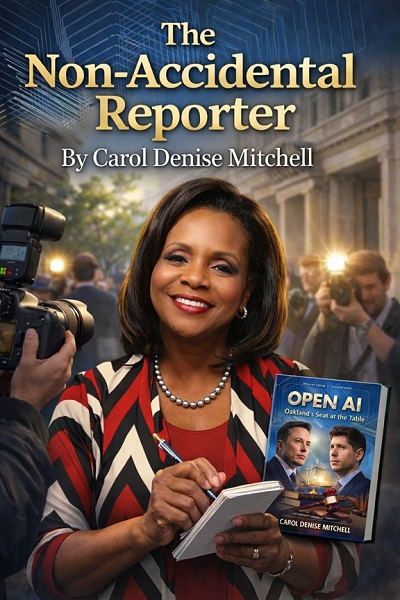
My new book, OPENAI: Oakland’s Seat at the Table, is the natural continuation of that journey. It is the story of the trial, yes — but it is also the story of how an Oakland reporter found herself documenting one of the most important legal battles in modern technology.
I didn’t learn AI from textbooks. I didn’t learn Elon Musk from gossip. I didn’t learn Sam Altman from headlines.
I learned it because I was there.
And that is why I am — and always have been — The Non‑Accidental Reporter.