* * *
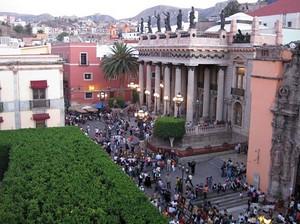
The year, almost certainly, was 1962. The month, I think, was June. The place was the Teatro Juárez, a century-old jewel of an opera house in the colonial Mexican city of Guanajuato – itself a hidden gem and, in its day, the source of more than half the world’s silver.
On leave from my first Foreign Service posting (as Vice-Consul at the American Consulate General in the industrial metropolis of Monterrey) I had set out to see the “real Mexico”, and – at the recommendation of several Mexican friends – had put Guanajuato at the top of my list. On my first-day city tour, as the guide proudly showed us through the gold-leaf and red-velvet richness of the Teatro, he noted with evident sadness that, because of the decline of the silver mines and Guanajuato’s isolated location, the Teatro now remained dark most of the year. He added, however, that any of us who would still be in town the following day would have an opportunity to see the theater come to life, because three young opera students from Mexico City’s Conservatory were coming to give a one-time concert.
I almost didn’t go.
Not wanting to waste a minute of my vacation, I weighed the pro’s and con’s carefully. On the one hand, this was an opportunity that does not come along often. On the other, although I enjoyed listening to instrumental excerpts from opera, I had never warmed to the operatic voices I had been exposed to on recordings, radio or TV. And after all, I thought in my gringo complacency, how good are three unknowns from Mexico City likely to be?
How good indeed! The performance the following day was spectacular!
During the first, and for me the best, part of the recital, each of the three took turns at the piano while one or both of the others sang a generous selection of the best - known arias and duets in the popular repertoire – much of the first act of “La Boheme”, the glorious duet from Bizet’s “The Pearl Fishers”, and many more.
And what voices! I had never heard such singing! No one was protecting their voice or giving half effort to a provincial audience on this day. To the contrary, they sometimes put the crystal lamps at the rear of the auditorium at serious risk. The atmosphere in the theater was electric.
For two hours or more, performers and public fed off each other. The three singers were obviously enjoying every moment of what they were doing, and we in the audience were ecstatic. The applause at the end was long and heartfelt.
After the show, I wandered around the Jardín Unión, the triangle-shaped plaza adjacent to the Teatro. As I passed the theater, the three singers emerged together from the front entrance, walked slowly down the steps, and ambled onto the plaza deep in conversation.
Reflexively, I checked my shirt pocket. Yes, the concert program was still there. In my early youth, I had been one of Philadelphia’s most avid collectors of autographs, and had sought and received the signatures of most of the top major league baseball players of those times. I had even, at the age of twelve or thereabouts, skirted security at a special event to get the autograph of Babe Ruth, just a few months before his death.
Should I or shouldn’t I? It would be easy to walk up and ask the three to autograph my program. But I was no longer a teen-age kid. I was a vice-consul of the United States for God’s sake! Wouldn’t that be a bit undignified? And wouldn’t I be invading their privacy? So I walked away.
Big mistake!
I wondered then, and for several days afterward, whether what I had heard was really as good as I had thought. After all, what basis did I have for judging operatic talent? None, really.
So I decided to commit the names to memory in the thought that, just perhaps, one or more of them might some day make it to “the big time”. One of the three, Javier (stage name “Franco”) Iglesias, was already a familiar name to me because he was from Monterrey, the city where I was currently assigned, and he had a large following there which included a number of my friends. The name of the other male singer, the one I thought was perhaps even better than Iglesias, might have been a little harder to remember, but luckily I noticed it was one of those relatively rare Hispanic names that could – if you stretched things just a little – be translated into English. As an aid to memory, I translated his as “Peaceful Sunday”.
Back at my hotel, I laid the concert program carefully in my suitcase. Upon my return to Monterrey, I put it loosely into my scrapbook until I would have time to mount it permanently.
Over the subsequent half-century, after moves to Washington, London, Princeton, Managua, Washington again, Geneva, and Washington yet again, I still have the scrapbook. But nothing – absolutely nothing – has ever been permanently mounted in it, and at some point the program apparently dropped out and was lost. I never saw it again.
On that day in Guanajuato, “Peaceful Sunday” and his colleagues introduced me to a world of musical enjoyment that I might otherwise have continued to ignore.
Although I don’t have an autographed program to remind me of that concert and to show off to friends, I do have one of my most treasured memories, one helluva good cocktail party story, and the knowledge that I was one of the very first Norteamericanos to be enthralled by the voice of Plácido Domingo.
jjs