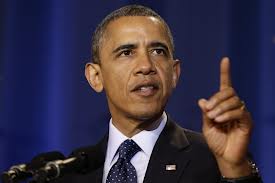
Obama’s Second Inaugural Address
Great Presidential speeches project a vision, one that taps into our values and stirs us to action. They therefore rely on time for their total rhetorical impact, especially those that impart a wisdom, a sensitivity, and a perspective on history that demand that it be read or listened to again and again within the context of many events—past, present, and future. Martin Luther King, Jr.’s speech, “I have a dream,” delivered 50 years ago just a short distance from the Capitol at the Lincoln Memorial was such a speech. Although I remember it well, it did not have much of an emotional impact on me when he delivered it. Today, I cannot read King’s speech, or listen to his swords, without a deep emotional connection. It reveals substance, and character, and a depth of understanding far beyond the moment. I believe Obama’s second inaugural address has the potential to become such a speech.
Great speeches invoke enduring ideas, they draw parallels with past and present, and they show us a glimpse of what can be. Thomas Jefferson was in attendance in the Virginia House of Burgesses in 1765 when Patrick Henry was arguing against the Stamp Act of Parliament. When Henry used the name of George III, he was interrupted with cries of “Treason!” He replied, “If this be treason, make the most of it!” Eleven years later with equal resolve Jefferson wrote the most enduring ideas of our nation in the Declaration of Independence from Great Britain when he said:
We hold these truths to be self-evident, that all men are created equal, that they are endowed by their Creator with certain unalienable Rights, that among these are Life, Liberty and the pursuit of Happiness.
Obama couched his address in Jefferson’s ideas, he linked them to today’s issues, and he projected them into the future. He first brought them to the present by showing us their limitations: “History tells us that while these truths may be self-evident, they’ve never been self-executing. That while freedom is a gift from God, it must be secured by his people here on earth.”
And he showed how we have strayed from those ideas by securing them for the wealthy, but not for the people: “The patriots of 1776 did not fight to replace the tyranny of a king with the privileges of a few, or the rule of a mob. They gave to us a republic, a government of, and by, and for the people.”
He called upon the memory and the wisdom of Abraham Lincoln who reminded us that liberty means nothing if it excludes anyone: “Through blood drawn by lash, and blood drawn by sword, we noted that no union founded on the principles of liberty and equality could survive half slave, and half free.”
He then laid out the challenges that we face, now and for the future:
“America’s possibilities are limitless, for we possess all the qualities that this world without boundaries demands: youth and drive, diversity and openness, of endless capacity for risk and a gift for reinvention.
My fellow Americans, we are made for this moment and we will seize it, so long as we seize it together. For we, the people, understand that our country cannot succeed when a shrinking few do very well and a growing many barely make it.
We believe that America’s prosperity must rest upon the broad shoulders of a rising middle class. We know that America thrives when every person can find independence and pride in their work, when the wages of honest labor will liberate families from the brink of hardship.
We are true to our creed when a little girl born into the bleakest poverty knows that she has the same chance to succeed as anybody else because she is an American, she is free, and she is equal not just in the eyes of God but also in our own.
We understand that outworn programs are inadequate to the needs of our time. So we must harness new ideas and technology to remake our government, revamp our tax code, reform our schools, and empower our citizens with the skills they need to work hard or learn more, reach higher.”
And finally, calling upon our heritage, our sense of duty, and our place in history, he concluded by calling us to action:
“My oath is not so different from the pledge we all make to the flag that waves above and that fills our hearts with pride. They are the words of citizens, and they represent our greatest hope. You and I, as citizens, have the power to set this country’s course. You and I, as citizens, have the obligation to shape the debates of our time, not only with the votes we cast, but the voices we lift in defense of our most ancient values and enduring ideas.
Let each of us now embrace with solemn duty, and awesome joy, what is our lasting birthright. With common effort and common purpose, with passion and dedication, let us answer the call of history and carry into an uncertain future that precious light of freedom.”
Words that engage, captivate, and urge us to action are no better than the actions they help to create. If history shines favorably on Obama’s second term, and we uphold our part of the bargain, the values and ideas within his speech will endure. Ultimately, that is what matters.