Excessive Wealth and Income are the Cause of Poverty
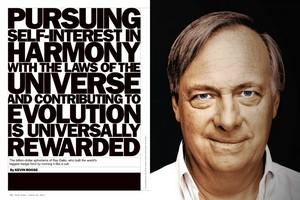
How would you like to be paid $2 million per hour? On an annual basis, you would receive $4 billion. As incredible as it may sound, there is at least one person with that amount of income. His name is Ray Dalio, and he is the founder of Bridgewater Associates, a Connecticut private equity company. One of his aphorisms displayed with his photo is this:
Pursuing self-interest in harmony with the laws of the universe and
contributing to evolution is universally rewarded.
I have no objections to that statement as an abstract idea. It does not apply in all circumstances, however, hence it would never be found on my wall as a constant reminder in justification for my income level or wealth. Here is the more appropriate reminder for both of us, as well as for all of humanity
Taking excessive amounts of income by the few causes
excessive poverty for the many.
The preceding statement is also the subject of this essay. Today we have 47 million Americans living in poverty, the direct consequence of too little money left for them in the income pool after the wealthy have raided it. My statement stands in stark contrast to the words on Dalio’s plaque, and to Mitt Romney’s assertion that the bottom 47 percent of Americans are takers, who rely on government handouts, who will not take responsibility for their lives or their circumstances, and who will never vote for him. Well, he is probably correct about their voting choice. Mitt Romney, you may recall, also ran the private equity company, Bain Capital.
Here is the proof: The American income pool is $12.75 trillion. That pool divided by the number of tax filers is approximately $90,000 each, or the average income. Each person who draws more than $90,000 from it lowers the average income available for all others. The logic of that observation is so compelling it does not require more than a third grade level of education to understand it. Moreover, if one person were to take $180,000 from the pool, one of the remainder of participants would receive zero. It is analogous to the game of musical chairs. And since $20,000 is the average poverty level, each time that about is taken above $90,000, one person is forced into poverty.
Mitt Romney’s income of approximately $20 million annually pushes nearly 1,000 others into poverty. Ray Dalio’s $4 billion income pushes 200,000 others into poverty. The 3,700 hedge fund managers with a total income of $1.85 trillion push 20 million persons into poverty. The 63,000 CEOs of Americas publicly traded companies with $281 billion of income push 4 million others into poverty.
So far in these calculations, we find that less than 0.05 percent of all those in our income pool has accounted for more than 24 million others being forced to live in poverty. Does this numerical fact agree with Mr. Dalio’s aphorism or with mine? Note: All 3rd graders are exempt from answering that question.
Objection: Yes, but the dollar total in the income pool is growing. Therefore, your numbers overstate the actual problem.
Response: Yes, the income pool is growing at a real rate of about 1.2 percent per year. But the number of participants in the income pool is also growing at about 1.13 percent per year. Therefore, the ratio of incomes to participants is relatively constant.
Objection: Yes, but those in poverty also receive lots of government aid that you have not included in your calculation, therefore you have overstated the problem.
Response: You are correct. The typical poverty recipient receives about $4,000 per year in government assistance. But they receive it because they live in poverty and are unable to survive at a humane level without it. That level of assistance does not solve the problem of poverty.
Objection: Yes, but there are lots of jobs that need to be filled. Why can’t those in poverty apply for them?
Response: The economy is creating jobs at a very slow pace, far below what is needed to absorb the unemployed and the underemployed. More stimuli are needed. A growing economy will resolve more of our social ills than most people believe. But that is an issue apart from the topic at hand.
Objection: Yes, but welfare cheats give all welfare programs a bad name.
Response: There are cheats at all income levels, in all professions, even a few in the third grade who cannot or will not do their homework or they cheat when taking a test. Dishonesty is an unfortunate characteristic of the human race.





As you have so often pointed out, putting wealth in the hands of the poor is usually spent immediately on necessities, resulting in higher sales tax (a regressive tax) and possible income tax (a progressive tax, if the income becomes taxable). In either case, not only are tax revenues increased, the economy is stimulated by the increased spending.
Most Americans, rich or poor, are upset with unnecessary spending (particularly governmental) and waste. Therefore there is a grassroots effort to cut spending in the federal budget. As you pointed out in the past, cutting the federal budget does little to stimulate the economy, because it puts many well-paid with benefits employees into the job market where most of the jobs require technical specialization or pay below poverty minimum wage. These same people seem to think that reducing taxes on the rich will stimulate more jobs. The rich, mostly investors, have been cutting jobs to artificially raise profits (short term) and increase their incentives like bonuses and stock options unavailable to wager earners. It's like shooting oneself in the foot because we walked too fast.
Fair pay for a fair day's work is not socialistic, it's good business (see Henry Ford). As for all the claims about small business. Most small businesses (especially in a economy like today) fail shortly after opening. They don't fail because of too many taxes, even though most try to find ways to not pay their employees enough and to avoid taxes. They fail because most business owners do not have a clue about their real costs when they enter into business, focusing on revenue that is often unrealistic, based on the quality and cost of their good or service. Focusing on small business is the wrong approach in this economy that needs massive amounts of stimulus to produce the kind of growth (actually quite dangerous––economic growth can have very bad consequences) and job production everyone would like.
Ron