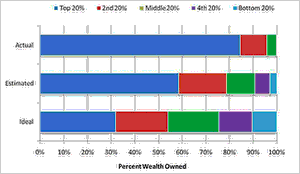
The United States has the most wealth, and the most top heavy distribution of that wealth of all other industrialized nations.
The Wealth of Nations
Wealth is the best comprehensive measure of any economy. It tells us more about what we do, how well we do it, and how we divvy up the goodies than any other metric. In the final analysis, that’s what economics is all about. Understanding wealth allows us to make a better assessment of how well we are being true to ourselves and to our principles. We truly need such an understanding. It permits a deeper philosophical insight into our collective psyches than we have dared to make heretofore. To understand wealth at this deeper level we need to know what it is; how much there is; its growth rate; how it is acquired; and how it is distributed. Those are the fundamental building blocks for making decisions at the corporate level, and at the local, state, and national levels. CEOs, legislators, and policy makers need to know how most of the pieces in wealth creation and distribution work and fit together to assure that their employees or constituencies have an opportunity for improving their circumstances and the extent to which they have a chance at life, liberty, and the pursuit of happiness. Citizens expect fairness in all these relationships. Political scientists call this relationship the “social contract.” It is this contract between rich and poor, between leaders and workers, and between legislators and citizens that lets us keep faith with each other. Ultimately, we, the people, must decide if our leaders are doing a good job at any or all of the important tasks of governing, and what needs to be done to improve on them. Those are also the objectives of this essay.
Economics is divided into two sets of issues for evaluation: The first is called “positive” economics. This set of issues is limited to describing things as they are: “How does the banking system work?” for example. Or, “how does someone’s education level affect his or her employment and income outlook?’ To circumscribe most of the component parts for understanding the discipline would require at least a course in micro (small) economics, one in macro (large) economics, and another in international economics. And that would need to be followed by a seminar in which participants were required to think about the implications of this new knowledge. The important part of this forum would consist of analysis, synthesis, and evaluation—the highest outcomes in any learning hierarchy. Once we understand how all the elements work together, then, and only then, does it make sense to begin a discussion of what needs to be done to make changes in them so that we might find solutions to issues in fulfilling our economic destinies.
That second set of issues is called “normative” economics, or the domain in which we seek answers to “what ought to be?” Normative economics deals with judgments and values. Right away, if you are thinking that we elect people to make laws in the realm of normative economics who do not have an understanding about positive economics, or how the economy works, your thinking is “spot on.” That describes our present state of affairs quite well. It simply makes no sense to entrust those with little understanding to enact legislation and tax policies that affect your life and mine without understanding either the subject matter or the ramifications of their decisions. Yet we do it. And we pay a heavy price for this fundamental flaw in how we elect our law makers.
Discussions about the economic well-being of any nation are typically centered on income, or how much is produced (GDP), or perhaps on average production (per capita GDP). These measures, whether taken individually or collectively, fall far short of providing an accurate profile of any nation’s wealth. In fact, they are so limited and misleading they and can and do lead to economic policy decisions that hurt rather than help the well-being of residents. Let’s try to clear up a few of the basic misunderstandings.
The wealth of any nation can be measured, analyzed, and evaluated by answering three questions: 1) how much wealth is held by its residents?, 2) who produced it?, and 3) how is it distributed among those who produced it? Without clear answers to each of these questions, any discussion about how to change any aspect of wealth is fraught with errors, misunderstandings, subject to wild conjectures, all leading to conclusions more likely than not to make matters worse. Here is a definition of what wealth is.
A Definition. Wealth means “net worth,” or assets minus debts. It’s much the same for individuals as for an entire nation. At the national level, wealth is the sum of all our major assets (homes, other real estate, savings, stocks, bonds, commodities) minus debts (mortgages, loans, credit cards). The U.S. has a current household net worth, or wealth, of $74.8 trillion. [1] That total is the highest by far of any nation.
Who Produces our Wealth? All those who are employed, those who pay taxes, and those who make economic decisions contribute to our national wealth. Those who merely inherit wealth do not contribute to its production by virtue of their inheritances alone.
How Wealth is Distributed. U.S. wealth is distributed as follows: Churches, schools, and charities own $2.8 trillion. The top 20 percent of households own $64 trillion. The next 30 percent of households own $8 trillion. The bottom 50 percent of households own zero wealth. Here is the same distribution per household in dollars:
Top 20 percent of households wealth = $3.23 million each.
Next 30 percent of households wealth = $270,000 each.
Bottom 50 percent of households wealth = $0.0 each
That distribution is the most severely skewed among all the industrialized nations.
Growth Rate. The long-term compound annual growth rate (CAGR) of total wealth in the United States is 7.2 percent. This rate means that our wealth total doubles every 10 years. Looking forward just 40 years suggests that this total will be $1.2 quadrillion, with $1 quadrillion held by the top 20 percent. The bottom 50 percent will still have nothing.
How did this distribution come about? Although this is the land of plenty, that plentiful amount is extremely top heavy. Approximately 20 percent are doing quite well, the next 30 percent (the middle class) are OK but losing ground, while the bottom 50 percent are virtually all living in poverty.
Why is wealth so severely skewed in favor or those at the top? The inheritance laws are the biggest factor behind our wealth distribution curve. Approximately 98 percent of all net wealth (after taxes) is bequeathed to others on the death of the wealth holder. That percentage is constant over time. It follows that approximately 98 percent of all new wealth therefore arises from inherited wealth. Thus, 96 percent of all wealth (.98 times .98 = .96) is inherited, directly or indirectly. Only about 4 percent of all wealth is created by entrepreneurs acting on skill, study, intuition, hard work, and luck. Probably no wealthy person believes, or wants to believe this fact that is based on probability analysis, but that would not be the first time they were wrong. Wealth begets wealth, and poverty begets poverty especially when a multitude of laws, customs, and informal networks are well-established to maintain the status quo.
The consequences of that allocation of wealth are many: First, our wealth distribution is the primary cause of poverty. There is likely no clearer example in logic than that cause/effect relationship. The proof of that statement is supported by mentally moving $10 or $20 trillion from the very rich to the poor. With enough time to learn how to manage money, poverty would cease to exist for them. Also, all the social ills that arise in the form of crime, incarcerations, illegal drug use, mental health issues, suicides, teen pregnancies, and more are the stuff that poverty breeds. In time, they too would diminish. More importantly, poverty violates the social contract. Those who must live in poverty are denied life, liberty, and the pursuit of happiness simply because they do not have the economic means to achieve them or even to pursue them. Thus, broadly speaking, excessive wealth causes poverty while it also denies those in poverty the fundamental guarantees of democracy and citizenship. More on social contracts follows later.
What can be done to change matters for the better?
Analysis. According to recent data, most Americans do not know the extent of the skew in our distribution of wealth. It is approximately 1,000 times worse than is perceived. Put another way, the actual distribution is far worse than we estimate, and the estimated is far worse than the perceived ideal. Go back and study the graph at the top of this essay. It shows the actual (what is), the perceived (uneducated guesses), and the ideal (what ought to be) as expressed by those in the poll. [2] When the results are further broken down by age, income, and political affiliation, there is a slight shifting to a larger share that might be held by the rich. No group, however, approves of the rich holding 85 percent of all the wealth. None.
In pooling some of the preceding data, we see that 156 million Americans have no wealth. This is understandable in that the bottom 69 millions taxpayers from the same group have an average income of just $15,292 per year. [3] On a 2,000 hour work week, the average adjusted gross income for those in this group is $7.65 per hour.
In analyzing and synthesizing this information, we need to think about how important wealth is to life and to liberty, and what the wealth distribution would look like if it satisfied our collective values. Only then might we achieve such a new distribution. Those are the higher order outcomes, the consequence of the kind of thinking our brains were meant do perform. There is no room in those processes for 30-second sound bytes, for ideological slogans and rants, or for dishonesty of any kind.
To all those ends, it is worthwhile to consider the thoughts and ideas of American philosopher John Rawls who spent most of his adult life contemplating and writing about justice in America. Rawls is widely regarded as our most important thinker on the subject of social justice. [4]
Rawls argued that the first principle of justice was that each person has the same and indefeasible [permanent] claim to a fully adequate scheme of equal basic liberties, which scheme is compatible with the same scheme of liberties for all.
His second principle of social justice concerns social and economic institutions: [5]
Social and economic inequalities are to satisfy two conditions: 1. they are to be attached to offices and positions open to all under conditions of fair equality of opportunity; and 2. they are to be to the greatest benefit of the least-advantaged members of society (the Difference Principle). Finally, he argued that people would choose four things in their collective judgments about social justice, which he called the "primary goods":
• wealth and income
• rights and liberties
• opportunities for advancement
• self-respect
In seeking the best principles Rawls set out to discover them in an impartial way. He reached back several hundred years to philosophers like John Locke and Jean Jacques Rousseau, as well as to our own historical scholar and social thinker, Thomas Jefferson. They each had developed ideas about social contracts (see definition below). Ultimately, Rawls reasoned that entire populations would support leaders and agendas via social contracts that met the principles and elements of his theory.
This leads us to assessing how “the people” of any society might determine how wealth and income are divided so that their rights, liberties, opportunities, and self-respect are integral parts of their social contract. But how can entire societies determine what ought to be without understanding what is?
We can get a pretty good sense of what ought to be by constructing a well thought out poll that reveals what people believe about what is, and what they believe ought to be.
Michael Norton is a Harvard professor in their business school. He and his colleagues have done a lot of research in the area of what makes people happy. They discovered that there are universal effects that go with spending money—on yourself or on others. Using their own and data from around the world, they found the people are happier when they spend money on others rather than on themselves. Drawing from worldwide data collected by Gallup, they found this trait was universal that persisted in every country in the world (except one in central Africa).
Consider those observations for a moment:
1. Among rich and poor giving brings about more happiness than receiving.
2. Ideally we think that the top 20 percent should own about 32 percent of the total wealth.
3. Our top 20 percent actually hold 85 percent of all our wealth.
4. Our workforce of 140 million produced all the wealth.
5. Our social contracts among residents and citizens are in disarray.
There are a host of subordinate facts, argumentation, and limited conclusions flowing from them concerning personal responsibility, the right to bequeath what one owns, envy, the limited role of government, the welfare state, dependency, the role of charities, prayer, and others. The solution to a persistent inequality offered by those who make these kinds of arguments is less, not more, government intervention.
The problem with these solutions is that they apply to a simpler time, to a far less complex society, and to a small population much like the one that existed in 1776 when Adam Smith published his economics treatise with the shortened title, the Wealth of Nations. They ignore the fact that dependency, for example, is the consequence of denial, and of putting up artificial barriers to education, and to health care, and the opportunity to pursue dreams and goals. And these symptoms are all linked back to the lack of income and the absence of wealth. They are also put forward as a way to change the subject and to re-direct it into issues far removed from the fundamental issues.
What then ought we to do?
We live in the most politically contentious times, perhaps the worst in our history. Any solution to our wealth inequality issue must therefore be mindful of those who oppose any change that might disturb the status quo, and in particular, to those changes that might take from the rich and give to the poor. And in spite of the barriers to change that are already in place, many others can quickly be erected to block changes that could circumnavigate old barriers. Although the task of putting into place a set of changes that can level the playing field enough to be able to see positive results, that task is not impossible.
The solution involves growing the economy in such a manner that market forces will direct new incomes and new wealth into everyone’s pockets. In this essay I can only outline the basic steps.
We need a fiscal policy that is wedded to a specific monetary policy. This means specific legislation that directs the Federal Reserve to inject new money into the economy so that it goes into M1, or into cash in circulation and into checking accounts. This new money must get into the hands of small businesses and consumers. The reason is simple: Consumers and small businesses account for approximately 70 percent of GDP and 75 percent of all new hires. Every dollar in M1 turns over 6 times per year, or it produces $6 in new GDP. Add $2 trillion (over time), and GDP will expand by $12 trillion, incomes will increase by $10 trillion, and employment will expand by 20 million.
The way to finance such a project is to offer new tax-free Treasury bonds for sale to the foreign nations and to wealthy Americans. We would need to offer a return that is competitive with other investments. The tax equivalent yield on a Treasury bond that pays 5 percent per year is 8.09 percent to those in the top tax bracket. That rate of return would be higher than their returns on their present wealth while being guaranteed by the full faith and credit of the United States.
A fully developed plan shows it would cost taxpayers zero dollars, it would not add to the public debt, and it could reduce both the public debt and our trade imbalance. It is not the purpose of this essay to include details of this plan, rather to show that there is a solution that could have positive results for the wealthy, the middle class, and the poor as well as to the U.S. government and to our trading nations. In game theory lingo, it would be a win/win/win/win/win proposition.
-------------------
1. Source: U.S. Flow of Funds Report, Federal Reserve Board, Sept. 2013.
2. Michael Norton, Living Beyond Your Means, NY Times Op-Ed, May 20, 2011
3. Data: Tax Foundation, 2009
4. John Rawls, A Theory of Justice, The Belknap Press of Harvard University Press, 1971.
5. In political philosophy the social contract or political contract is a theory or model, originating during the Age of Enlightenment, that typically addresses the questions of the origin of society and the legitimacy of the authority of the state over the individual. Social contract arguments typically posit that individuals have consented, either explicitly or tacitly, to surrender some of their freedoms and submit to the authority of the ruler or magistrate (or to the decision of a majority), in exchange for protection of their remaining rights. Source: Wikipedia.
|


Whenever I bring up the idea of redistribution of wealth, I hear the words "socialism" or worse, "communism." However, if we can be educated like you are doing about the situation we can focus our efforts on fairness and a proper social contract by rewarding those who do right and sending petitions to companies like McDonald's who have a workforce living on a poverty wage. If we reward companies that pay fairly by buying their goods and services and deny purchases to companies that are unfair, the picture will change.
The public needs to have knowledge that most wealth is inherited instead of the lie that is created by hard work. The public also needs to know that the wealthy do not create jobs and good salaries, only the small portion of entrepreneurs who develop new companies with new concepts and good salaries. We need more Henry Fords and less Bill Gates in this world.
Ron