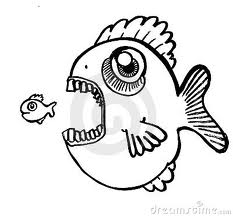
Big Fish, Little Fish
Practicing what we disbelieve
By our own standards of morality, human beings are not to be trusted. Put in its best light, we all fall short of the glory of God in our interactions with each other. But this essay is not about God; it's about us. And in particular it's about hypocrisy—holding a belief in a high standard of conduct, but practicing a low standard in reality. Or condemning others while we practice the same acts that we condemn. And refined a bit further, condemning the small acts of fraud and cheating by the poor while ignoring the colossal acts of fraud and cheating by the wealthy.
Cheating is an act of fraud against each other because we all pay for cheating either directly in higher taxes, or indirectly in services needed but not delivered. And so, cheating is a serious offense against the social contract we all have with each other. It violates a trust, and that is a most serious offense. When we lose trust in each other, we break faith with each other. And on any scale of morality, that is a serious violation.
Let's look at two examples. We hear a lot about welfare cheats, i.e., the poor lying or stealing when applying for food stamps or some other form of government assistance. The Labor Department estimates that between 1 and 3 percent of welfare payments are fraudulent. That puts the total cost at $7 to $22 billion annually since our annual budget is about $750 billion for all such programs. None of that fraudulent taking is excusable, but most of it is understandable. According to the Tax Foundation, the bottom 69 million tax filers had an average income of just $15,292. Those who must live on this meager level of income are under constant daily pressure to survive.
On the high end of the income scale, the IRS estimates that the rich cheat the government out of $300 billion annually by not paying all their taxes. And let us not forget that this group receives 70 percent of all income, and has 85 percent of all wealth. Moreover, physicians cheat the government out of $60 billion per year in Medicare alone, via phantom billings, multiple billings, and by false code billing.
I don't sit in judgment of anyone, not even those who cheat the system. But I am entitled to speak out against hypocrisy—the practice of claiming to have high moral standards or beliefs while violating the same standards. Those who practice hypocrisy can recapture some of their virtue by blessing us with their silence.





CBS Sunday Morning had a segment on how counterfeit wines are being passed off as being original when they are created by fake techniques and sold to rich people like Bill Koch. Bill claims that nearly half of his wine collection is probably counterfeit. He bought four bottles of wine supposedly made by Thomas Jefferson for nearly $500,000 that turned out to be fake. He has currently spent $24 million in lawsuits against those that sold him counterfeit wine. I really feel for the poor chap. A clear case of the cheater being cheated. Such are the high stakes of the unfettered "free enterprise" class.
Ron