[image: cobblestone.com}
Snake Oil for Sale
Who hasn’t looked out into a night sky and felt the immenseness of the universe, and asked “Who am I?”, “Where am I?”, or “Why am I?” These are the timeless questions that have baffled many, confused others, and made still others vulnerable to the vicissitudes of those only too ready to provide answers. Life is full of instances, people, crossroads, and circumstances that invoke these issues and their consequences. How we deal with them can determine whether we become leaders or followers, thinkers or doers, givers or takers, successful or failures in this thing we call life. Well, that is my contention anyway. Let’s see how far this theme goes.
Many years ago I wrote a “scholarly” paper entitled “The role of persuasibility in decision choice shifts.” It was as boring to read as its title suggests. But I meant well. I tried to identify who is susceptible to persuasion, who is not, and what accounts for the differences. My objective was to identify a list of traits that comprise each profile, to test my thesis in actual decision making settings, and to let the behavioral outcomes of participants tell if their own self-proclaimed profiles were predictors of those outcomes under a variety of different situations and circumstances.
My research paid off—in academic terms. The scale proved to be accurate, reliable, and valid as a predictor of who was susceptible to persuasion, and who was not. But like most research into matters of this nature, it has now laid for many decades on the dark, dusty shelves of a university library where its pages have become yellow and brittle with time, and its contents as lifeless as its title suggests. I moved on to other issues, to other interests, and to other places.
I could say that my insights into decision making deserve to be rewarded—perhaps in book sales, CDs, seminars, videos, or in consulting fees from lawyers and corporations. After all, wouldn’t they like to know who the leaders and the followers are in decision making groups—especially when the participants did not know each other? Highly paid lawyers, for example, do not rely entirely on their oratory skills, their charm, the law, or their persuasive argumentation in trying to persuade jurors to vote in favor of their client. They also rely on focus groups, and in how members react to very specific words, ideas, and the manner in which they are presented. In addition, they rely on profiles and recommendations of psychologists when selecting jurors who will likely behave as they hope they will. Truth and justice are often secondary to lawyers who base their reputations and their fees on verdict outcomes.
Here is one more thought before shifting the discussion toward the sellers and the buyers of snake oil. The most persuasive persons are not necessarily those who are handsome, or charismatic, or charming, or with a lot of money, or with power in other settings. They are reflective, they ask probing questions, they reject arbitrary assertions, they do not trust opinions, but insist on facts and sound reasoning. They are willing to suspend judgments until they have enough facts. They are good listeners, they’re analytical, and very creative in how they go about testing ideas. When they decide the best solution or outcome in a situation, the rest of the group tends to follow their lead.
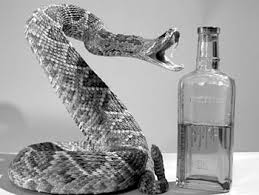
In contrast, a charlatan is someone who simply masquerades as a truth seeker. He or she sometimes wears the cloak of clerics, the crown of a king, or the outdated checkered suit of a used car salesman. He relies on sleight of hand, misdirection, lies repeated again and again, half truths, and the 30 second sound byte. In the days of the old west, he sometimes rode into town aboard a funny looking wagon selling bottles of Dr. Alexander’s elixir guaranteed to cure warts, colds, typhoid, hang nails, lumbago, and impotency. He was referred to affectionately or sarcastically as the “snake oil” salesman.
Today’s snake oil salesmen rely on Madison Avenue marketers to provide them with their sales literature and their tools. Their objective, however, is the same: to sell you and me a worthless bill of goods. They have ready made audiences when they meet those who rely on a need for authority and others to tell them exactly what they want to hear. Our homes are filled with knick knacks of every type and description consisting of things we don’t need but we have been brainwashed into thinking we do. And why are ball players, singers, actors and hedge fund managers paid millions of dollars for making nuisances of themselves? Because you and I have bought the line of bull crap that Madison Avenue has been selling.
Who else is trying to sell half the inhabitants of this planet snake oil? Religionists. All of them. They presume to know that which they do not. Whether they rely on old books written by old people in an old age, or new books and new people, they rely on others to pronounce with certainty things about which they know nothing. If they were truth seekers and honest brokers, they would say “Here is what I believe. It could be false. You can accept it or reject it as you see fit. It matters not.” None do.
In politics, there are snake oil salesmen everywhere. They merely mouth what others tell them to say. There are no independent thinkers among them. In the corporate world, there are no creative, independent thinkers. Show that you can think on your own, and you will find yourself out in the streets in search of new employment. It’s inevitable. In the academic world, you must conform to a long list of requirements in order to gain “tenure,” that lofty place where you have the illusion of job security under the guise of “academic freedom.” But you are not free to think independently. Stray from the pathway set for you and you will find yourself isolated at first, and then unemployed by virtue of downsizing, or perhaps you will be entrapped in a circumstance involving sex.
In the world of organized religion, the search for truth is a forbidden activity. Why would any cleric allow you to seek truth when it has already been handed to you on a silver platter? In bygone days, those who went up against the church were sent to prisons to be tortured, or to the guillotine for beheading, or perhaps to be burnt to a crisp at the stake. Writers are free to express their innermost thoughts, but only if they have the means to survive apart from their writings. Try selling any poem, story, novel, or thesis that approaches the truth and you will be shunned faster than you can say “please.”
Consumers of all stripes and means prefer to hear, see, taste, smell, touch, and absorb anything that is 100 percent bullshit, but we run like hell from anything that approaches the truth. Why? Because we fear losing our jobs, losing our status, losing our income, losing our homes, losing our ability to save a few coins.
So, who and where are the outsiders, those brave souls who tell society to “go suck eggs” rather than give in to the high lords of bullshit? Socrates was an honorable man who sought the truth. He was forced to drink hemlock. Astronomer Giordano Bruno told the pope to go and hitch a ride on the flying finger of fate. They burnt him at the stake. In war or peace, in the arts, the sciences, and in politics, to the victor go the spoils. And their first act following victory is to extinguish the opposition—permanently.
So where does that leave the few of us who have the temerity to think we are free thinkers in search of the truth? Personally, I feel like the character portrayed by Al Pacino in “Carlito’s Way,” who evaded every thug in a shootout in Grand Central Station, who was making off with $70,000 of ill-gotten gains, and about to board the train to glory with his pregnant girlfriend, when the last son-of-a-bitch among the bad asses shot him three times in the chest. With his final breath he handed his love the $70 grand, and said words to the effect “take it and run, baby, I know how this is going to end.”
|


Sure makes me glad to know that I am retired and no longer beholden to anyone.
Ron
PS. I like some bull shit, but my crap detector keeps me from falling from both lines look.
Jk
Truth clarifies. You have spoken truth.
The problem with adjusting to crazy people and a crazy society is that you have to pretend to be crazy as well, and you get found out.