[image: Fed.gov]
Is the US Economy in a No Win State of “Zugzwang?”
Those who recognize the term “Zugzwang” are probably chess players. It is a condition in which any move the next player makes will put him or her in a worse strategic position. I don’t have much of an interest in chess, but I do acknowledge that life also can reflect circumstances in which our next move could put us in a worse situation than we are in now regardless of what we do. For example, the choice to have a risky heart operation, or to delay it could portend equal chances of dying; also to give a condemned person the choice of dying by hanging, by firing squad, or by lethal injection would be a no win state of Zugzwang for him. Under those conditions his best option would be to delay his decision as long as possible on the chance that he could get a reprieve, or he could be saved by an invasion from Martians.
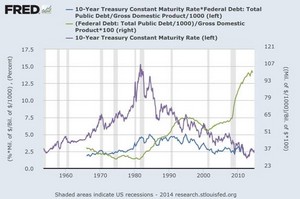
In a recent article, analyst Thad Beversdorf made the argument that the US economy is stuck in a state of Zugzwang, and it is likely to remain there for an indefinite period of time far into the future. Beversdorf’s thesis is based on the assumption that the debt/GDP ratio is the controlling factor, it will remain high and perhaps it will go even higher. The Federal Reserve would face the prospect of continuing to keep short-term interest rates low so that interest paid on the public debt would be at about 2.5 percent. A higher level would raise our interest payments and suppress economic growth. He also argues that the Congressional Budget Office is basing its projections on those assumptions. He could be right in his assessment but only if gridlock is a permanent mental state of Congress.
Under gridlock interest rates will remain low, GDP and employment growth will be sluggish, wages will continue to stagnate, and fixed income investments will remain a poor investment for income and retirement accounts. Stock prices might continue upward as long as our markets attracted US dollars from abroad. If the economy stagnated, the Fed would then be forced to resume its quantitative easing policies just to maintain a low level of growth. And so, Beversdorf would be right on all outcomes.
The above outcomes suggest that first, there is no urgency at all in diverting money to pay down the public debt. Such a tactic would have a depressing effect on GDP growth and tax revenues, thus raising the debt/GDP ratio and retarding the economy. Also every dollar diverted to debt reduction would mean something else must be foregone in the federal budget, and less spending always means lower GDP, lower employment, lower tax revenues, and higher deficits and debt.
The Fed has two major tools it can use to try to help stimulate economic growth—controlling interest rates and raising or lowering the money supply. Yet it must encourage economic growth if it hopes to lower the debt/GDP ratio. Should Congress choose to cut spending to further reduce that ratio, such a choice would be counter productive and might push the economy into a recession.
So higher economic growth is the only rational way out of our predicament. But with gridlock the objective of 53 percent of Congress, the Fed is our only hope for maintaining a constrained easing in their monetary policy actions. The Fed has always said, however, that they do not have enough authority to act alone in bringing about growth. It needs Congressional help.
The American public is complicit in this outcome. Our composite voting pattern has made gridlock our national choice. We don’t trust Congress to do the right thing, so we have stripped them of their options to make matters worse. In the immortal words of Pogo, “We have met the enemy, and he is us!”
Perhaps a super computer can rescue us from Zugzwang.
In the 1990s IBM scientists developed a computer program dubbed “Deep Blue.” It proved its mettle by defeating world chess champion, Garry Kasperov, in a series of chess matches. Yes, there are many tasks well-suited for fast acting brainpower.
The US Congress is not in the same league with Garry Kasperov, Deep Blue, or any other intelligent being or device for that matter. But now we have supercomputers capable of analyzing the economy, identifying the problem areas, and for finding intelligent solutions for fixing it—at nearly the speed of light. One goes by the name of N-ABLE, it resides with Sandia National Laboratories, and it can do in a few minutes what Congress could not do if given until the end of time. Strange, but we build weapons able to destroy the world, then live in fear that we might use them. Simultaneously, we build computers and programs able to rescue us from our own economic follies, and then also live in fear of using them because they are smarter than those we elect to Congress.
It’s time to enable N-ABLE and let it help us escape from our self-induced state of Zugzwang.
|



hug
Kathy
Better to enable our economy than stalemate it, right?
Ron
ChipB.