AuthorsDen.com   Join | Login    
Where Authors and Readers come together!

SIGNED BOOKS    AUTHORS    BOOKS    SAMPLE CHAPTERS    AUDIOBOOKS    eBOOKS    STORIES    ARTICLES    POETRY    BLOGS    NEWS    VIDEOS    SUCCESS    TESTIMONIALS

Featured Authors:  Dave Tabler, iPamela Wiedenbeck, iTom Kitt, iJ. Allen Wilson, iWilliam Martell, iTeresa Walker, iMargaret Mullings, iMichael Charles Messineo, iTracey Morait, iJohn Henning, i

  Home > Essays > Articles Popular: Books, Stories, Articles, Poetry      Authors: A B C D E F G H I J K L M N O P Q R S T U V W X Y Z     

E D Phillips

 Follow Me  

· Contact Me
· Success story
· Books
· Articles
· Poetry
· News
· Stories
· Blog
· 1,302 Titles
· 6,063 Reviews
· Save to My Library
· Share with Friends!
·
Member Since: Dec, 2008

E D Phillips, click here to update your pages on AuthorsDen!


Books by
E D Phillips


See all Books
by E D Phillips


America: Change it or Lose it
by E D Phillips   
Rated "G" by the Author.
     
Last edited: Wednesday, February 18, 2015
Posted: Wednesday, February 18, 2015

Recent articles by
E D Phillips

• Spiritism Explained
• Segments from a Bifurcated Life
• AI at Its Best
• July 4, 1776: 250 Years Later
• A Sage or a Saber-Toothed Renegade?
           >> View all

Consumer spending and government spending account for 90 percent of GDP. We can redirect it to change both the political landscape and the equitable sharing of wealth and income in America.

[image: US Dept of Labor]

America: Change it or Lose it

Following WWII the U.S. economy began a growth pattern the likes of which neither we nor the world had seen before. As our economy grew, the middle class expanded, home ownership became common place, the number of college graduates swelled, our national debt fell, and prosperity was visible everywhere. This euphoria lasted until about 1970.

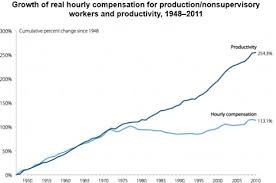
Beginning in 1970 and continuing today, the fruits of our labor shifted and got directed into two different streams—one branch became a gushing giant that flowed into the hands of the rich, while the rest of us saw our stream of plenty virtually dry up. Although our productivity continued to rise and rise, our efforts went unrewarded. We have had to settle for less and less. Today, the top one percent have more income and wealth than the other 99 percent combined. If that revelation doesn’t bother you, stop reading. You won’t like the rest.

The other readers should be asking: “What the hell happened? “

For the last 45 years you and I have rested on our soft spots content in our beliefs that we have a mighty free market economy, that it will correct itself, renew itself, and divvy up the fruits of our labor according to our productivity. Look at the chart above and find your answer to how well that proposition has worked out. A better way is to look at this division is in how wealth has been divided. The bottom 50 percent of Americans have none; the next 30 percent (the middle class) have about $10 trillion, while the top 20 percent have $80 trillion. That division, by the way, is the worst in the industrialized world.

If you are content with this division, please stop reading and go back into hibernation. The balance of this article is for those who care, who can think for themselves, and who rely on facts, logic, and sound reasoning in reaching valid conclusions.

We no longer have free markets or free elections in the U.S. We have a stacked deck, a political/economic system of the rich, by the rich, and for the rich. The wealthiest among us have brought about a lot of tax law changes, voting law changes, inheritance law changes, investment and banking law changes, political maneuvering of voting districts, new laws aimed at reducing or eliminating unions and collective bargaining, less oversight of securities markets and of lending practices, lower tax rates on the wealthy, the emergence of overseas tax havens, job outsourcing, major manufacturing moves to overseas locations, and this above all: They now have funded a huge propaganda mechanism that controls who gets nominated and elected to public offices so that their will prevails far into the future.

The Problem. I could list the names of the top 100 wealthiest Americans, the names of the most powerful bankers, the politicians who vote consistently the way the rich want them to vote, the dollar flows from the PACs and from the Fed, and the top 5 or 10,000 lies perpetrated by all of them. I could also show which political party has opposed Social Security, unemployment insurance, Medicare, Obama care, minimum wage hikes, and increases in farm subsidies to the wealthy and cuts in food stamps for the poor. Which party wants to cut funding for higher education, which wants less regulation of clean air, water, more drilling for oil, less expenditures for renewable energy sources, more pipelines. I could show education data that reveals most students and adults can neither name nor identify more than 3 or 4 states on a map, don’t know who represents them in Congress, and whose buying and voting behaviors are exactly what the preponderance of TV ads tell them to do.

And then those who rely on facts, logic, and sound reasoning in reaching valid conclusions who would agree that everything I have said so far is accurate, or supportable by documented facts. But none of that would point to the solution or how to implement it.

The Solution. The American consumer is the key to change. We account for 70 percent of GDP and 59 percent of all jobs. We spend just $1.8 trillion each year. Each of those dollars turns over 6.2 times for a grand total of $11.9 trillion in GDP. That is a lot more buying power than the rich who have more than all of us combined. But they don’t spend theirs.

We need to organize into a small number of purchasing power pacs. Let’s call them PPPs. We would direct our spending power to those companies that agreed to increase wages consistent with the productivity of its workers. We would vote in blocs only for those politicians who agreed to roll back legislation enacted over the last 45 years that favor the rich and the powerful, and who will enact new legislation favorable to the middle class. Using the power of the purse we could reshape America from what it is now to what it once was. Remember also: Consumer spending plus government spending is equal to 90 percent of GDP. Yes, we can direct our spending intelligently and effectively for greater prosperity for all.

_________________________________________________________


Web Site: AuthorsDen.com


Want to review or comment on this article?


Need a FREE Reader Membership?
Reviewed by Danae Wilkin
Reviewed on February 20, 2015
Good one. I think those who watch the news unbiased such as BBC America know all these things even if they don't care that the rich take everything. We know the wealth gap by now, but don't know what to do about it other than raising taxes on the upper 1% to fund projects like rebuilding our schools, infrastructure, and programs for the poor who can't get ahead. The middle class can't get ahead either despite how hard they work. We need free college and trade skills to rise above and can only get it through billionaires paying their fare share in taxes and enforcing those taxes even if they've hidden away money in the Caymans and Switzerland, for example. I could go on, but you already know this. Thanks for sharing, Danae.

Reviewed by Isabella Koldras
Reviewed on February 19, 2015
Have you seen...on YouTube...program called:

Illuminati 2015: Predictions! We must reach mass awareness.
1:01:11 long, with Clinton starting the "talk".

Could help to set the statistics...right.

Reviewed by E Phillips
Reviewed on February 19, 2015
Ron and Lark: I sent a copy of this article to about 75 others including 20 PhD staff members of the Federal Reserve. My best hope is that one or two others will see how "brilliant" this solution is, and they will then present it to the world as their idea. That's OK by my. Nobody pays any attention to me under any circumstances. If I keep feeding solutions into the stream of ideas, sooner or later someone will grab it and run with it. Oh yes, billionaire George Soros is on my mailing list. I did get a message from his chief financial advisor that he thought one of my ideas was somewhere between brilliant and a genius mind at work, or words to that effect.

Reviewed by Lark Pogue
Reviewed on February 19, 2015
Well, I agree totally with Ron. For one thing, how many people do you think will read this excellent article. Your idea is great, and if I knew how to organize a PPP, and knew a few people who didn't act like sheep, I'd gladly do it. But once again, I am not optimistic that more than a few would even pay attention.

Reviewed by Ronald Hull
Reviewed on February 19, 2015
Another good idea. You seem to have a wealth of ways that we, the people, can improve our lives through our action. The problem is… And you have given an indication in this article… That the average American is simply ingrained in a system that goes along with the status quo, is ignorant in spite of education (the result of grade inflation) and fearful of doing anything that would anger friends and relatives. The proof that we are a country of backsliders is evident in the experience of immigrants who come to this country, many times, with nothing, and, in one generation, become wealthy.

No, we are not intelligent enough to do what you ask. We are not intelligent enough to work our way out of this dilemma of wealthy control. I think, rather, that we will follow your earlier prediction. That is, we will become so disheartened and disillusioned that, like the rabble in France in the 18th century, we will rise up and take back the wealth of the rich in a class war that nobody will win.

Ron

Popular Essays Articles
  1.  Where Have All the Authors Gone?
  2.  The Advent of ALICE 1.0 Advanced Logis
  3.  War and the Earth we need to live on.
  4.  An Era of Stupidity and the Challenge
  5.  Down with Group Chat
  6.  Critical Race Theory & the 1619 Projec
  7.  Needed: A Progressive Grand Strategy t
  8.  Less Words, More Results
  9.  Takeaways from Adam Smith's The Wealth
  10.  Mr. Trump, have you no sense of decenc
  11.  The Crisis of Opioid, Fentanyl, Cocain
  12.  Verifying Ones Self
  13.  Where, oh where, has my Porsche dream
  14.  Critical Race Theory
  15.  Just a Kid
  16.  Super Spreaders Disguised as Congressm
  17.  Daylight Saving: Stop Legislating the
  18.  Are You Writing for Me?
  19.  The Compassion of Christ
  20.  Why Excessive Inequality Matters
  21.  Bone-headed Supreme Court Decisions
  22.  Rhode Read: RI’s Tobacco-Based Wealth
  23.  Genghis Khan Rides Again!
  24.  The Cozy Mystery: Death by a Thousand
  25.  American Fascism and the Bush Administ

Free Book Review Program
Select a book to read and review today!

Democratic Dilemmas and Divine Inspiration (A Kindle Short) by Aberjhani

Democratic Dilemmas and Divine Inspiration examines the significance or relevance of the idea that the U.S. Constitution was, as many believe, divinely inspired. How much did that belief matter to founders of the nation and how much does it matter no  
Member BookAds

Democratic Dilemmas and Divine Inspiration (A Kindle Short) by Aberjhani

Democratic Dilemmas and Divine Inspiration examines the significance or relevance of the idea that the U.S. Constitution was, as many believe, divinely inspired. How much did that belief matter to founders of the nation and how much does it matter no  
Member BookAds

RAM: Random Articles and Manuscripts by Jay Dubya

RAM: Random Articles and Manuscripts, a non-fiction collection of 38 stories and essays, is author Jay Dubya's 32nd book.  
Member BookAds