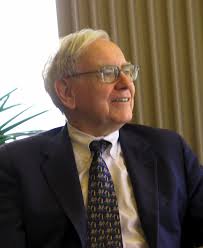
[image: Warren Buffett, Wikipedia]
America: Change it or lose it, Part II
Every successful movement needs a vision and visionaries. And every successful vision must be stated beforehand with goals and limitations. And every visionary must know the who, what, when, where, why, and how of his or her purpose. Those of the objectives of this article, the second in a series.
Most Americans spend what they earn out of necessity. We would save more if we could, but with typical incomes of approximately $27,700 per year(50 percent make more, 50 percent make less), that is next to impossible. If we were given a $100 or a $1000 tax break we would spend that also and for the same reasons—we need the necessities of life: food, fuel, housing, health care, and transportation. That $27,700 of income just won’t go far enough in the land of the free and the home of the brave. But spending money here at home also creates profits, and jobs, while it creates new tax revenues. Consumers are also the biggest creator of GDP, jobs, and wealth.
The rich face an entirely different set of circumstances. If they receive $100, or $1000, or $10 million in tax breaks, they save it by buying stocks, bonds, real estate, or they sock it away in some off shore secret account in Lichtenstein, or the Jersey Islands, the Cayman Islands, or a couple dozen other locations around the world. They do not spend it. Their activities do not help the economy, nor do they create jobs. They simply make the rich richer, while they create budget deficits. Period.
In my article America: Change it or lose it, I explained the underlying reasons why we need to organize consumers into a new powerful purchasing power political action committee (PPP). Briefly, it is because the rich are sucking all the life out of our economy, and they are showing no signs of stopping until they have all the wealth. And they are well on their way to that objective. Trying to stop them so far has proven to be a Mission Impossible.
Here is how we can form a new PPP with the objective of not only stopping them, but for reversing a large chunk of their gains.
As I noted consumers account for 70 percent of GDP. That comes to about $11.7 trillion per year. Because each dollar spent turns over 6.2 times per year, it only takes about $1.8 trillion to produce that GDP level. Remember, a rich person does not purchase 50,000 Big Macs just because he can. Nor does he buy 50,000 gallons of gasoline for his Rolls Royce just because he can. No, he only spends a tiny portion of his income on such items. Conversely, one-third of Americans must spend their entire income, and they have less that $1,000 in savings.
But let’s say 50 million of us at the low end of the income scale put up the price of one Big Mac at $4 each. That would give us $200 million of seed money with which to kick off our PPP. And let’s say that Warren Buffett (he’s the second wealthiest American, but he is also a kind, considerate philanthropist) was so impressed by our actions that he agreed to match our money with $200 million of his own. And then along came a lot of football, basketball, baseball stars, along with 100 top names from Hollywood who put up another $200 million. Now we would be talking real money.
And let’s say we branched out into state and local branches all designed to work together to keep us all informed about objectives and how to reach them. We would zero in on just the companies who wanted our business, but were also willing to share more profits with their employees—the real wealth creators. We, the consumers, would patronize just those companies who agreed to our requests, and avoid the others. Our power and influence would spread like wild fire. Other companies would come running to us like ants at a picnic. Those that ignored us would do so at their peril.
In very short order, the Koch brothers and all their henchmen would scream “Foul!” And so would all their political puppets at every level of government, whether local, state, or national. But we would not give in. We would become a cohesive force like none in history. We would watch company after company fold from lack of sales, while those we supported would thrive. There would be a dramatic shifting of money and power taking place all over the land. Politicians would come sucking up to us faster than they could get their greedy little hands out and their lips puckered.
Banks would bend to us or go under. Supply-side economics would fall, while demand-side economics would rise with the vigor of a newly created giant. The stream of wealth that had been flowing to the wealthy at $20 billion dollars per day would shift and start flowing down the wealth and income curves—not in a trickle—but in gushes and gushes.
But all this would take bright, concerned, honest, and charismatic leaders at the top of our new PPP. So we would need to be careful to keep all the rats out.
Such a PPP would not seek power beyond the power of the purse. There is no mechanism within a free market economy that can stop a playing field that becomes tilted more and more toward the wealthy. A PPP would merely seek to level it back to elevate living standards for the poor and the middle class to be consistent with the rest of the industrialized world.
Ground swells today seem to begin with internet petitions. This one would likely take a million or more signers to get it off the ground. It would also need donations, a safe and secure data base of members, organizers, and a solid group of dedicated workers who had the time, energy, and the passion to see something new and exciting develop from infancy to a living, breathing mass of dynamic action. In all honesty a five-year old with a lemonade stand has more of those skills than I have. I am just the idea guy.
|



I still think that our buying power can make a difference by refusing to support the monopolies out there that are rapidly taking over internationally. Everyone should be informed on alternate ways to spend our money in the right direction. It's all we have in the losing battle of fairness for the average citizen.
Ron
One question: in paragraph 7, I don't understand the second sentence "give up a little more of their employees."