Channeling Milton Friedman
Milton Friedman was one of the most famous economists of the past 100 years. He also was a gifted speaker, a brilliant analyst, and a superb thinker. He did not object to being called a conservative, although he embraced that concept in its very best sense. He believed in free markets and in free choice, and in the collective wisdom of all of us acting in our self interests. And so do I. He was a monetarist. So am I. He was an incredible debater. I am not. He probably could have pummeled me into submission in very short order in that format. Actually, I do not know of another person anywhere who could have taken him on head to head. Few dared try.
He probably forgot more about economics than the entire group of those who call themselves conservatives today think they know about this subject. He was so talented, in fact, he would take on 10 or 12 opponents from many walks of life—all at the same time in a debate forum. And, by and large, he made them look like chumps. Those who recall his television program on PBS (c. 1980) remember his series, “Free to Choose,” and know how good he was in those forums. But he had one fatal short-coming that too often afflicts brilliant minds: He believed that, in the aggregate, we would do the right things to solve our economic problems. All we needed were the right insights. He never met most of today’s mental light weights.
Friedman was a genius in his ability to reduce the major issues of the day into simple concepts. For example, he often stated that the major task of government with respect to the economy was to see that the money supply grows at 3 or 4 percent per year. Then policy makers should get out of the way and let the economy grow. That is why he was known as a “monetarist.”
Although Friedman’s theoretical thinking was virtually flawless, his adherence to the concept known as “laissez faire” (let it alone) has proven that even the best minds are not immune to the frailties of human greed. Experience has shown us that if we should not meddle with the economy, we should at least keep a sharp eye on, and exercise some control over, those who have a big influence on it. Our Founding Fathers knew a lot about the tyranny of power and the need for “checks and balances.” They too are likely spinning in their graves over today’s bunch of ne’er-do-wells.
I learned long ago that Friedman was right about the underlying factor behind economic growth. But I also learned that ideologues can and will take a fundamental truth, and filter it through their tiny brains until it becomes sludge, and still expect it to work. Or they don’t care as long as it works for them. To wit: In the past 35 years they have made a mockery of the simple concept known as the “
Laffer Curve” that seeks to lower income tax rates to a point at which they are optimized for highest revenues at lowest rates. Conservatives have chosen to believe that the optimal point for rates is somewhere near zero where budget deficits and debt levels are somewhere in outer space. But instead of acknowledging their own folly in supporting very low tax rates and trillion dollar wars, they choose to blame the shortages on too much spending—on the poor, the disadvantaged, the disabled, and the aged.
Now they want to believe more nonsense about money and growth, and they are willing to pursue their objectives no matter what happens to the economy or to the bottom 90 percent of us who must live with the consequences of their muddled thinking. Specifically, they want to believe that new money can be channeled into corporate banks, thence into the hands of the wealthy, and “Voilà!” the economy will grow. Neither Friedman, nor conservatism, nor monetarism, nor logic, nor laissez faire, nor economic reality, supports such an outrageous notion of how to grow the economy.
Friedman knew that money times its turnover rate equals economic growth. This relationship is in every basic economics text that I have ever seen: M1 X V1 = GDP. If one dollar is spent 6 times per year, it will produce $6 in GDP. Add $1 trillion to the economy, and it will generate $6 trillion in GDP. To rational minds, that makes sense. It isn’t magic. But to a political ideologue it is the road to miracles and riches. They falsely conclude: Put $1 trillion into the hands of bankers, thence to their best friends, and they will get very rich while the economy also grows. The first part can happen, the second part cannot. No way, no how, no where.
Even slower students can see that money must get into circulation in order to create growth. When it is diverted into the stock market, or into real estate, the wealthy can add to their wealth, but the economy goes no where. Here is the expanded view of that truth:
M2 X V2 = GDP where: (M2 equals M1 plus investment)
And:
(M2 – M1) times (V2 – V1) = GDP
$1 trillion times -4.8 = -$4.8 trillion
Conclusion: In the above example money that goes into the investment portion of M2 equals $4.8 trillion in lost opportunities to economic growth. That is what has been happening to the U.S. economy in the past 8 years. The economy has grown a little from M1 growth, but it has foregone about $14 trillion in economic growth while the stock prices and real estate values (wealth) have grown by $32 trillion.
It is too bad that we do not have a conservative economist today with the intellect, the skills, the fortitude, and the impact of Milton Friedman. But in this age of diminished expectations, I would settle for someone equal to him on just one of those attributes.
To watch and listen to Milton Friedman in action, click here:


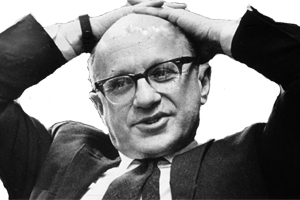



In the economics classes that I took in college, I recall that Friedman was the author of the textbook. While economics wasn't my best subject, I do recall some of the concepts stuck with me. I doubt if many of our lawmakers today understand those concepts at all.
Ron