Oligarchies and Oligopolies
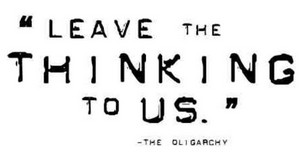
Say both of these terms in one breath and it sounds like gobbledegook-ologies. They mean “rule of the government by the few,” and “rule of the economy by the few.” There is a difference, but it’s becoming almost too little to matter. But at least somebody put labels on why our country is well on its way to financial and economic hell-in-a-handbasket.
With Donald Trump as the leading contender for the Republican nomination, and Michael Bloomberg as the leading Independent on the sidelines sizing up the nominating process, we have two private sector billionaires vying for the government office of the Presidency. Why? Because they can. Because their ears crave hearing “Hail to the Chief.” Because their egos love to be caressed by the multitudes as we bow down in humble submission. Because they have earned the right to live in regal opulence, but paid for by you and me. After all, they are only billionaires.
Donald Trump asserts he has a net worth of $10 billion dollars that many dispute, while Michael Bloomberg has a reported net worth of $37 billion that nobody disputes. Both are ready to throw about $1 billion into the race for the top job. But let’s set that issue aside for the moment and discuss that other tongue twister, oligopoly.
Today, Johnson Controls and Tyco International announced that they will merge and become a $36 billion company, called Johnson Controls PLC. So what is new or different about that? Nothing. It is just another merger that constitutes an oligopoly. This merger will mean less competition and therefore higher prices for everyone. And it is another step toward power consolidation where “too big to fail” raises its ugly head, and taxpayer bailouts are the way to pay for the incompetence of the wealthy. More importantly, it means another giant that can and will muscle its way to the front of the line in scooping up all the money it can from corporate banks that borrow directly from the Federal Reserve ahead of all individuals and small businesses. It is a diversion of the money stream that adds to more corporate and CEO wealth, while denying growth and jobs to the economy. This cozy arrangement between the Fed (a government agency), large banks (private corporations), and the concurrent expansion of their “old boy networks” is another milestone in the death of free markets, and the reduced ability of small businesses and individuals to get a foothold for a tiny piece of the action.
Both Trump and Bloomberg tote and connote big money. And even the Supreme Court has joined in with them in the transformation of control of the government by and for big money. They ruled in
Citizens United v the FEC that for any profit or nonprofit organization can contribute unlimited amounts of money to political campaigns. And the Federal Trade Commission “oversees” mergers and acquisitions by large corporations. In their
own words they are pretty much a rubber stamp for such activity.
And so…we have this arrangement going on: The Fed controls monetary policy for the United States. When they want to increase money, they simply order the US Treasury to print the amount they have in mind. Let’s say they order $1 trillion from the Treasury. They take that money and purchase Treasury bonds to hold as collateral. Then they make that $1 trillion available to member banks, who further make it available to corporate banks. Corporate banks borrow it as fast as they can. Why not? Interest rates are so low that money is practically free.
Corporate bankers can lend that money to you and me, or they can divert it to their own accounts for a multitude of activities such as providing investment services, buying and selling securities, engaging in foreign exchange, and lending to other large corporations. Notice that you and I are at the bottom of that totem pole. We are the ones who go out and spend our money, and that activity makes the economy grow, we create jobs, more wealth, and more tax revenues. But we get only a tiny amount of that $1 trillion. Our share is called M1. Bankers do their best to see that very little money gets into M1.
The giant’s share goes to banks and to large corporations. That is M2. They could use it to expand their businesses, but that doesn’t happen to the great bulk of that money. They can and do buy back their own stock, thus driving up the price of those stocks. And since the executives in corporate America own huge amounts of stock, they enrich themselves at our expense. The savings portion of M2 money does not grow the economy at all. It merely adds to the wealth of the wealthy.
Bankers and CEOs are products of the Harvard Business School, and Wharton Business School, Carnegie Mellon, the University of Chicago. They are typically the offspring of America’s wealthiest families. Donald Trump went to the Wharton School and Michael Bloomberg went to the Harvard Business School. Repeat this scenario among the top 5 or 10 thousand corporate CEOs in America, and therein lies the framework for both the immense oligopoly structure, and the oligarchy outcome. And the proof is in the final reckoning: The top one percent of Americans has more wealth than the bottom 99 percent combined.
I wonder how many of them predicted the recent fall in the price of oil, the rise in the value of the dollar, and the plunge in stock prices? I did. Just one of my security picks shot up 32 percent in the past 7 weeks. But I am just a retired economist who didn’t have the fare to Pennsylvania, Boston, or Chicago. Poor me.




Another good article explaining clearly our dilemma. I fail to see why people are so attracted to these very rich people whose only celebrity is their wealth. But if we look back, many presidents from the past, like Herbert Hoover, Franklin Roosevelt, John Kennedy, Ronald Reagan, and others were all wealthy people--some self-made, but most, not.
You touched briefly on mergers and did a very good job. A year or so ago I read an article outlining who owns what, and was not surprised to find out that about 10 megacorporations own about everything, most of the brands that we think are independent companies, are owned by these corporations. Most United States citizens seem to like to save a buck and gravitate towards companies that are monopolizing an industry like Walmart or Amazon. They tell me they like these companies because of their variety of goods, low prices, and service. What they don't see is the aggressive actions by these companies to squelch competition and dominate whole sectors. In the end, they control prices just like Saudi Arabia is controlling oil prices by dumping cheap oil on the market right now.
Ron
I did!
Love ya!
Jane