May the Circle be Unbroken
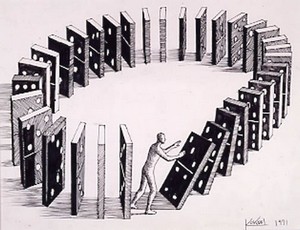
This short essay is written for those who find it difficult to see and understand how economic issues are connected. If you can visualize the connections, the problems as well as their solutions become clear, or at least clearer. I will use two analogies to help in this clarification. They are a circle of dominoes, and musical chairs. Think: Knocking over one domino can sometimes result in 20 or 30 dominoes falling—with wonderful or devastating results. Likewise, preventing someone from pulling two or three of those dominoes (as in musical chairs) can keep the dominoes from falling and prosperity vanishes. It doesn’t get much simpler than that.
I have made the argument (It’s Time to Lower the Corporate Tax) that the corporate tax needs to be lowered or eliminated altogether. We would definitely see a lowering of the price of goods and services across the board (from more spending and competition for the new dollars) as a result, leading to higher corporate profits, and that outcome would become a bargaining chip for workers to seek higher wages, while it would give US companies a better competitive position in international trade. Recall from macro economics that higher profits and more exports would mean more GDP thus more jobs, more income, and more tax revenues. I also mentioned that lower corporate taxes would give Democrats in Congress a bargaining chip to offer the other side a big discount on repatriated profits currently resting overseas estimated to be $2.1 trillion—and those dollars put into circulation here would give the economy a huge boost. Add up those positives and we would all win by lowering the corporate tax. But why not add one more bargaining chip to this list by seeking one more colossal (but obscure) incentive?
We could seek to amend the Federal Reserve’s charter so that all newly printed money must go into M1, or money in circulation. That bottleneck (between the Fed and banks) is the biggest obstacle that stands between a lackluster economy and a huge jolt to prosperity. It is the primary source of those dual inequalities of incomes and wealth, which are the source of 95 percent of poverty, and poverty is the source of a very long list of social ills (crime, incarcerations, drug usage, mental health issues, suicides, illiteracy, teen pregnancies, obesities, education needs). And all these poverty issues are the reason for those government programs such as food stamps, income subsidies, etc. all of which must be paid by tax revenues. Clear the bottleneck and watch the dominoes fall and good things happen.
So now we have come full circle. The corporate tax is not a good tax. Many corporations move their operations overseas to avoid paying it. We need to lower or eliminate it. And we need to get those companies to bring their profits back home to help stimulate the economy. Good things will flow from those changes. Also eliminating the huge bottleneck between the Fed and the economy would usher in more prosperity than almost anyone knows about. A trillion dollars of new money that gets into the hands of consumers produces $6 trillion in GDP, $5 trillion in new jobs and incomes, and $2.4 trillion in new tax revenues. That same amount of money that gets diverted into the hands of bankers and their wealthy friends produces zero GDP, zero jobs, and zero new tax revenues.
There is, of course, a political intruder who snatches dominoes from this circle. The wealthy elite are against it, and so are their puppets in Congress. It will take a landslide win by Democrats this November to have a chance to set it all into motion. That’s where you and I come in. We must vote for our own and our children’s future. Otherwise, it’s back to that old game of gridlock where obstructionists in Congress keep stealing dominoes from the circle, and the rich keep on get richer and the poor keep on getting poorer. November is our sane choice, our rational choice, our nonviolent choice. May the circle be unbroken.





--Ed
But I'm wondering whether or not more jobs would be created because it's all about profits and corporations will, generally, do everything in their power to create profits by eliminating jobs, outsourcing, and finding the lowest paid workers anywhere in the world. Lowering taxes would not affect this trend, continuing as long as "free enterprise" is unbridled. A second problem is mergers. The largest corporations are continually buying successful newcomers and merging with less successful competitors. The result is that the monopolies formed can control prices with less competition.
Finally, corporations are the source of income inequality paying their CEOs exorbitant salaries and perks, while paying slave wages to those who sweep their corporate floors or serve their lavish luncheons. Wasteful government agencies pay their employees much more fairly and provide benefits for all. Something that corporations are notoriously bad at.
Ron