Income Tax Cuts: Good or Bad Idea?
An income tax cut today is a bad idea. Here’s why:
Not every tax cut is bad. It all depends on where most of the additional cash goes. If most of the additional cash is spent, that route not only generates more sales of goods and services, it also generates more profits, business expansions, more jobs, and more tax revenues. Moreover, each new dollar in circulation is spent about 6 times in one year, thus there is a multiplier effect through out the economy. Those are all positive outcomes for everyone.
But if most of the additional cash is saved, that money makes its way into personal wealth; namely into stocks, bonds, and real estate. And although that is also a good use of money, only the wealthy can direct it all into personal wealth. And since they get the lion’s share of tax cuts, that is where most of it goes. As a result the economy does not expand, jobs are not created, and new tax revenues are not generated. Treasury revenues fall, and the federal budget deficit gets larger.
Example of a 10 percent tax cut. For someone who makes $100 million per year, such a cut would amount to $3.96 million (10 percent of $39.6 is $3.96). But a 10 percent tax cut to someone who makes $10,000 per year amounts to zero (10 percent of zero is zero). The multi-millionaire has no new spending needs, hence he or she puts that new money where it will do them the most good. And that is into stocks, bonds, or real estate. The poor man or woman just struggles on. But the Treasury is short another $3.96 million.
The conservative argument is this: Tax cuts always pay for themselves. Just look at what happened following the Kennedy and the Reagan tax cuts.
The reality is this: During the Kennedy and Reagan years, the top income tax rates were 90 and 70 percent respectively. Those rates were inordinately high. Lowering them (from 90 to 70 and then from 70 to 50) put more money into circulation with all the benefits noted in the opening paragraph. But Reagan also lowered the top bracket from 50 to 25 percent. Then they were raised and settled in at 39.6 percent,
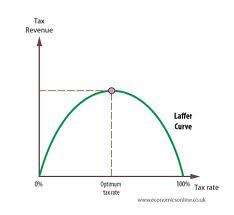
The pictorial above is the Laffer curve (named for economist Arthur Laffer), It shows why the Kennedy and Reagan top tax bracket cuts were effective, while all rate cuts below 50 percent have resulted in higher budget deficits.
The Laffer curve is one of the easiest charts to interpret, in spite of the fact that it is subject to much criticism by economists. It simply shows the relationship between the marginal tax rate of the top tax bracket and its effect of total tax revenues. It shows an increasing tax revenue level for all tax rates from 0 to 50 percent, an a decreasing tax revenue level for all tax rates from 51 to 100 percent. It suggests that tax rates between 51 and 100 percent are perceived as too high and people will engage in many activities to avoid pay those rates. At al 100 percent tax on income, all work would cease because everyone would perceive that rate to be confiscatory.
Conservatives seem to understand the upper half of the Laffer curve, but their heads go all wobbly over the lower half of the same curve. Presumably, they believe (or want to believe) that tax revenues collected become greater and greater all the way down to a zero tax rate.
In practice when they “discover” that tax revenues actually fall and create a bigger budget deficit from rate cuts below the 50 percent level, they simply blame the shortfall on entitlement programs, and set about cutting them. In 3rd grade logic that is another reason why the rich get richer and the poor get poorer. It also outrages fair-minded people.
Sec. of Treasury Steven Mnuchin recently asserted to the world that tax cuts pay for themselves. Now you know that he was wrong, he is wrong, and why. You may quote me.






The average wage earner does not have the advantage of these special laws.
Ron