AuthorsDen.com   Join | Login    
Where Authors and Readers come together!

SIGNED BOOKS    AUTHORS    BOOKS    SAMPLE CHAPTERS    AUDIOBOOKS    eBOOKS    STORIES    ARTICLES    POETRY    BLOGS    NEWS    VIDEOS    SUCCESS    TESTIMONIALS

Featured Authors:  William Martell, iAlexander Shaumyan, iLisa Loucks Christenson, iH.G. Potter, iDiane Hundertmark, iEva Pasco, iT. Cline, iCharlene Proctor, iGary Caplan, iShirley Francis-Salley, i

  Home > Essays > Articles Popular: Books, Stories, Articles, Poetry      Authors: A B C D E F G H I J K L M N O P Q R S T U V W X Y Z     

E D Phillips

 Follow Me  

· Contact Me
· Success story
· Books
· Articles
· Poetry
· News
· Stories
· Blog
· 1,302 Titles
· 6,063 Reviews
· Save to My Library
· Share with Friends!
·
Member Since: Dec, 2008

E D Phillips, click here to update your pages on AuthorsDen!


Books by
E D Phillips


See all Books
by E D Phillips


Why I am Not a Religionist
by E D Phillips   
Rated "G" by the Author.
     
Last edited: Sunday, August 19, 2018
Posted: Saturday, August 18, 2018

Recent articles by
E D Phillips

• Spiritism Explained
• Segments from a Bifurcated Life
• AI at Its Best
• July 4, 1776: 250 Years Later
• A Sage or a Saber-Toothed Renegade?
           >> View all

Freedom to think means nothing if we are not free to examine life and all that it portends.

Why I am Not a Religionist

This above all: to thine own self be true ,
and it must follow, as the night the day,
thou canst not then be false to any man.

--Polonius, in Hamlet

First, let me be clear: I am not anti-religion. I do not hate those who belong to or practice any religion. But to draw upon another quote from Shakespeare, “To be, or not to be, that is the question.” Religion should always be a free choice, not an imposition. Anyone who is born into and raised under the precepts (litany, dogma) of a religion cannot be a free-thinker unless and until he or she steps outside all religious beliefs and begins to examine life anew. And that is merely the first step in the search for knowledge, wisdom, or truth. It also accords with the wisdom of Socrates, who is reported to have taught this principle: “The unexamined life is not worth living.”

The issue starts with beliefs. A belief is to assume something is true without verification, or reason, or in the face of contrary evidence. Children are easy targets for beliefs. It is not a coincidence that children are indoctrinated into a religious belief system. They are malleable of mind with neither the skills of logic nor the observational experience with which to put a belief to the tests by using higher mental abilities. And so, Jews become Jews, Muslims become Muslims, and Christians become Christians. We could extend the list to include all dogmatic religions. (The case can be made that many Eastern religions are neither dogmatic nor predisposed to punish those who are open to new ideas or new ways of thinking. They are excluded from this discussion).

The clash of values, and purpose, and intentions arises when someone steeped in the dogma and the practices of their religion ventures out into life and meets up with persons, places, events, or conditions that present him or her with thoughts and ideas that suggest a different pathway to knowledge, wisdom, or truth (KWT). Let it happen again and again, and something that psychologists call “cognitive dissonance” begins to set in. Most of us need relief from such dissonance. We cannot merely dismiss it and go about our lives. Living with ambiguity is too difficult for too many.

Sometimes we can “rationalize” our way forward. But rationalization is not a very satisfactory way to finding KWT. It falls flat in the face of undeniable facts, or observations, or logic. One who simply falls back on beliefs learned without evidence or logic becomes trapped in a world of make-believe. But someone who ventures forward must suspend those beliefs while searching harder, and by acquiring new skills in how to analyze, and how to synthesize, and to evaluate life and issues creatively. But those are the skills that Socrates taught, and the reasons also that the elders of his day found too confusing and too formidable to deal with. As we know, he was forced to drink deadly hemlock because he was seen as a threat to their authority. Those who developed such skill sets since Socrates and before the Age of Enlightenment were often labeled “apostates” or “heretics.” Thus, were born the seeds of conflict, within, without, or between religions.

History is chock full of millions of examples of those in search of dissonance reduction, of better answers, or the truth who were imprisoned, stoned to death, or burned at the stake for the simple act of searching for better answers to issues in their lives. It is the age-old clash between free-thinkers and religion, science and religion—even religion and religion.

Ironically, neither free-thinking nor science has issues directly with religion. They have put all religions in the safety zone of the “unverifiable,” to be left alone until or unless their beliefs can be verified if only in theory. I would also argue that the “verifiability” principle—supported by a long list of philosophers and scientists—is the most humane and accommodative principle ever established for reducing the friction between science and religion.

This discourse is also not a blanket condemnation of religions in how they treat those who venture outside their individual belief systems. Today, some religions approve of many scientific advances and in the methods by which science operates. Let’s give them a dispensation. But many more do not make such accommodations.

Many religions in progressive societies, however, such as most of Europe, and most of the Western Hemisphere are unaccommodating and seek to impose their beliefs via laws, and punishments on the pretext that such laws are the will of the governed. And so, the world is many decades—perhaps centuries—away from finding ways for religions and the examiners of life to live in peace with each other.

To me, on one level, it is almost humorous that such a value gap persists. But there is nothing humorous about having to shoulder anyone’s beliefs especially when they are now embodied in the biases of judges, or legislators, or even in the otherwise comedic antics of television evangelists. But they are especially egregious when held by ultra-wealthy political activists who are finding it easier and easier to reign in and to circumscribe their domain of practitioners with huge amounts of wealth.

On a psychological level, the fundamental difference between those who have a need to believe without question, and those who do not, is a mental state called “open- v. closed-mindedness.” These two predispositions are opposite by design and by outcomes. I choose to be free to find the best answers to all issues except those that I know in advance that I cannot find, starting with the existence of a superior cosmic being. Believe otherwise if you must. Your beliefs do not bother me.  Just stop trying to impose your beliefs on me by laws, or by religious proclamations.  Excluding the actions of tyrants, I do not know of a single person or living thing that was ever harmed beyond minimal necessity by advocating or continuing the search for best answers about reality.

And so, I choose to remain as free as I can to pursue knowledge and wisdom, and to examine life as vigorously as my mind permits.

Web Site: AuthorsDen


Want to review or comment on this article?


Need a FREE Reader Membership?
Reviewed on September 6, 2018
I love that everyone has their own thing going on but no one should force anything on anyone. Everyone has a different brain! Right? How can anyone EVEN think exactly like someone else? Oh, I get going on this stuff!

Love ya!

Jane

Reviewed by Odin odin@aflx.com
Reviewed on August 20, 2018
The essence of your writing here, at least for me, is that government and church should stop their interference into the hard-wiring our brains have from birth: the ability to establish and way of life that works for the individual. Unfortunately, as your essay points out, there is far too much effort to impact the individual and make him or her into part of the pack, the herd, the flock of global sheep that have as their shepherd one or more stick wielding controllers. Thank you for this write. Hope a lot of people read it.

Reviewed by E Phillips
Reviewed on August 20, 2018
Timothy: Yours are the words that flow from a biased, closed mind, "Sadly" is a dead giveaway word of bias, used to try to lure the reader to an unsupported point of view. "Truth by assertion" also underscores all your comments. Examiners of life avoid those shortcut statements to nowhere like the plague. And "nothing new under the sun" is hardly the words of "the wisest" man. It is refuted everyday with new discoveries, new ways of doing things--even by former asserters who discover the error of their ways. But there is a glimmer of hope for you, Timothy. A Deist (not an atheist) is someone who acknowledges the grandeur of the universe and the high probability of a benevolent entity behind it all without the need for a religion. As to purpose, the Deist finds purpose in preserving Nature; in respecting others, in developing his or her talents, in exploring and in bringing excellence into his efforts, while being an honest, trustworthy, kind, caring, and loving person all the while. He and she follow an inner moral compass that does not require them to bow down to, or make pledges to, or give money to clerics or religious institutions in order to be the best person he or she can be. What could be better than to do all that without condemning those who haven't yet developed their skills and opened their minds to the beauty that is life?

Reviewed by Timothy Buchanan
Reviewed on August 20, 2018
There is nothing new here, indeed, as the wisest man said, "There is nothing new under the sun." In order for slaves of humanism profess themselves freemen, they must first deceive themselves. No one can ever be truly free apart from understanding the purpose for which he/she was created and placed here. The fact is that no "religion" can be imposed on anyone. Exercise can be dictated, but the heart of man is not changed by external action. It's amazing that those who condemn and berate religion, are themselves, the most dogmatic and tyrannical in their atheistic doctrines. Sadly, the most miserable fool is he that trusts in men--worst of all, he who make a god of himself. Deception by any other name is still a lie.

Reviewed by Eva Pasco
Reviewed on August 19, 2018
The line separating church from state has definitely been blurred by self-righteousness among politicians who pander to segments of the electorate.

Reviewed by Ronald Hull
Reviewed on August 18, 2018
Another article showing how your open-mindedness can help everyone deal with complex problems in a reserved and logical way without rancor or close minded, all or nothing. Philosophers have shown us much more than religionists. We just have to read them carefully and open our minds to their ideas.

It is dangerous to place religion on a pedestal. The recent indictment of the Catholic Church in Pennsylvania is a wake-up call to all of us that we cannot fall back on religion and expect religion to stay true to what is right. Why have we been asleep to the abuse so long?

Ron

Popular Essays Articles
  1.  Where Have All the Authors Gone?
  2.  The Advent of ALICE 1.0 Advanced Logis
  3.  War and the Earth we need to live on.
  4.  An Era of Stupidity and the Challenge
  5.  Down with Group Chat
  6.  Critical Race Theory & the 1619 Projec
  7.  Needed: A Progressive Grand Strategy t
  8.  Less Words, More Results
  9.  Takeaways from Adam Smith's The Wealth
  10.  Mr. Trump, have you no sense of decenc
  11.  The Crisis of Opioid, Fentanyl, Cocain
  12.  Verifying Ones Self
  13.  Where, oh where, has my Porsche dream
  14.  Critical Race Theory
  15.  Just a Kid
  16.  Super Spreaders Disguised as Congressm
  17.  Daylight Saving: Stop Legislating the
  18.  Are You Writing for Me?
  19.  The Compassion of Christ
  20.  Why Excessive Inequality Matters
  21.  Bone-headed Supreme Court Decisions
  22.  Rhode Read: RI’s Tobacco-Based Wealth
  23.  Genghis Khan Rides Again!
  24.  The Cozy Mystery: Death by a Thousand
  25.  American Fascism and the Bush Administ

Free Book Review Program
Select a book to read and review today!

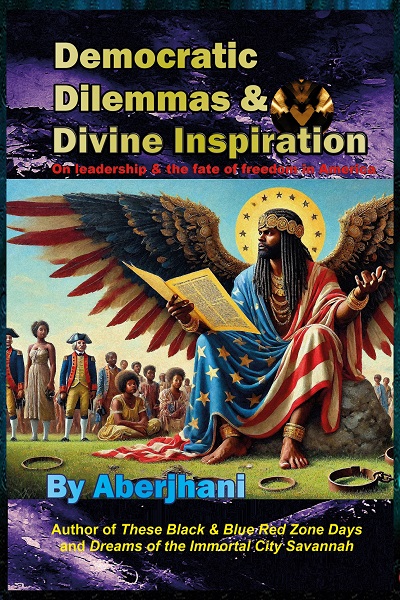
Democratic Dilemmas and Divine Inspiration (A Kindle Short) by Aberjhani

Democratic Dilemmas and Divine Inspiration examines the significance or relevance of the idea that the U.S. Constitution was, as many believe, divinely inspired. How much did that belief matter to founders of the nation and how much does it matter no  
Member BookAds

Democratic Dilemmas and Divine Inspiration (A Kindle Short) by Aberjhani

Democratic Dilemmas and Divine Inspiration examines the significance or relevance of the idea that the U.S. Constitution was, as many believe, divinely inspired. How much did that belief matter to founders of the nation and how much does it matter no  
Member BookAds

RAM: Random Articles and Manuscripts by Jay Dubya

RAM: Random Articles and Manuscripts, a non-fiction collection of 38 stories and essays, is author Jay Dubya's 32nd book.  
Member BookAds