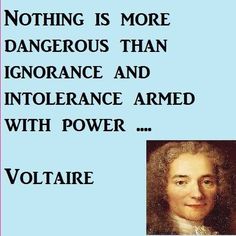
Nothing is more dangerous than ignorance and intolerance--armed with power. --Voltaire
Progressivism v. Conservatism
A note about reviews: I could cite more than 100 peer-reviewed source documents in support of this narrative. But this is an essay, not a doctoral dissertation, and I have tried to make it interesting and readable as well as scientific. Please do not muddy up my essay with shallow opinions that are refuted by science. Have the courage of your convictions by posting such objections on your own web pages—where they can stand alone for humanity to read and rejoice in or lament in perpetuity.
* * * *
The distinctions between progressivism and conservatism are stark. They are not equal but opposite either in origin or in application. Progressivism is a way of thinking and doing while searching for best answers in most matters that are consistent with our state-of-knowledge. It seeks equity and fairness in how we treat each other in our communities, in our schools, in our churches, and in our daily activities. In contrast, conservatism is an ideology designed with the purpose of gaining control over our lives whether in education, in the work place, in what we produce, how we produce it, but toward the end of directing profits and flows of money and wealth up the pyramid of rankings to those who have inherited the most. It seeks power and control by preserving those wealth flows to the wealthy.
Progressives view the world as a “work in progress. They use analysis, synthesis, and evaluation of facts and observations, plus logic and creative thinking in finding better ways of living. Conservatism presumes to have ready answers to most of life’s issues while it seeks to apply those answers to situations and circumstances. The two approaches are especially contentious in a political climate. I will start with progressivism.
A progressive also sees society as people in search of better answers to issues. In order to have a realistic chance of taking on and overcoming challenges that come our way, we must grow intellectually, emotionally, and philosophically. That can happen mainly by pursuing reason and the scientific method in gaining more enlightenment. Truth is too elusive a concept to waste time in its pursuit. Progressives rely on observations and empiricism in finding best answers to issues. Facts are submitted to analysis to gain further insight into them. Such analyses consist of submitting facts to stringent tests. A few of the analytical tools are mathematics, statistics, artificial intelligence, and a host of different models unique to the particular discipline of those conducting them. The outcomes are limited to only what the tests support. These outcomes are synthesized into our body of knowledge so that we can artfully project what they could mean in a broader context. Science seeks accuracy, reliability, and usefulness as the qualifiers that limit what we have learned. Emotional maturity is dependent on the state of knowledge as revealed by psychology, psychiatry, and the neuro-sciences. Philosophy is how we critique our body of knowledge. It consists of logic (the true ), ethics (the good), and aesthetics (the beautiful). The good might include what best serves humanity. Concepts such a kindness, goodness, understanding, caring, tolerance, and forgiveness serve as guides. Progressives are not doctrinaire about religion. They often rely on a distant God who does not intervene in his already perfect plan, who does not grant favors, and who does not need humans to bow down and worship him or her. This God seems content to ask only that we treat each other fairly, honestly, compassionately, and with respect. A progressive is an open-minded free-thinker who evaluates all important matters on his own. Progressives are also self-actualizers, with a lively sense of humor, and they ultimately seek to give back to humanity in wisdom, assets, or goodwill. Politically, they are independents or Democrats who reject loyalty over facts and best answers.
Many (not all) conservatives have a totally different world view. They rely on authority figures for their facts and their course of action with important issues. They are taught right from wrong, good from bad, what to think and how to behave in most situations. They rely on their religion or their authority figures for guidance. Neither science, nor psychology, nor philosophy interest them much at all. They prefer to think of reality as unchanging, or they want to regress back to a prior time. Their lives are reduced to very simple concepts. Companionship, group thinking, and tradition often sum up their activities. They are climate deniers, dislike higher education, and they believe they have a personal relationship with God who prefers them over most if not all others. When issues are too big, they pray to God for intervention or a miracle to solve them. They see progressives as annoyances at best, as their enemies at worst. They are intolerant of those who are different from them. They are fiercely loyal to their companions and to their leaders. They are closed-minded in all important matters and don’t want to change. They often suffer from low self-esteem, have a limited sense of humor, rely on group-think, they are highly dogmatic, have a low ability to differentiate source from message, have difficulty rising to become self-directed, and rarely become self-transcenders, or those who give back to humanity in a meaningful way. They love to put labels on others, define what those labels mean, and then act as if their labels are true . In the U.S. they are predominantly Republicans.
The biggest difference between the two groups is not political, as great as those difference often are; the primary difference is open- versus closed-mindedness—a contrast in how we think about, assimilate, and act on many different topics and issues.
Open- v. closed-mindedness. Contrary to what you may read elsewhere, an open-minded, progressive person is not easily persuaded. This person requires hard, observable, measurable facts that are proven by scientific investigations before moving toward a given point-of-view. He or she can hold conclusions or opinions on that issue in abeyance until convincing facts are in. This ability is known as a “tolerance for ambiguity.” The closed-minded conservative, however, has very little tolerance for ambiguity. He or she needs answers now, thus they are quite easily persuaded to a false—even an outrageous—conclusion from their authority figures about important matters. But take notice: In closed group discussions, the opposite outcome very often occurs: the closed-minded person—alone--cannot offer good and convincing arguments for a faulty belief or opinion, thus he or she is easily persuaded by the open-minded persons to a different, more enlightened point of view. Good lawyers know how to detect the open- from the closed- minded person, and they select their potential jurors accordingly.
Beyond juries, can this knowledge be used effectively to help transform societies throughout the world into better thinkers and doers? The answer is “yes, but…”
The power of education. A growing number of scientific studies have shown that there is a very high relationship between open-mindedness and education levels. From this fact, alone, we would expect to find a high percentage of open-mindedness among college and university graduates and faculties throughout the world. And we do. But open-minds are found everywhere we find persons with keen minds, who can and do think for themselves, and who will not listen to authoritarian gibberish. So who are the closed-minded persons? High on this list are devout religionists who refuse to listen to reason and science; brutes and thugs who are incapable of listening to reason and science; and totally innocent persons who have been brain-washed or forced into believing that some authority figure in their lives has found the truth, the whole truth, and nothing but the truth.
I can tolerate ignorant, apathetic people. But I will not vote for them.
|




You use some harsh wording here but it is necessary to make sure that al aspects of these mindsets are explored and not swept under the rug.
For the most part, Americans have followed the rules that science has provided for dealing with the coronavirus. Unfortunately, our individual freedom and patterns of behavior have led us into becoming the country with the most infections, hospitalizations, and death per capita.
But if there is a real threat the country much greater than 9/11 by a sovereign country and not by a small terrorist band like in World War II, all Americans will step forward, and fight for the survival of our country as a whole.
Ron