Concentric Rings and Centers of Influence
Life is about choices. Whether we are rich or poor, we can still choose to make the most of our circumstances. Imagine yourself carrying a placard around your neck with the words “I am part of the Problem.” Now see yourself with a placard that states “I am part of the Solution.” Which do you prefer and which do you deserve to have hung around hour neck? That question is the subject of this essay.
I am not a preacher. I am not like them, and I don’t even like most of them. I am merely exercising my right to write, and to state my point of view acquired over a very long time period. I’ve found that I can solve your problems a lot easier than I can solve my own, but that discussion is for another day. You (humanity) are my subjects for today.
Let’s start with purpose. My purpose in life is to do the best I can with what I have in the time allotted to me. I happen to believe that life extends beyond the grave, but I don’t give preachers any credit for that. What you believe about life after life is your concern, not mine. Neither you nor I can change it. What you and I do here and now is a lot about me and you—and we both have it within ourselves to change things for the better.
I like to think about my role as someone who emits concentric rings of influence that extend outward about 100 yards. Every thought I make, every action I take, gets carried on those concentric rings. Some draw attention; others do not. Some elicit smiles while others don’t. I try to avoid pity and contempt circles, but I am not always successful. The birds and the bees, the flowers and the trees are my pals. I can feel their warm greeting. I would not harm them at all because they do not give me problems.
Teaching is different from preaching. I have credentials as a teacher. I worked my ass off in acquiring them, and my students used to say that I was a good teacher. Whatever my subject, I always made time (in consultation with those above me) to teach my students how to learn. And that consisted of drawing distinctions between memorizing and understanding; showing relationships between subjects; how to apply what you have learned; how to gather facts, analyze them, synthesize them, and evaluate them; and draw limited conclusions about them. I made certain they understood that truth was too elusive to pursue. We need only seek enlightenment. We need to improve on what we know, and how we can apply that knowledge. Our answers to issues must be accurate, reliable, and useful. No exaggerations, no embellishments, and nothing false. Never be dishonest with yourself, and you very likely will not be dishonest with others. And remember those concentric rings. They go where you go. And your influence is a lot wider and more profound than you will ever know.
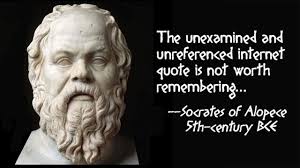
I told them about Socrates and the Socratic method. He was a teacher who inspired his students to ask a lot of questions—of their teachers and of themselves. He told them that the answers were always within them if only they went through the rigor of the preceding paragraph, also known as the pocket version of the scientific method.
Armed with just that knowledge, how might a young man or woman approach their duty and responsibility when evaluating candidates for public office? They might ask if a given candidate is looking out for him/herself, or for them? Is he an asserter, or does he rely on facts that have been analyzed, synthesized, and assimilated into a coherent whole? Is he a liar who doesn’t care about facts? Is he somebody else’s puppet? Does he understand his role as a public servant? Does he have higher or lower standards for himself than he does for others? Read, watch, listen, and distill. Does he fit your profile of someone who is doing the best he can, with what he has, in your time frame? Are you being true to yourself and to others with your vote? The answer is already within you.
Elections have consequences, not only to the candidate, but to you and to your mobile center of influence. You cannot ask Socrates. You cannot plead ignorance. You must follow your own star, with your own values, and your own sense of purpose. To thine own self be true . Then let the chips fall where they may.





Your usual succinct, but far-reaching words of how to do it, from experience.
Ron