Welcome to Pittsburgh
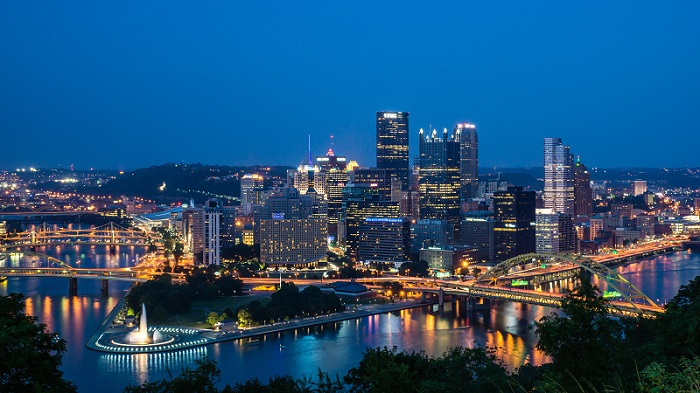
Say what you will about Pittsburgh, but she takes a mighty fine picture especially at night. She has a spotted past based on smog, old-style industry, and low wages. But just look at her today, and tell me she has no potential. This short narrative is about Pittsburgh today, tomorrow, and far into the future. Pittsburgh has arrived.
What do Pittsburgh and the Milky Way have in common? After all, one is a city and the other is our home galaxy? The answer is that one is the child of the other. Each is also representative of us in the best sense of that word. Pittsburgh has three beautiful rivers that depend on each other; our Milky way has billions of beautiful interdependent stars that also depend on each other. Both exude diversity and coherence. Both are lovely, picturesque, and stable. Both are good representatives of their wholes. Both teem with possibilities. But there is one drawback: Pittsburgh’s night lights are too bright. Wouldn’t it be nice if we could stand at the junction of the Allegheny, Monongahela, and Ohio Rivers at night, look up, and see the Milky Way from horizon to horizon—Pittsburgh’s grandest complement? What could be more appropriate? And who would dare to obliterate such a sight?
Others with a deeper sense of history, art, beauty, and imagination have pondered these questions. And they have come up with an answer about how to make them happen. It’s all in the lighting. LED's last longer, illuminate better, are much more economical, and when properly directed, they allow us to see the sky at night.
Pittsburgh has come of age. Back in the days of old mills and smokestack factories, Pittsburgh was Smokytown USA. No more. It now has a dark-sky ordinance. It has bids out for converting all of its 35,000 street lights to LED’s not only for better visibility of the night sky but also to use less energy, to help plants and animals by maintaining a crisper day-night cycle, to reduce glare for better night vision, and to benefit those in poorer neighborhoods who are disproportionately negatively affected by wasteful over-lighting. It’s underway now.
There is much more about the vision of Pittsburgh’s faculty members at Carnegie-Mellon, their famed university, and the city council members who are taking action to see this transformation through. But this narrative is limited to a tribute to the new aesthetic Pittsburgh, where you will soon be able to stand on the banks of any of her three famous rivers and see our cosmic home from one horizon to the others. And I will never again travel around this beautiful city at night just to save a little time.



But this isn't the first time that Pittsburgh was transformed. Andrew Carnegie, a Scottish immigrant, took advantage of the cheap labor of his fellow immigrants and helped Pittsburgh rape the surrounding countryside of Western Pennsylvania, parts of Ohio and Kentucky, along with West Virginia to grow Pittsburgh into "Smoky City." Late in life, while fabulously wealthy, he realized the error of his ways, and set up many foundations and philanthropic charities like establishing Carnegie Mellon University, turning Pittsburgh from just a dirty industrial city into a center of learning and culture.
Ron
As some may know, the Irish have a great affinity for the stars, one such noteworthy association being found in 'the star and the plough' motif that permeates more recent Irish history, and of course, given the intensely romantic bent that is an innate Hibernian proclivity, the stars have provided many an inspiration to those of Gaelic identity throughout Ireland's ancient past. I was therefore quite pleased to learn of steps being taken by Pittsburgh to not just conserve energy resources, but to regain that beautiful spectacle of nature known as the night sky! Who among us has never absently gazed at that blazing panorama of endless cosmic mystery and not drifted into a dream of fantastic imaginings, at some time in their life? For me this occurred most notably when I was a Boy Scout on high mountain camping trips, often around a blazing campfire, but I also well recall indescribably romantic late night walks on the beautiful Vienna Ringstrasse with a lovely woman on my arm, when the skies were unforgettably ablaze with uncountable trillions upon trillions of stars! Such moments are truly another priceless resource to conserve and protect!
Irish patriot and poet James Connolly, although he was referring to Eire's cruel and prolonged subjugation by England, memorably stated that "The Irish people shall only be free when they own everything from the plough to the stars!" Allegorically speaking, that is also the figurative legacy of all people everywhere, and we are long overdue to assume the concurrent responsibility of taking better care of our small but beautiful part of the vast universe that we inhabit.
Thank you for yet another catalytic inspiration, Edward!