The Scientific Method is for Everyone
Winston Churchill once captured the essence of democracy with these words of exclusion: “Democracy is the worst form of government – except for all the others that have been tried.” In an imperfect world, the same can be said about everything we know, or think we know. Knowledge comes to us slowly, and often painfully. It is never perfect because it is subject to more and better ways of knowing “what is,” or “what is the best we can do or use today.” Still, knowledge is an outgrowth of our inquiring minds. If we are to make the most of our potential, we must use our best minds and thoughts. To do that, we need a set of rules to follow that represents the best that we can do. And, in general, our best thoughts are known as products of the Scientific Method.
Science is not in competition with religion, or mysticism, or guesses, hunches, surmise, assertions, or opinions. Science is much too important to human progress to be so fragile and so fractured. It does not assert or demand that we accept any if its findings as being true . It is tentative. It merely fails to reject our best thoughts as false. It tells us what is tenable and useful, but subject to change with more and better evidence. Science moves forward slowly, often too slowly for the best minds to see or to realize the fruits of their thinking in their lifetimes. But science is not merely for scientists. It is for the good of humanity without showing favoritism or bias to anyone to the extent that it can.
This essay is intended to show the steps in the Scientific Method without the heavy philosophy, the complex models, the higher-order mathematics, or the deep thinking that goes on in the best scientific minds. It could be called the “walking around” version of the Socratic Method—the steps that evolved over time in reaching best, albeit tentative, conclusions about life and the usefulness of what we think we know. Still, it is not shallow. It is intended to place science right where it belongs: In the hands and in the minds of everyone who is capable of reading, analyzing, synthesizing, evaluating, and in drawing limited conclusions about this world, the universe, and how its components interact with each other. My task is to help you reduce all those steps into an understandable version that most 3rd grade minds can grasp.
Preliminary. State what you intend to discover. Doctoral students call this the “Hypothesis under Investigation.” Example: “There is a force that exists between any two objects in the universe.” Isaac Newton found that there is a measurable attraction between bodies in the universe. He developed the Inverse Square Law that reveals how to measure it. He also found that it was not as precisely measurable as he had hoped. So he developed the Calculus to refine it further. Later, Einstein defined it even further by adding a Gravitational Constant to Newton’s law. But a Newton or an Einstein comes along only about once every hundred years or so. Our efforts will be much more modest. We might try this hypothesis: “Our investigative skills diminish as we get older.”
Step One. Get the facts. Go to the best sources of knowledge to start your investigation. Government sources are usually the best—especially if you eliminate political thoughts that come from Congress, the White House, the Supreme Court and similar state and local offices from your sources. When used with care, the Internet is a fast and reliable source of information. Avoid opinions, guesses, surmise, and anything that smacks of religion, mysticism, or politics. Good clean researched facts are better than nearly all opinions and goofy hokum combined.
Step Two. Learn how to analyze your facts. A good course in Logic is helpful. Even Logic for Dummies is a fair start. So is Socratic Questioning. Ask solid questions about “what is” and “what could be.” Look for good supporting sources. Discover what great thinkers had to say about your facts. This step need not take a long time. Answers are available today that did not exist in a ready format just a few years ago. Facts also need to cohere with each other. They need to flow easily to the next step.
Step Three. Synthesize your facts and your analyses of them. Do they blend well with what you already know? Can you make sense of what they imply? If you find your tentative answers are exciting or titillating, delve deeper. Reach for the most plausible answers. Carry them to the next step.
Step Four. Evaluation. This is the payoff step. Ask who, what, when, where, how, and why your premises occur? Pull your answers apart. Evaluate them in pairs, then in three’s. Allow for all potential answers. Do not cut corners. There are a few hundred models used by scientists. You need only satisfy your “walking around” needs. Your answers will be much more tentative than the elaborate models that can take years to develop. But you are probably already years ahead of the great majority of humanity.
Step Five. This step sets forth the Power of your findings. Let’s call it the Golden Triangle. The three sides to this triad are Accuracy, Reliability, and Usefulness. Accuracy is the degree to which your findings tell us what you purport that they tell us; Reliability is the extent to which they are likely to be repeated by others; and Usefulness limits the use of your findings. You must decide based on your entire investigation the narrow use of what you found. DO NOT let others tell the world how useful your findings are, or are not. It is your investigation, not theirs. You sweated your way through it; you understand its nuances; and you are in the best position to put your stamp of approval on it, whatever its limitations. Others, less talented than you, will leap at the chance to define your work. They may even want to tell the world how careless or how shallow you are. You are in the best position to tell everyone about its use and its Limitations.
Step Six. State the limitations of your inquiry. You could not possibly have explained something that is good for all times, all places, and all circumstances. Modesty demands that you do not engage in “sweeping generalities.” Just tell us what you found and did not find.
Do all these steps once, and you will discover they are easier the next time, and the next. Indeed, you can become your own Walking Around version of the Socratic Method, better known as the Scientific Method. Soon, you may discover that you are head-and-shoulders more fleet of foot, keener of wit, and steeped in gratitude than are most others. And you may also learn about the modesty found in Newton’s observation: “If I have seen further it is by standing on the shoulders of giants.”


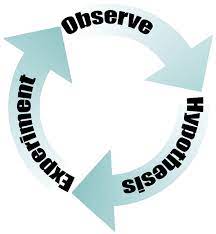



All through my schooling years, science subjects beckoned me to learn more. But so many of my classmates shied away from all that. Bored with science subjects as though they were of no use in their socially centered gossipy lifestyles. It certainly takes some willingness to go it alone without friends in order to gain a better understanding of science and the scientific method.
I was always interested in finding out why things were, like simple things like why is grass green and what makes gunpowder explode, etc.? My insatiable curiosity blossomed into a lifelong love of science where I get most of my outlandish ideas and verify what is needed to correct bad directions that the bulk of humanity may be headed if we don't change to match the change in technology that so many are afraid of. I see technology and science are going to save us rather than the opposite, most feared.
Ron