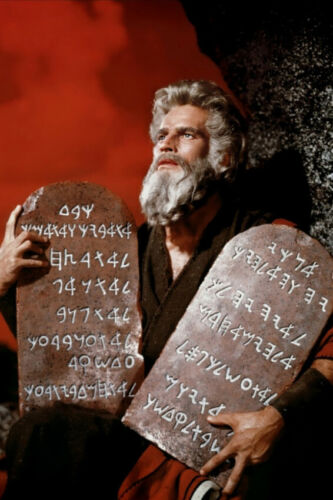
[image: Charlton Heston as Moses from creative commons]
Enlightenment
First, don’t lose your cool: This is not a sermon. I do not preach nor do I judge others. I am generally opposed to religions of all kinds mainly because they too often reflect a narrow point of view reflecting more ignorance than enlightenment. Assertions that religions contain the “word of God” are an example. Such proclamations are insulting to the human mind that is equipped to think, to analyze, and to reach valid and limited conclusions. A vengeful God is also a view that rings loudly of ignorance and fear. Eternal damnation is another. So is any final judgment with no chance for redemption. Those concepts make no sense at all, not for an all-knowing, all-understanding, all-forgiving Creator. They are laced with primitive points of view that play into the hands of clerics and preachers who want control by using fear as their weapon. In contrast, a kind, caring, loving, understanding, and forgiving Creator are attributes that make a lot of sense to me.
There is a belief among those who find Spiritism (not a religion) a rational, honest, and justifiable concept of the afterlife that we are our own critics. That means in the afterlife we get to judge ourselves and the life we just lived--not a heavenly council, not angels, and not God. And as part of our own judgments, we also get to set forth our punishment and our objectives in our next incarnation with respect to whether we must live in poverty, with physical or mental limitations, and the extent to which we will be burdened with environmental hardships. Why? Because we all fall short of the glory of God. We need more than 80 years or so in order to achieve that lofty goal. Some of us are also really bad-asses who need a lot of reflection time. So we get to come back again and again until we get it right. Also, we would not dare give ourselves too much credit knowing our plan would need to be approved by God. We are partly responsible for our actions (assuming we were given a bit of free will constrained by the rules of our circumstances imposed on us by equally-flawed others). I doubt if we could take credit for singing 14,243 hymns over a span of 80 years while cheating others of their right to live in peace; or dressing in our “Sunday best” to listen to a pastor who tries to influence our civic voting. I am appalled at any preacher who believes he or she is entitled to a $25 million mansion, or a $75 million dollar personal aircraft, to say little of diamonds, $3,000 dollar suits, or $300 hairdos. Actually helping a child, a poor person, or an invalid would seem to rank a lot higher than singing, preaching, or taking. Speaking out against slavery, or violence against others matters, or speaking up against polluting the planet would also be high up on that “do good” list. Silence on such issues out of fear and/or cowardice are two attributes that simply do not register with me as charitable or god-like.
I don’t argue against Commandments appropriate to their times. Moses, for example, lived 3,400 years ago, a time when illiteracy was rampant, knowledge was severely limited, and ignorance and the Flat-Earth theory prevailed. But the usefulness of “thou shall not” probably ended about the time of Christ, 1,400 years later. But even he did not remove the cloak of ignorance that prevailed. It has also been observed that Con-gress is the opposite of Pro-gress. The author of that observation deserves a humanitarian medal. Our Congress is not simply divided, it is severed by an abysmal chasm of injustice that is even more aberrant than the ignorance of times long past. It may take another 1,000+ years to defeat it, but defeat it we must. Or we may all die while only a few show they are “in it to win it.”
I recognize that I am a “universalist”—someone who tries to see the “big picture,” and who argues against injustices. But I am also content to let the “case-particularists”—those talented engineers of society who tackle the issues at hand and try hard to correct them. But rebuilding a broken dam will not cure many diseases, nor will it eliminate social injustices, nor will it help us capture the wind or the sun’s power or the tides and use them to our advantage. We also dare not let today’s angry band of tiny minds take control of our legislatures and pass laws that would take us backward to the Moses era when burning bushes and stone tablets carried more weight than did the voices thousands of men and women of good will.
Personally, I support the proposition that the way forward must rely on “enlightenment” as our goal. It may not be the complete answer to our salvation, but those in search of the “truth” are living in the wrong universe. Think about this: Nothing in the known universe is static. Even the tiniest speck of dust is moving and changing. We can watch as these particles collect, coalesce, and knock us for a loop, or we can plan ahead and use our God-given brains to better ourselves and our planet, and leave our posterity something better than what we found. It might even help us lose some of our misguided sense of entitlement, as well as our fear of dying.
|




Thoughts from my first novel and a concept that I thought of 30 years before that novel. If extraterrestrial intelligent life was able to ever cross the great distance between their solar system and ours, they would view us like our educated view our natural world with wonder, study and protection. We would consider them to be like gods. No reason to kill or enslave us like most science fiction today. And they would have no reason to stop by momentarily and give us little clues to the right way to live and create religions and so-called, civilization. Like endangered species, extraterrestrial gods would try to save us from ourselves. Not judge us like we are so prone to do.
Ron