Freedom v. Slavery
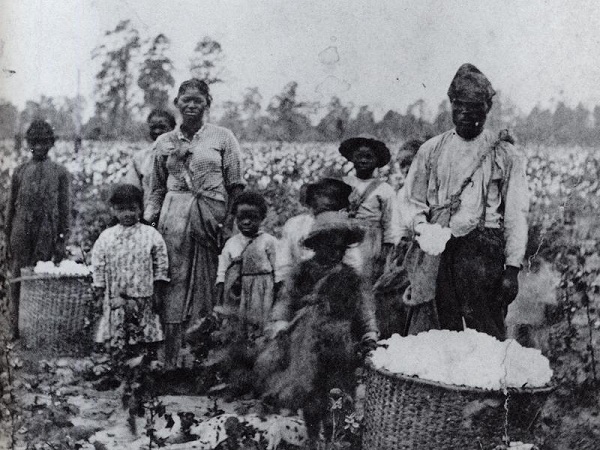
Carry me back to ol’ Virginny
There's where the cotton and the corn and taters grow
There's where the birds warble sweet in the springtime
There's where this old darkey's heart am long'd to go
There's where I labor'd so hard for old Massa...
By James A. Bland (1854–1911), an African-American
It requires a bit of empathy, a little study, and mutual respect to understand when you are being insulted and when you are not. But a “useful idiot” is different. He is someone who is so stupid he plays into the hands of his adversaries without understanding the meaning of either word. I must have been a burgeoning useful idiot back in my days as a young boy because I was instructed to memorize the words to “Ol’ Virginny” with no explanation about what a “darkey” was, or who “old Massa” was, but I understood completely about sweating under burning skies in the hot corn fields of southern Ohio. I was an unpaid slave, and I damned well knew it. Those days are burnt deep into my psyche.
Fast forward to 2016 and onward. John Bolton, the former Trump Administration National Security Advisor, is reported to have attached the "useful idiot" term to his former boss, Donald Trump, a label also voiced by Marine Corp General and Trump Chief of Staff, John Kelly, and by retired Army Lt. Col. Alexander Vindman. Useful idiot was also picked up by a large number of reporters, their readers, and by mild to serious intellectuals far and wide. Today, that term appears to have been embraced completely by Trump’s 35 million MAGA enthusiasts. The writer’s fairness code and a little humility, however, demand a new acronym for those less keen of mind so that all the right-wing crazies extant might learn a little more about labels, stupidity, and slavery. “Make America Serenely Stupid Again” is the new label that would fit all of Trump’s followers, his misguided misfits and his walking brain-dead. “Massa” was the term used obediently by black slaves when referring to their white owners, aka their “masters.”
Most of us honor our place of birth, humble though it may be, and even if devoid of grace, respect, and human decency. We may flee in terror, unlike elephants and other peaceful residents of this planet, yet we yearn to return—if only to die where we were born. It’s a small thing to ask from our kindred spirits.
Today, historians and others of goodwill, denounce Putin, Trump, the MASSA faithful, and those who cannot remember the past. But there is more to ignorance or to memory loss than merely a definition. It was a Spanish/American philosopher who reminded us that “those who cannot remember the past are condemned to repeat it.” (George Santanya, 1905). And it was a writer who rattled our brains by showing even the physically weak the pathway out of our state of mental numbness when he wrote: "The pen is mightier than the sword. " That term of enlightenment was intoned by novelist and playwright Edward Bulwer-Lytton in 1839, in his historical play, “Cardinal Richelieu.” Richelieu, chief minister to King Louis XIII, discovered a plot to kill him, but as a priest he was unwilling to take up arms against his enemies. But let us not give more credit to Richelieu than he is due. He also left us with these words: “Give me six sentences written by the most innocent of men, and I will find something in them with which to hang him.”
With that bit of sketchy history, let us move onward—despite Richelieu’s warning or the contempt with which he held his own wayward brethren.
For more than 2,000 years governments around the world have come under the control of an autocrat, a singular ruler with unlimited powers. It was during that same time period, that humanity saw some movement toward democracies, or rule by the people. The precise names of each era is less important than are the underlying forces at work within them: Excessive wealth accumulation at the top accompanied by an overt slavery, versus a subdued freedom where voting is the dominant activity believed to give all those controlled a new lease on life. Augustus in 27 BC founded the Roman Empire, following the end of the Roman Republic. Augustus officially kept the Roman Senate while effectively consolidating all the real power in himself. The Aztec Empire in Mesoamerica and the Aztec Emporer functioned as both the sole ruler of the Empire, as well as its military leader. Other countries include Egypt, India, Hungary, Brazil, and Tanzania under the late President John Magufuli; Germany under Hitler; Russia under a spate of rulers, and the United States under the sloppy orchestration of Donald Trump and a ragtag band of true believers. Some autocrats have used the pandemic to halt demonstrations against their rule while allowing rallies in their favor, as in Uganda, Russia, Thailand, Cambodia, and Cuba.
To summarize this opening, I am not an historian, but I have felt the sting of hunger, the cruelty of slavery, and the absence of freedom. All around me were others who knew, yet who did nothing about it. My motivation is the voice of experience, learned in the shadows of life, felt in the arena of war, and revived by the power of the pen. I damned-well intend to use this power—against every vile cause that time and circumstance grant me. This is one of them.
* * * *
Today, the US is on a collision course with those two opposite forms of government within our shores. Freedom is the hallmark of a democracy, while slavery is the dominant feature of an autocracy. It is not my purpose in this essay to foment more distrust between legitimate and well-intentioned political parties; rather it is to show how deep the divide between freedom and slaver really is, and how incompatible slavery is to life as we know it. Manipulation of wealth is the choice of the greedy, but the fight for freedom is a fight for survival.
Let’s define our terms with a little more specificity. I am referring specifically to democracy as a democratic-republic form of government--of, by, and for the people with elected officials sworn to represent, defend and protect our Constitution and the rights of minorities. We are also bound by the fundamental values of life, liberty, and the pursuit of happiness. Our actions are further circumscribed by the 6 principles found in the Preamble to our Constitution: to form a more perfect union; establish justice; insure domestic tranquility; provide for the common defense; promote the general welfare; secure the blessings of liberty for ourselves and for our posterity.
A wealth-based government is of, by, and for but a small group of ultra wealthy autocrats. It features a huge division by wealth, with unquestioned loyalty, servitude, and slavery by all residents to a small coterie of inheritors who, by vote or by declaration proclaim they can do no wrong. It’s primary features are opulence and total control of nearly all wealth and a zombie-like obedience to them by the masses. Should a leader emerge from among them, with delusional inclinations, so much the better. Foreign autocrats love useful idiots who do their bidding.
Knowing the stark differences between these two forms of government is essential because they are mutually exclusive; they cannot co-exist.
The birth of autocracy in the US is too lengthy and too convoluted for a detailed explanation. Suffice to say as others have noted that “power corrupts, and absolute power corrupts absolutely”(Lord Acton, et al). Such a state of being requires control over the mechanics and the venues of wealth, and the control of freedom over those who have the temerity to believe they deserve to be free. Some call these dual controls greed and punishment--sugar-coated with lies, propaganda, and false allegiances. We know them as the wedding of greed and politics in an unhealthy alliance with mental degradation, aka the Republican Party.
How many scientists and other open-minded individuals belong to the Republican Party? Probably none. How many believe that religion is the way to truth? Probably none. Why? A very good answer is that persons of high intellectual abilities and curiosity seek enlightenment, not great wealth, or greed, or power; nor do they allow religious or other dogmas to tug away at their moral fiber or take control of them. Am I asserting that moral purity and concern for others are the hallmarks of disestablishmentarianism (look it up)? Yes.
Critical Thinking. In the midst of all this is the answer to solving the riddle of how to de-fuse authoritarianism, greed, and a lust for power. That answer is open-mindedness. And that means reason. And clarity. And the search for enlightenment (not truth). In other words we need to teach Critical Thinking starting at a very early age. There is no greater gift to ourselves or to our posterity than is the gift of how to shed ourselves from failed dogmas, of greed, and the pursuit of power for power’s sake. Critical thinking is the way. It consists of how to analyze available facts, evidence, observations, and arguments to form a judgment. It is rational, skeptical, and unbiased. It is the foundation to how to build a better world. It is probably the only way forward to a world that is free from all the maladies that we impose on ourselves including the power to extinguish all life on Earth as we know it.
Nearly 2,500 years ago Socrates devoted his life to these pursuits. So did Joan of Arc, and Galileo, and Isaac Newton, and Albert Einstein, and Madam Curie, and Richard Feynman, and Carl Sagan, and Stephen Hawking. Today, their efforts are continuing by a long list of pursuers of enlightenment. We let ourselves down to give up the quest. It is no stretch of logic or of history to believe that Abraham Lincoln was speaking for all of us at Gettysburg when he said “…that we here highly resolve that these dead shall not have died in vain—that this nation, under God, shall have a new birth of freedom—and that government of the people, by the people, for the people, shall not perish from the earth.”




I have often felt that most people in the workforce, the ones that politicians talk of when they say they are helping "hard-working Americans," when they are lying through their teeth, are merely wage slaves. Just keeping themselves and their families off the streets in jobs they don't really like but have to do. While the rich and their "useful idiots" appease the masses with platitudes as they get richer playing on the idea that power is might. And their whipping boys carry out the ugly business of "right to work" laws that allow people to be fired for absolutely no reason at all. Nobody wants to be on the street unless they are crazy. So everyone bows down to the source of their mammon. Nobody grows it anymore, we have to buy head at the supermarket.
I will repeat. One of the best articles by you that I have seen. Keep up the good work, cut through the red tape, and change America for the better by your keen words.
Ron