AuthorsDen.com   Join | Login    
Where Authors and Readers come together!

SIGNED BOOKS    AUTHORS    BOOKS    SAMPLE CHAPTERS    AUDIOBOOKS    eBOOKS    STORIES    ARTICLES    POETRY    BLOGS    NEWS    VIDEOS    SUCCESS    TESTIMONIALS

Featured Authors:  Glen Schulz, iTrennis Killian, iErin Kelly-Moen, iShirley Woods, iKarin Adams, iJ and C Wordsmiths, iGlenda Bixler, iTeresa Walker, iJudy Joy Jones, iKalikiano Kalei, i

  Home > Essays > Articles Popular: Books, Stories, Articles, Poetry      Authors: A B C D E F G H I J K L M N O P Q R S T U V W X Y Z     

E D Phillips

 Follow Me  

· Contact Me
· Success story
· Books
· Articles
· Poetry
· News
· Stories
· Blog
· 1,302 Titles
· 6,063 Reviews
· Save to My Library
· Share with Friends!
·
Member Since: Dec, 2008

E D Phillips, click here to update your pages on AuthorsDen!


Books by
E D Phillips


See all Books
by E D Phillips


Why Free Markets are Superior to Capitalism
by E D Phillips   
Rated "G" by the Author.
     
Last edited: Friday, March 7, 2025
Posted: Friday, March 7, 2025

Recent articles by
E D Phillips

• Spiritism Explained
• Segments from a Bifurcated Life
• AI at Its Best
• July 4, 1776: 250 Years Later
• A Sage or a Saber-Toothed Renegade?
           >> View all

[image: the 3 stooges plus 1]


Why Free Markets are Superior to Capitalism

(Another unsolicited essay to counter the diatribe of lies
in the Heritage Foundation’s Project 2025)

First, capitalists would have you believe that capitalism is synonymous with free markets. That is not true . They are vastly different. Here is an incomplete but accurate list of their similarities and differences.

• Free Markets consist of many individual business owners and small businesses. 70 percent of GDP comes from individual and small businesses. They are the lifeblood of innovation, jobs, and GDP; while they provide most of the government’s tax revenues for many products and services that capitalists love to use, but are last to pay their fair share to build, repair, or improve them. Capitalists also divert huge amounts of revenue to raise top executives pay, give huge bonuses, and stock options (often making CEO pay 500 times or more that of those who conceptualize, innovate and build their products), and for stock buy-backs—not on merit, nor incredible skills, nor much of anything but to bask in the good life—for them.

• Free Markets feature competition, the lifeblood of good products and useful services. It forces improved products, better features, and makes them safer, and with lower prices. Competition forces bad- and over-priced products to shape up or go out business. The Invisible Hand” of supply and demand keeps things that way.

• Many buyers and sellers are the great deciders of who selects the good products and services over the bad ones. Capitalism first uses the blunt force of exaggerated advertising to maintain its flow of funds from consumer to the top brass.

• Companies like Amazon would have you believe they provide only good products at low prices. But they also collect lots and lots of data on you and me, then they inundate us with endless advertising to make or keep us as buying automatons to be manipulated endlessly as long as we pay a fee of $175 annually for overnight delivery. Capitalists also love mergers and acquisitions (M&A) that create less competition; and with vertical integration of all aspects extracting raw materials from the ground to finished products (with higher prices); and paying for political candidates who will do as they are told. They also love patents, and copyrights, and very high entry costs to anyone with the temerity to think they can succeed in business against them. Hello, Elon Musk.

• Conglomerates often eliminate good and safe products via price wars (acting like Tariffs). Without their political connections and alliances, but without legislative assistance they would--themselves-- wither and die against thousands of more consumer friendly products offered by small company competitors.

• Capitalists moan about “too many regulations” that are costly and that make them inefficient. But as we enter the new pro-capitalist era, even safety regulations are being torn apart by inept managers installed by the new administration, often for the express purpose of neutering or eliminating the very organization they were named to head.

I can only speak for myself when I say I stop often at a roadside stand that sells tomatoes (I used to plant, grow, pick and eat them for survival); or when a group of high school kids with the energy and compassion to wave at me so they can wash my car for $5 to help their schools. I gas up at Costco and make a few purchases because of their clean, orderly stores and lower prices; round-up-my-bill for my occasional purchases at Goodwill; and sing the praises of any young man or woman willing to do a hitch in the Armed Forces to learn the art and necessity of how and why to defend their country while earning almost enough government assistance for a 4-year college education. These are just a few ways of how to help take the “un” out of unfairness, without the need for preachers of any denomination to tell me what a sinner I am; or let any Trump suckup try to lecture me on what freedom, free markets, or capitalism are all about.


Want to review or comment on this article?


Need a FREE Reader Membership?
Reviewed by Ronald Hull
Reviewed on March 18, 2025
Thank you for the refresher course in the markets. I agree wholeheartedly with everything you wrote: honest, direct and true.


Most people don't know that the major capitalists donate almost equally to both parties. That way, regardless of which party wins, they have people beholdin to them to carry out their bidding when it comes to everything from regulations to porkbarrel gifts.


Run

Reviewed by Patricia Hilliard
Reviewed on March 11, 2025
I believe the system is called Capitalism. The big billionaires do everything they can to dominate the market so that smaller entrepreneurs find it difficult to stay in business. Soon there will be no "middle class." I prefer a "planned economy" where there are checks and balances and no one is allowed to become a billionaire. Any extra that society provides should go as "equity" to help those who did not have the funds to get to college, buy a reasonably-priced home, or who need special health care. Why should someone starve while someone else has way more than he needs?

Reviewed by Rebecca McKeehan
Reviewed on March 10, 2025
Amen! Thank you for continuing to educate me in the realities of what is or isn't. I need reminding from time to time of things I was once taught in school, but which few are taught any longer.

Rebecca

Popular Essays Articles
  1.  Where Have All the Authors Gone?
  2.  The Advent of ALICE 1.0 Advanced Logis
  3.  War and the Earth we need to live on.
  4.  An Era of Stupidity and the Challenge
  5.  Down with Group Chat
  6.  Critical Race Theory & the 1619 Projec
  7.  Needed: A Progressive Grand Strategy t
  8.  Less Words, More Results
  9.  Takeaways from Adam Smith's The Wealth
  10.  Mr. Trump, have you no sense of decenc
  11.  The Crisis of Opioid, Fentanyl, Cocain
  12.  Verifying Ones Self
  13.  Where, oh where, has my Porsche dream
  14.  Critical Race Theory
  15.  Just a Kid
  16.  Super Spreaders Disguised as Congressm
  17.  Daylight Saving: Stop Legislating the
  18.  Are You Writing for Me?
  19.  The Compassion of Christ
  20.  Why Excessive Inequality Matters
  21.  Bone-headed Supreme Court Decisions
  22.  Rhode Read: RI’s Tobacco-Based Wealth
  23.  Genghis Khan Rides Again!
  24.  The Cozy Mystery: Death by a Thousand
  25.  American Fascism and the Bush Administ

Free Book Review Program
Select a book to read and review today!

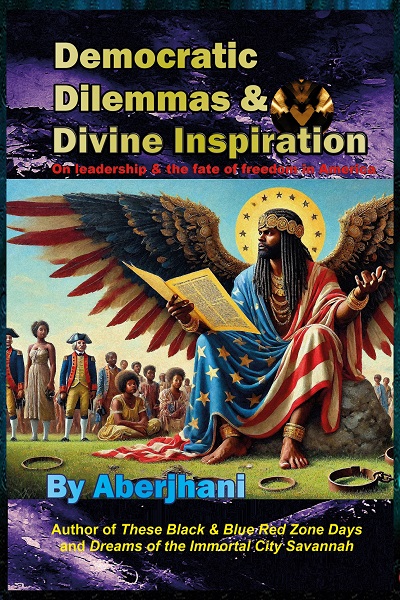
Democratic Dilemmas and Divine Inspiration (A Kindle Short) by Aberjhani

Democratic Dilemmas and Divine Inspiration examines the significance or relevance of the idea that the U.S. Constitution was, as many believe, divinely inspired. How much did that belief matter to founders of the nation and how much does it matter no  
Member BookAds

Democratic Dilemmas and Divine Inspiration (A Kindle Short) by Aberjhani

Democratic Dilemmas and Divine Inspiration examines the significance or relevance of the idea that the U.S. Constitution was, as many believe, divinely inspired. How much did that belief matter to founders of the nation and how much does it matter no  
Member BookAds

Democratic Dilemmas and Divine Inspiration (A Kindle Short) by Aberjhani

Democratic Dilemmas and Divine Inspiration examines the significance or relevance of the idea that the U.S. Constitution was, as many believe, divinely inspired. How much did that belief matter to founders of the nation and how much does it matter no  
Member BookAds