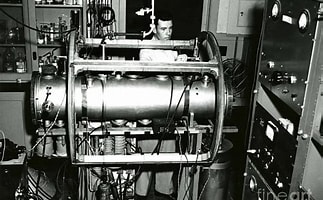
Metrology: The Science of Measurement
Before I expire I want to pass on some information to young men and women with a knack for science and mathematics but aren’t certain about how to apply them in a meaningful career. In addition to those skills, it is for those who enjoy working on their own while being part of a team of other very bright individuals, who also work much on their own. The field of endeavor is Metrology, the science of measurement. But hold on, there’s a lot more coming.
Metrologists measure length, mass, time, temperature, luminescence, amperage, and amount of substance—plus a few hundred compound measurements such as mass per cubic centimeter. This kind of work exceeds other measurements by the numbers that fall within plus or minus 34 decimal places to the left or right of zero. You read that right, so put away your yardstick and your bathroom scales. We’re talking about other measurements from dark energy, to dark matter, and plasma swirling around in centrifuges.
Your tasks: Make certain that when you sign the quality certification for any given test, measuring, or diagnostic instrument is as accurate and reliable as it can be. As an example of accuracy, the ion quantum clocks (the “atomic clocks”) maintained at Boulder, CO can measure time to the 19th decimal place, making them the most accurate clocks ever built. This level of precision means they would neither gain nor lose one second after billions of years. These clocks define the international second and synchronize everything from GPS satellites to financial networks. The ion clock’s 19‑decimal precision pushes the frontier of physics, enabling tests of relativity, dark matter searches, and future refinements of the second.
As an aside, I worked in 5 different US Air Force metrology labs in 5 different locations around the world, and was a member of the “flying clocks” team that laid much of the ground work for GPS satellites. That was back in the early years of the Stone Age when we were paid in rocks. Later, I became the Metrology Laboratory manager for Bell Aerospace. Today, metrologists earn $90,000 to $124,000 annually—work away from the madding crowds, but are respected as scientists even though most do not hold a PhD.
You will work in a special laboratory that is temperature, humidity, and dust controlled, with air locks and laminar air flows to stop air particles. It is also linked to the National Institute of Science and Technology (NIST). All of your measurements must be linked directly to national standards and under the supervision of that National Standards Laboratories located in Gaithersburg, MD and Boulder, CO
I have no idea how, when, or where AI models are now in use in standards laboratories, but you can be certain that they are under the supervision of highly qualified metrologists, not the other way around. You need not worry about visitors who come by for a visit—no matter their field of study. You will have unique credentials, knowledge, and experience not held by others. Nobody—but nobody—doubts that you are the one to go to for best answers to a measurement issue. And you will almost certainly wear a white smock and comfortable shoes.
For more information about schools that feature metrology, do an AI search. The rest is up to you.