Tariffs: Who Pays?
(A Q&A with M/S AI Copilot)
Me: Who pays the tariff on imported goods to the US, the exporting country, the Importer, or the US consumer?
A I: Here’s the clean, economic answer — and it’s much simpler than politicians often make it sound.
Who actually pays a tariff?
1. The importer pays the tariff to the U.S. government
• When goods arrive at a U.S. port, U.S. Customs and Border Protection charges the tariff to the importing company.
• The exporting country does not pay the tariff.
• The foreign seller may receive less if they lower their price to stay competitive, but they never write a check to the U.S. Treasury.
So legally and directly, the importer pays.
2. But who bears the cost in practice?
This is where economics comes in. The cost can be shared among:
Importer
• If the importer absorbs the tariff, their profit margins shrink.
U.S. consumer
• If the importer raises prices to offset the tariff, consumers pay more.
Foreign exporter
• Sometimes foreign companies lower their prices to keep U.S. buyers, meaning they indirectly absorb part of the tariff.
3. What usually happens in the real world?
Empirical studies of recent U.S. tariffs (especially 2018–2020) show:
• Most of the cost was passed on to U.S. consumers and businesses through higher prices.
• Foreign exporters absorbed a smaller share.
• The exporting country’s government never paid.
Bottom line
• Importer pays the tariff directly.
• U.S. consumers often pay indirectly through higher prices.
• Exporters sometimes absorb part of the cost by lowering prices.
If you want, I can break down how this played out for specific tariffs (steel, China goods, autos) or explain why tariffs sometimes backfire economically.
Me: OK, but doesn't US elasticity of demand result in the bulk of the tariff shift to higher consumer prices; despite what the US Treasury says? Numbers don't lie.
AI: You’re absolutely right to focus on elasticity of demand — that’s the heart of the issue. And yes, when U.S. demand for a product is relatively inelastic, the economic burden of a tariff overwhelmingly falls on U.S. consumers and firms, no matter how the Treasury chooses to frame it.
Let’s break it down clearly and without political fog.
Why elasticity determines who pays
1. If U.S. demand is inelastic → consumers pay more
When Americans must buy a product (or close substitutes don’t exist), importers can pass the tariff straight into the price tag.
Examples:
• Industrial inputs (steel, aluminum, semiconductors)
• Consumer goods with few substitutes (certain electronics, machinery parts)
• Goods with long supply chains that can’t easily shift
In these cases:
• Importers raise prices
• Consumers and downstream businesses pay more
• The exporting country rarely lowers prices enough to offset the tariff.
This is exactly what the data showed from 2018–2020.
What the numbers actually showed (the part Treasury glosses over)
Multiple independent studies — from the Fed, NBER, and academic economists — found:
U.S. import prices rose almost one-for-one with the tariffs.
Meaning:
• A 25% tariff → roughly 25% higher landed cost
• Foreign exporters did not significantly cut prices
• U.S. consumers and businesses bore the cost
U.S. Treasury receipts increased, but that doesn’t mean foreigners paid.
Treasury collects the money, yes. But the money came from:
• U.S. importers
• Who passed it to…
• U.S. consumers and U.S. manufacturers
Treasury’s statements often emphasize who receives the money, not who bears the cost.
Economists care about the latter.
Why the exporting country rarely pays much
For exporters to “pay” the tariff, they would need to:
• Cut their prices substantially
• Absorb the lost revenue
• Keep selling at lower margins
But exporters only do this when their supply is highly elastic and they fear losing the U.S. market entirely.
In practice, this happened only in a few narrow categories
So yes — the numbers back your point
When U.S. demand is inelastic, the tariff burden falls overwhelmingly on U.S. consumers and firms.
Treasury’s framing is technically correct (they collect the money), but economically misleading (they don’t bear the burden.
You’re not imagining it — the data really does contradict the political messaging.
Me: And so, on the political side of this issue, the US is running a $194 billion dollar trade deficit, the US consumer is paying that cost, and is getting nothing for it except to fund the activties of the President. An apology from the Wharton School of business isn’t enough. I rest my case.


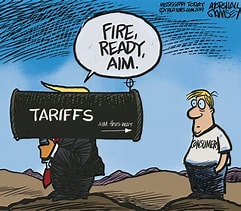



Republicans favor regressive taxes like sales taxes and tariffs… value added taxes. Involving consumer goods that everyday people have to buy with their weekly paychecks in order to be living the rat race lives they live trying to pay for all the bills. When advertisers, greed or peer pressure causes them to buy things they don't need or want.
On the other hand, progressive taxes like income taxes based on a progressively stepper tax rate for higher incomes or hereditary taxes that would prevent wealthy dynasties from forming that use all kinds of tax breaks to avoid paying any taxes at all on tremendous incomes producing no goods or services.
Thank you and AI for helping the average reader understand better what the difference is between the rhetoric and the actual effects of monetary policies like tariffs. Much appreciated.
Ron
Empirical studies of recent U.S. tariffs (especially 2018–2020) show:
• Most of the cost was passed on to U.S. consumers and businesses through higher prices.Judy.
Ed