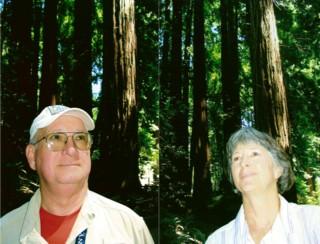
When I heard that there were 3,200-year-old trees in the U.S. I had to see them. I recently got my wish. Bud, my husband and I had an opportunity to see the giant redwood trees at Muir Woods. The 370 feet high redwood trees with a diameter of 22-feet are known as the tallest living things alive.
Ever since I can remember I have loved trees. Apart from their beauty they make me feel more rooted and solid. The older ones remind me not to take myself so seriously.
When I heard that there were 3,200-year-old trees in the U.S. I had to see them.
I recently got my wish. Bud, my husband and I had an opportunity to see the giant redwood trees at Muir Woods about 12 miles north of San Francisco’s Golden Gate Bridge.
The 1,000-year old redwood trees at Muir Woods National Monument are the remnants of the many redwood trees that covered Northern California’s valleys before the 1800s. The 370 feet high redwood trees with a diameter of 22-feet are known as the tallest living things alive. The Giant Sequoia, found elsewhere, with a diameter of 40-feet are shorter but larger.
William and Elizabeth Kent bought the land to protect the redwood trees in 1905. President Theodore Roosevelt proclaimed the redwoods a National Forest when the Kent’s donated the land to the Federal Government in 1908. At the Kent’s request Roosevelt named the park Muir Forest after John Muir, the scientist, author and conservationist.
There was a morning fog as we stood at the base of a redwood tree and gazed up and up and up. We never did see the top of the 252-foot high 14-foot wide redwood tree.
I imagined the past flowing through her long trunk. The tree rings of a similar sized cut redwood showed it was here in the days of the Vikings, Mayans and Anasazi people around 909 A.D.
The wind swirled around us as we stood next to some of the one–million visitors from around the world who come to gaze at the trees. We ambled down a one-mile paved loop trail and watched wide-eyed at the towering redwood trees of all ages. The trail followed and crossed Redwood Creek on the canyon floor.
A map showed that the 560-acre park has six longer trails that connect with Mt. Tamalpais State Park.
Redwood sorrel (it looks like clover), sword fern and mosses thrived under the redwood canopy. Bay laurels and big-leaf maples leaned into pockets of sunlight.
Redwood Creek starts on the slopes of Mt. Tamalpais and almost bisects the park.
The endangered steelhead and silver salmon move up the creek to spawn when the winter rains turn the shallow creek into a raging torrent each year.
The salmon life cycle is amazing. Born in the freshwater of Redwood Creek the tiny salmon populate the quiet pools during the summer. They bond not to a parent but to the water and stones of Red Creek. The juveniles migrate down river to enter the ocean at Muir Beach. No matter how far they rove at sea sometimes over 10,000 miles they climb back up Red Creek to return to their birthplace, not to mate, but to lay their eggs. The journey is fatal. But their bodies provide rich food for their offspring.
During the summer drought the fog condenses and drips off the redwood’s evergreen leaves and needles to moisten the forest floor. The around 40 inches of rain in winter replenishes the trees.
Examining the redwoods thick fibrous bark we felt a sense of peace. A nearby sign caught our eye. It was a quote by John Muir. "Through all the wonderful, eventful centuries since Christ’s time—and long before that—God has cared for these trees, saved them from drought, disease, avalanches, tempests and floods: but He cannot save them from fools—only Uncle Sam can do that." We smiled. Muir’s words spoken to Kent in 1909 continue to apply.
|



Muir Woods is a wonderful experience. I hike the trails in that area often. Glad you had a terrific time.
Cynthia
Elizabeth