AuthorsDen.com   Join | Login    
Where Authors and Readers come together!

SIGNED BOOKS    AUTHORS    BOOKS    SAMPLE CHAPTERS    AUDIOBOOKS    eBOOKS    STORIES    ARTICLES    POETRY    BLOGS    NEWS    VIDEOS    SUCCESS    TESTIMONIALS

Featured Authors:  Charles Keller, iLisa Loucks Christenson, iAntoinette Kopperfield, iDr. Patrick ODougherty, iDavid Clure, iSam Vaknin, iGlenda Bixler, iD. Enise, iDebra Kraft, iChristina Neely, i

  Home > History > Articles Popular: Books, Stories, Articles, Poetry      Authors: A B C D E F G H I J K L M N O P Q R S T U V W X Y Z     

JC Pinkerton

 Follow Me  

· Contact Me
· Books
· Articles
· News
· Stories
· Blog
· Messages
· 34 Titles
· 31 Reviews
· Save to My Library
· Share with Friends!
·
Member Since: Jul, 2004

JC Pinkerton, click here to update your pages on AuthorsDen.


Fashion In The 1800s
by JC Pinkerton   
Rated "G" by the Author.
     
Recent articles by
JC Pinkerton

• Cactus Joe: The Children's Cowboy
• Old Riders Of The Range
• Robert Adam: Creator of Adam Furniture
• Young Sam Houston
• The Riders of The Pony Express
           >> View all

What was fashion like in the 1800s?

The Early 1800s:
When Napoleon proclaimed himself emperor in 1804, he decided to restore the grandeur of Versailles. He called Leroy, a popular tailor of the rich and famous, to his court to consult on matters of fashion. It wasn’t long before Leroy was known as an authority on design.


Once again women’s clothes were decorated with trimmings and laces, and men turned to embroidery military uniforms and short, knee-length culottes. Napoleon wanted his court to look superb, and at the same time establish a successful textile industry. His court donned clothing such as cashmere, satin and velvet created in Italian and French factories.


Women’s Garments:
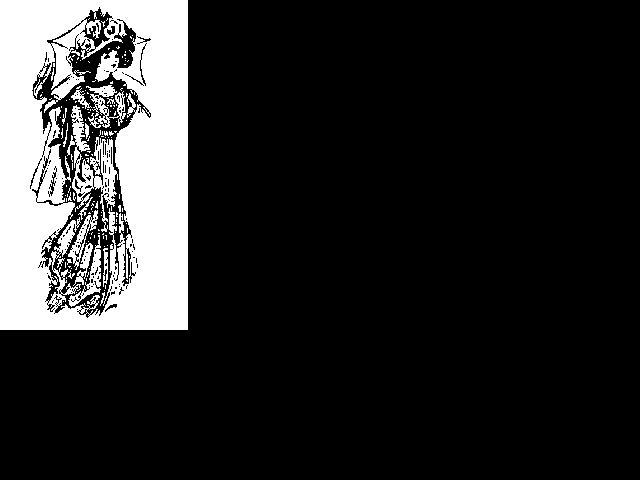
Women’s dresses were designed with a high waist under the bosom, and low round or square necklines, and sleeves came in different shapes. Some were short and worn with long gloves past the elbows, and some were long with padded puffs. Hems were decorated with light ruffs, and colorful embroidery.


The seam between the bodice and skirt was covered by trimmings, or embroidered belts held with pins. It was fashionable to cover women’s shoulders with a cashmere shawl to keep warm, and give an added touch of decoration to the dress. Women wore leather or cloth slippers for shoes and leather boots.


Men’s Garments:
Men’s clothing continued to be fashioned after the English style consisting of trousers and a short jacket. Pins and other decorations were worn on the collars and ties. Men wore leather shoes and boots. Nobels wore leather shoes with buckles, and some peasants wore wooden clogs.


Post Napoleon:


Women’s Garments:
After Napoleon, women’s waistline returned to the middle of the dress, and corsets became popular once again. Sleeves widened along with the skirts and were decorated with embroidery, or sewn-on ointments. Material used for making dresses became brighter with printed fabrics, and shawls were still used for the added touch of fashion.


The crinoline skirt became popular, and required padded material for the stiff underskirt. The crinoline was costly due to the enormous amount of silk, satin or taffeta required to make it. During the summer crinolines were made with a cooler material such as crepe, muslin or tulle.


Women’s Hairstyle:
Many women wore their hair braided, and gathered in a bun. For eveningwear they were decorated with ribbons, flowers and lace. 


Men’s Garments:
Men were as interested in having a slender waistline as women, and tied wide sashes around their waist to make it appear smaller. Three-quarter coats and cloaks became popular along with shirts having high collars. By the 1850s, tails were popular for eveningwear, and the cane gave the added touch for men’s fashion.


Popular Clothing Shops:
Clothing shops appeared with ready-made dresses of a variety of material and prices. Shops such as Quenin in Paris, and Korn and Hostrupp in Hamburg were quite popular among the wealthy. Soon an American, Issac Singer, produced a sewing machine, and opened a whole new world for women.


Ladies learned how to operate the sewing machine, and created decorative clothing that was once only available to the privileged. Women now had the advantage of designing their own clothing and producing it at a much faster speed. Today’s clothing is not only more comfortable, but requires less material to make, and the crinoline skirt (slip) was still popular in the 1950s.


Bib:

Lexicon Universal Ency.New York

The Reader’s Companion to American History,Boston, MA.


© jpinkerton


Want to review or comment on this article?


Need a FREE Reader Membership?
Reviewed by m j hollingshead
Reviewed on May 5, 2006
clothing today is far more comfortable, fabric now requires so much less work and effort to maintain. I remember well the days of ironing all Saturday so that my school clothes would be in shape for the coming week. Hurrah for wash and wear and simple styles

Reviewed by Jennifer Butler (Reader)
Reviewed on April 21, 2006
Well, I cannot agree with your last comment about today's clothing. It is actually degrading to women, causes rape and molestation, keeps the glass ceiling in place for all those complaining "women's libers" and the dresses are only worth wearing when they are wide skirts that fall well below the knee. I prefer my skirts to end several inches above the ankle so that stairs can be climbed while carrying loads of toys and snacks, and I can sit comfortably on the sofa without flashing everyone in the room! I think women dressed so beautifully back in former centuries, and now they are looking and behaving like whores all over the place. It's shamefully stupid, and it all happened after the Civil War when you know which transformations took place in society.

Popular History Articles
  1.  Recalling the Unforgettable 25 Years L
  2.  A history of Soviet Project 651 (Julie
  3.  Dogs in Space: The Soviet Canine Space
  4.  A Brief History of the Leather Jacket
  5.  ICAN Invitation
  6.  Disposing of Luxuries
  7.  The Gold and Azure Frontier
  8.  Forward Facing the New South, a New De
  9.  Queen Liliuokalani's Fateful Constitu
  10.  JFK and America in England
  11.  How to Ruin a Poem in One Easy Step
  12.  America 250: Benjamin Franklin
  13.  The Deep History of Pockets
  14.  Shakespeare's Secret Messiah--Book Rev
  15.  What Makes History Come Alive
  16.  Delaware’s Anabaptists Balance Traditi
  17.  American lawyers have lost their audie
  18.  Red Ruffing’s Dover Chapter: From Mino
  19.  And The Pope Visited Us
  20.  Osterville Historical Museum’s town sp
  21.  The American Liberty League’s Stand Ag
  22.  From Wobbly Watts to Broadcast Brillia
  23.  Last History Lesson
  24.  How Haiti Won Its Place in Black Histo
  25.  Book Review: Every Stone is a Story by

Free Book Review Program
Select a book to read and review today!

False Flag: General Joe Hooker Lives, Judge Janet Posten on the Bench by Dr. Patrick ODougherty

Neil Armstrong played the Dissolution of America Card After His Return From Space-- the Military Dishonor Card. He had a very messy DIVORCE after a military Platoon Experience for his wife and family.  
Member BookAds

False Flag: General Joe Hooker Lives, Judge Janet Posten on the Bench by Dr. Patrick ODougherty

Neil Armstrong played the Dissolution of America Card After His Return From Space-- the Military Dishonor Card. He had a very messy DIVORCE after a military Platoon Experience for his wife and family.  
Member BookAds

Free Download - The Belgian Curtain - Europe after Communism by Sam Vaknin

The European Union, NATO, the euro, and central and eastern Europe after the fall of communism.  
Member BookAds