Well, I had a milestone of sorts last week, I turned 50 years
of age. Odd, I don’t remember it like it was 50 years, and I
don’t feel (mentally at least) like it’s been that long. Of course
since life expectancies keep increasing and mine is a long lived
family I may not even be middle aged yet…
As a teenager just getting into the work world I dreamed of
being an oceanographer, then that morphed into a physicist or
nuclear scientist. I worked in the Navy (1973-1979) as a
machinist mate which actually means I repaired machines (vice
a machinery repairmen who did machining work) and, since I
was on a nuclear submarine, did laboratory and health physics
work. Health physics means taking radiation surveys, cleaning
up spills of radioactive water and materials and things dealing
with keeping the rest of the crew (and outside world) from
getting contaminated by the reactor. As a chemist I was
responsible for maintaining the chemical balance in the non-
radioactive steam plant and in the radioactive reactor coolant
to help reduce corrosion and monitored the coolant loop for
levels of radioactive material.
So, I was a nuclear chemist and health physicist for a while,
then got out of the Navy and concentrated on being a Nuclear
Chemist (1980-1990). Essentially I followed recipes to test
water samples. The most fun part of the job was gamma
spectroscopy. Essentially a gamma spectrometer was a chunk
of ultra pure germanium super cooled by liquid nitrogen with a
2000 DC volt charge across it. When gamma rays interacted
with it they would be absorbed (a certain fraction of the time)
and during this process electron-hole pairs would be formed,
the charge differential would sweep the electrons to the
charge collection system which would amplify the signal.
Some other electronics would then convert this analog data
into a digital signal and result would be a number that through
various mathematical convolutions you could use to determine
the energy level of the original gamma ray.
Of course any one sample from a nuclear reactor coolant loop
could have dozens of radioactive elements in it, each giving off
one or more gamma rays, plus the normal background
radiation (which we mitigated with lead shields). So a given
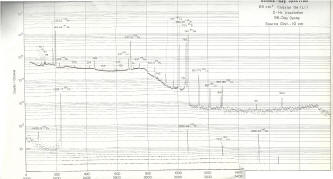
gamma ray spectrum from a sample could hold dozens of
gamma ray energy lines. I have included an example below.
These lines could lay virtually on top of each other. In the
beginning of the nuclear age a sodium iodine detector
(essentially a chunk of salt) was used and it would produce
scintillations whose brightness would correspond to the
energy of the incident gamma ray, however the peaks
produced would be wide (20-30 Kev FWHM) and difficult
to analyze. The peaks would be hand plotted then the areas
under them computed on a slide-rule and it would take days
to analyze a single sample. With the germanium detectors the
peaks would be nice and crisp (1-2 Kev FWHM) so it would
be easier to see the peaks. However, we used computers to
do the analysis of the germanium spectrums and what had
taken days now took 11 seconds.
Gamma Spectrum from Fission Products (From: Gamma-Ray
Spectrum Catalog, Aerojet Nuclear, R. L. Heath 1974)
The first article I got an award for was “Gamma Emitting
Isotopes of Medical Origin in Sanitary Waste Samples”, a
real page turner. Anyway when I started in the civilian nuclear
field I did about 90 percent chemistry and 10 percent
computers, by the end of the 10 years I worked in the civilian
field I was doing 90 percent computers and 10 percent
chemistry. I was working at Tennessee Valley Authority when
Marvin Runyon ( unaffectionately called Marvin Runyaoff )
was brought in to clean up TVA. His clean up, due to union
rules and contracts, consisted of firing (laid-off) all of the
junior people (read, the ones with the new ideas, new
concepts and new ways of doing things) and keeping the old
timers ( status quo, keep things the way they are, let’s not
types) since I only had 3 years of staff time, I was let go.
I determined that Nuclear power had limited upward mobility
so taking a deep breath I leaped into the computer world. I
had been working with the Informix and Ingres databases and
had been the database administrator and developer for the
VAX-VMS based systems in the Sequoyah Nuclear Training
center, I saw an advertisement for an Oracle DBA job
working with Aerojet on a NASA project so I sent in my
resume. I was called in for an interview so I quickly picked up
the book (at that time there was only one) on Oracle and read
it on the flight to the interview. I believe I got the job because
I was the only one who showed up for the interview. The job
was in Iuka, Mississippi at the old Yellow Creek nuclear site,
sold by TVA to the government to be the site for the factory
building the replacement boosters for the space shuttle. I
guess you could say that ultimately I owe my career in Oracle
to the Challenger shuttle disaster since the Iuka plant was a
direct result of that incident. I finally finished my degree in ’92
in computer science with Kennedy-Western University. I had
over 140 credits from various classes and courses I had taken
or CLEP’ed while I was in the Navy, but no clear
concentration to give me a degree. I took that and a bit of life
credit and some additional course work and parlayed that into
a computer science degree.
Since then I have worked exclusively with the Oracle
database system on VAX-VMS, HPUX, Sun Solaris, AIX,
Linux, Windows (various) with Oracle versions 6.0.22 to
10.2.0.2. I have been to 14 countries, 20 States, two sets of
Islands given dozens of lectures and presentations, taught thousands of folks how to use, tune and maintain Oracle, and wrote 2 dozen books. I’ve even had a couple of fiction short stories published.
During this 50 years I also met and wed my wife of 32
(almost 33) years, Susan, had two wonderful daughters
(Marie and Michelle) and come this October will be a
Grandfather.
It has been quite a ride, this first half (third?) of my life. I have
ridden and repaired (and steered) nuclear submarines, stood
next to a nuclear reactor, flown in jet aircraft, sailed on
surface ships and cruise liners, parasailed, driven bicycles,
cars, motorcycles, trucks, boats learned to fish, hunt, scuba
dive, dance, sing, play the guitar, play the dulcimer, work with
wood, work with chemistry, and work with computers. I’ve
watched my daughters be born, grow up, get married and
now get to watch as they bring new life into the world. I’ve
dealt with the death of loved ones, the horrors of the world,
the joys of life. I’ve read well over 3000 books, attended 14
different schools from kindergarten to my college degree. I’ve
learned a bit of tolerance, how to love and thankfully not too
much how to hate, learned to love God and praise powers
higher than myself.
I’m looking forward to what the next 50-100 years brings.