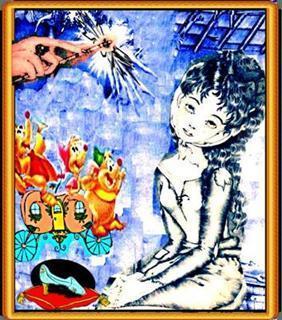
"What is it with Cinderella?
I posed this question to my philosopher/friend...and begin to see my life in a whole new light.
“What is it with Cinderella?”
I posed this question to my philosopher/friend, Richard, having watched a recent Made-for-TV remake with real people the previous night. I must confess my cyberspace pen pal sometimes seems like not only my friend, but also my psychiatrist! Anyway, I asked him why do I love this children’s tale so much, the absolute most, yet find it the most emotionally disturbing of all to watch?
His response: “If I were acting like a good therapist, I would help you discover the answer for yourself. I would ask questions like: What do you remember about how the story goes? What was happening in your life at those times when the story was important to you?
Well, I can tell you, since childhood, an impressionable four-year-old, I was hooked on this particular fairy tale.
I can't remember if I saw it first, or Bambi, at the movies in London, England, in the days before television.
Of course, I adored Bambi and was traumatized by the death of Bambi’s mother, but I was mesmerized and completely identified with Walt Disney’s Cinderella.
Incidentally, we, my little family, were poor post-war refugees... and more than once lived in somebody's basement.
A Cinderella comic book was among my prize possessions a year later when I arrived in Canada.
Even today, as a ‘mature’ adult, I can sit and enjoy the Disney movie/cartoon, thanks to the endearing comic relief, but that adaptation from 2001 was hard to take. I made myself watch it because it was beautifully done - a combination magical/mythical/modern concoction. But I found it stressful and disturbing -- Kathleen Turner made a pretty convincing Wicked Stepmother -- it made me squirm, psychologically, --- except for the good parts.
So, "Whatsa matta, Me"? I repeated my request for a ‘diagnosis’ from my friendly ‘therapist’. “I’ll tell you more, Richard, but first, what’s the generally accepted message of the fairy tale, the folklore, the mythology, the archetypes, from a psychological perspective?”
“I have some ideas, which may or may not apply to you” he said. “I can think of two or three themes, which are combined in Cinderella to get you started on your self-analysis:”
NOT MY REAL PARENTS!
Cinderella had cruel stepmother and siblings but her (symbolic) real mother was a fairy godmother, which makes Cinderella very special and equal to noble birth.
Very bright children often have a fantasy that there was a mix-up at birth, or that these less than ideal parents are not my real parents. Some day my real parents, who are royalty, or very special will come and get me.
There are many variations on the future ruler who as a child, is hidden from those sent to kill him, or floats away on the water like Moses or the King of Egypt as a child. These "hidden royalty" children are very special, royal or chosen, who are raised by common folk or servants.
In another variation, their parents are royalty, killed by an evil person, but servants hide them from danger until they grow up and avenge the murder of their parents. This is the theme of the movie "Dune", where the child grows up to overthrow the evil emperor and take over the universe or something like that.
Star Wars has a similar theme.
Hercules has a mortal mother and doesn't find out he is the son of Zeus until later.
Then there is the story of the ugly duckling which is out of place with the other ducks in his or her foster family, but then the truth is discovered that he or she is not a duck but a royal swan.
Tarzan was from the English nobility but raised by animals after a plain crash.
Superman was sent as a child from another planet but raised by common earth people, Mr. and Mrs. Kent.
In "The Importance of Being Ernest", Oscar Wilde deals with this subject humorously. As a child the male protagonist was left in a suitcase on someone's door step, so he is of low birth and can't marry the aristocratic girl until someone looks at the suitcase and discovers that he is of Noble birth, and belongs to the aristocracy.
There is a standard theme in older romance novels or fairy tales where a royal person wants to marry a commoner, but cant' due to the low birth of the other. Then it is found that the other is really of noble birth, and they live happily ever after.
MY PRINCE WILL COME!
RESCUE ME!
The second theme is the Damsel in Distress who is rescued by a handsome prince. Or the child who is rescued by some magical figure. Cinderella has both kinds of rescue as well as the implicit idea of noble birth since "this is not my real family".
I had a feeling Richard would have something helpful and enlightening to say...
I think he hit on something!
I remembered a cute story, "The Mistaken Zygote", which I’d read and enjoyed and related to:
The stork hits turbulence and delivers the basket to the wrong house.
I used to tease my parents "There must be some mistake!"
My mother 'hates' the outdoors - She'd be happy living in a plastic bubble -- It's always too warm, too cold, too windy, too sunny, etc.
She calls my wonderful wildlife corridor 'that jungle mess'.
She hates My Dream House!
She's into her ethnicity. I see myself as a Citizen of the World!
I adore beautiful things -- She says, "We're not Martha Stewart".
No point even talking about the ways I'm different from my dad!
I met my Prince once, at the very least, but I lost him when I couldn't bring him home.
Don't get me wrong - for all that, I love my parents, such as they are.
According to Richard the next step was for me to tell the Cinderella story, without looking it up, just tell the story in my own words, choosing vocabulary and keywords, as best I remembered. Is it a comedy, tragedy, melodrama or tragicomedy? His idea was to give me the tools and get out of the way. So here’s what I did with them:
Cinderella, poor dear, is basically alone in big castle where she's relegated to the basement and attic with her only friends, the mice.
Her Wicked Stepmother and ugly spiteful Stepsisters live there too, but she is their servant, their slave, their scullery maid.
They treat her like dirt.
They laugh at her and make fun of her and are mean to her.
They've taken over her bedroom and favorite four-poster bed, her closets, her clothes, and help themselves to all her stuff.
They give her a long list of chores that it’s a miracle she can finish in a day.
Her mouse friends always find ways to help her out.
Don't know where her dad is in all this.
One day she overhears them making plans for the ball and she even helps them get ready.
She can’t go: she has nothing to wear.
After they leave she wanders in the garden, feeling sorry for herself - when her plump kindly fairy godmother suddenly materializes, waves her magic wand and poof - Cinderella has a beautiful dress, a new hairdo, and magical glass shoes.
A nearby pumpkin from the garden turns into a coach, and other creatures, I forget which, are turned into coach horses. Her mouse friends are turned into coachmen.
She goes to the ball.
Everyone gasps. Who is she?
The Prince sees her and is smitten.
They swirl and twirl outside in the palace garden under the stars.
He's about to kiss her, when the clock tolls.
She pulls out of his embrace, without a word of explanation of who she is or where she lives or how she feels -- dashes off and loses one of her magic slippers.
She's back in her sackcloth and ashes attire and the coach is a pumpkin and the horses are one old nag, I think.
She gets home the hard way.
He looks everywhere in the kingdom for her.
He comes to her house but the mean stepmother and sisters lock her up.
The mice come to the rescue - they find the key and unlock the door in a nick of time.
The Prince sees her, not realizing the scruffy waif is really her, but the slipper fits!
Everyone gasps, her lovely family is livid, and the Prince suddenly recognizes her.
They live happily ever after.
The End. :)
"Someday My Prince Will Come." Isn't that a song?
I want you to know I wrote this 'off the top of my head' without an edit.
My Cinderella Story is making me laugh, the way I wrote it. It does sound like a tragicomedy, doesn't it? LOL
And yet, it's also true that various aspects of the aforementioned vignettes have actually played out for me in reality!
Yes, Richard, my friend, the more I look at my life, the absurdity of many of the situations I've found myself in, including the present one -- some of my best friends are people I haven't met -- my elusive love affairs -- my communication problems -- the funnier it gets!
Very therapeutic to see my life this way. Makes up for a lot of tears and angst and regrets.
Reference:
Mistaken Zygote Syndrome
By Clarissa Pinkola Estes, Ph.D.
Excerpt from Women Who Run With the Wolves: Myths and Stories of the Wild Woman Archetype
|



I was thinking also about the story coming from basic psychological factors within the 'female' psyche - to do with dependency and interdependency with others within the family dynamic and how that relates to and becomes a metaphor for the experience of growing up to become an adult, which the story originally came out of.
As a child growing up there is always the dichotomy between the 2 different sides of the personality - on one hand being adored as a little princess being waited on hand and foot - and on the other - having to help the family and chip in doing the chores - with the fears of exploitation and unhappiness that this involves, yet the internal struggle of wanting to be a 'good' girl at the same time.
Both of these are desires which carry through also to adulthood, and can be seen within the psyche to give one a feeling of 'success' or 'failure' in one's life, as to how one relates to other people, and as eastern philosophy would describe, these can be seen as the ego measures how people treat us in our day to day lives, as we measure whether we are treated fairly, or whether we are exploited or rewarded in our interactions with others around us.
Are other people caring for, and appreciating our talents, or are we being exploited and abused, meaning that we need rescuing by someone who will recognise our beauty both outer first, and then within?
On one hand as women, we want to be worshipped, and for everything to be taken care of by 'others' mice/men/servants - yet on the other we also have to take responsibility for our own actions and those of others, and often women make enormous sacrifices out of love and a sense of duty, and doing the right thing.
It also reminds me of the 'dichotomy within christian (and other) traditions' of being a 'good girl' by being 'helpful' and 'working for the common good' - yet again with the fear of exploitation by the evil 'step-family' it manifests the negative side of the 'family' dynamic whether it is from the real family or even from 'society' as a whole, or the 'family networks and friends' and 'group dynamics' when we are at work - these all represent elements of exploitation of 'goodness' or 'self-scrifice' from within the individual for the 'social' good - but that 'goodness' can be exploited if others do not contribute equally themselves.
The rescue by the 'prince' is therefore seen as the reward for being a 'good girl' and not complaining, and therefore becoming 'wicked' oneself. It is a similar notion to that of 'Snow White'. In Snow White the female character is the innocent victim of the '(step) mother' vying for 'male' attention as the 'daughter/child' becomes sexually available. The power struggle between an emerging young adolescent female with her mother can go both ways. The young innocence of youth is the one glorified here, but 'self-sacrifice and victimhood' could also be a dangerous cocktail divorced from reality, whereby the 'victim' percieves herself as victim, not realising the 'damage' she is causing by 'demonising' the 'mother' in the process.
Another myth occured to me which also has parallels but from the male perspective. In Islam there is the idealisation of 'heaven being filled with caring kind beautiful women' to reward 'men' after their 'self-sacrifice' that is given for the sake of 'giving your life to God'. Even though Mohamed preached that the concept of paradise was unknown and that it was basicaly whatever you wanted it to be, as a reward for your troubles in the 'earthly' life - this seemed to be the standard 'fantasy' that has gripped the 'male' muslim world from those early times.
I know that the Cinderella myth creates problems, or provides 'context' for my own personal myths. I was brought up on one hand to 'provide and help for the family' whereas on the other - I was also brought up to expect to have a man to look after me.
I did meet my prince from another land.
and thinking about it, I did also leave my shoes last time I was there. I don't know if he found them though as yet!
Another element of my fantasy also involved a female version of the islamic fantasy which was to have lots of young men after me. But I currently just wish that is was the 'one' prince instead. So I am currently waiting for him to find my shoes.
:-)
Heather
I also liked the parallel you drew with Hercules and Superman, and other tales of royal children.
In the case of Superman, he was placed, although found, but I think carefully placed to be found by parents who would give him a loving home. What's more, Superman's adoptive parents, raised him with the understanding that he was different, and not theirs, and that they would someday have to let him go. It is a story of unconditional love. While Cinderella, thought on the surface is the story of faith and triumph over evil, is really a story about child abuse and neglect. But I remember as a child, glamorizing her unhappy circumstances; rather dangerous concept for a child to have. The message I heard the loudest is that those who endure suffering will be rewarded.
This is a very interesting subject, indeed, and one that could generate greater discussion than this review section allows. Very well done. You write with strength and intelligence and purpose -- I like that about you.
Carmen :-)
And as the other David said, I look forward to seeing how all this plays out.
This was quite the fabulous article~
I found myself stopping and rereading parts thinking I relate to this..
I have no doubt whatsoever that you are a damsel - a maiden of noble birth, and of great interest to single princes of all ages. The trobadors with bands prefered to entertain married dames they could not have.
I would not pretend to fathom the peculiar nature of a damsel's distress - whatever their status, women are a mystery to me. And I have little faith in shamans or priests - many are attracted to the priesthood because of their 'sin' and various mental disturbances. I especially distrust those who wear the modern psycho-therapeutic habit - the honest ones, the successful ones, will indeed advise the mentally dis-eased, mal-eased (malaise), and un-eased to work things out for themselves.
The mice always come to the rescue, as was well known to the Mouse Cult. Human beings as you know are cousins to the Mouse (see The Animal Kingdom, Our Family Tree), who had to develop keen eyesight and intelligent nocturnal strategies to survive underfoot of dinosaurs. The mice eat through the chains binding the Sleeping Dragon who then rises as the Sun - but 'he' was a 'she' before the Patriarchal Poets performed the sex-change operation - he ran wild while she was kept in the cave by the narcotic stream at Delphi for awhile - I think she is presently buried in the Middle East somewhere pending the Apocalypse.
I look forward to seeing how all this plays out: I think you have the makings of a good play.
By the way, I appreciate your reference to Star Wars. It often amazes me how regressive and limited our post-modern imagination can be - to medieval lore and costumes.
Thank you for he insights!
Ø¿Ø