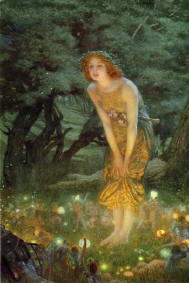
Midsummer’s Eve is in Ireland is also known as St. John’s Eve or Bonfire Night. June 24th is officially St. John’s Day or Midsummer’s Day. It is the celebration of summer solstice and the longest day in the year.
Edward Robert Hughes
Midsummer is a time for lovers. They would clasp hands as they jumped over the fires. It was also a time when magic was most potent, a time when the Otherworld is close and it’s possible to see the future.
On Midsummer Eve, if one leaped over the fire it would ensure fertility and would bring good luck. Those who wanted to find their true love would perform one or more love divinations. It was believed that if a maiden fasted on Midsummer’s Eve, then set a table with a white cloth, bread, cheese and ale, the man she would marry or his spirit would come over the threshold to eat with her.
Farmers would drive their cattle through the flames and burn coals across the cattle pens. In the Scottish Highlands, the herders would make a ceremonial walk around their sheep with torches lit from the Midsummer fire.
Midsummer’s Eve is the best time to gather herbs for their magical properties would be most potent. St. John’s wort is used for medicinal purposes. Yarrow is gathered also. It is used for a marriage divination by young girls. It was believed if the young woman placed a bit of the herb under her pillow, she would dream of her future husband. Hawkweed magical properties are to improve sight. It is also used for indigestion and burns. Vervain is to ward off enchantments; Mullein to ward of evil spirits; wormwood should be placed under the bed to dream of an intended love. Mistletoe is used for protection against lightning, disease and misfortune of every kind.
At one time, two fires on Midsummer’s Eve were lit in every county of Ireland. There was a large communal fire where the townspeople would gather for prayer and merriment: dancing music and jumping over the fire. The family fires were for ceremonies to invoke protection for the fields, flock and the house.
In ancient times, it is noted that bones were burned with some sort of ceremonial intent. So not to incur disrespect for the symbols of piety, they would discard rosaries, statues, scapulars into the bonfire.
After the fires would die down, the people would carry the ashes to the fields and sprinkle them in the four corners of the field. It was to bless the crops. They would place a few embers on the hearth as well for luck. Sometimes people would carry torches around the fields or inside the barns to keep milk and butter safe from evil magic.
This season is still memorable in Ireland by lighting fires on every hill. When Baal fires were kindled, it was part of the sun worship. Now it is in honor of St. John. They still dance around it and every young man takes a lighted brand from the pile to bring home with him for good luck.
When the fire burns down the young men strip to the waist and leap over the flames. This is done backwards and forwards several times. The one who braves the largest blaze is considered the winner over the powers of evil. When the fires are almost out, the young girls leap over the flames and those who clear it three times back and forward will be guaranteed a speedy marriage and good luck in life and many children. The married women walk through the lines of the burning embers. The yearling cattle is driven through the trampled down embers and their back singed with the lighted hazel twig. The hazel rods, being considered to have immense powers, are used to drive the cattle.
|


enjoyed.....Art Sun...