A learner's guide on the concept of INFORMATION and DATABASE.
----------------------------------------------------------------------------------------------
The world is full of illusions, we are are in perpetual quest for reality and we act in accordance with what our mind perceives as real. We use a mirror to determine the reality of our looks, a clock to gage the reality of time, a scale to discern the reality of our weight. We comb our hair when the mirror reflects that it is disheveled, hurry when our wristwatch indicates we are late for an appointment, diet when the scale shows we are precariously gaining weight.
Unfortunately, we are not perfectly imbued to sift the real from the unreal because of the limitations of our mind and sensory facilities. Our distant ancestors made terribly wrong perceptions in believing that the earth is flat and that the sun revolves around the earth. We are thus continuously learning and developing ways to enhance our capability to discern the real world.
The field of Information Technology (IT) evolved primarily to augment human capability to come up with reliable and timely mental perceptions. It is an agglomeration of various fields anchored mainly on computer and communications technologies. The core elements of IT are the underlying concepts of information and data.
Information is a representation of reality in the human mind. The mind builds a portrait from the data acquired through the sensory facilities. The portrait accurately or inaccurately depicts the real world depending on the data used to construct it, a process aptly characterized as “garbage in, garbage out’.
Data is an elementary descriptor needed to build information. A single item of data by itself may or may not be translatable into information. For instance, a data item represented by the number ‘5’ is hardly sufficient to mentally portray a reality. On the other hand, this item when merged with another say, ‘years’, forming the combination ‘5 years’ results into information about a time period.
Data can be represented in various ways, by characters, numbers, symbols, images, sounds, etc. Commonly used data are expressed in terms of characters and numbers.
The human mind stores data acquired by the senses and processes them into information. However, in certain cases, the mind is limited in terms of the variety and magnitude of data that it can store and process accurately in a timely manner. An example of the kind of information that the human mind cannot cope to derive alone is the Gross Domestic Product (GDP) of a country. A reliable GDP figure needs a huge and complex mix of data.
Obtaining information which cannot be generated by the mind alone has become part of our basic needs to live a normal life. We live in an Information Era and we depend on information support systems in our quest for knowledge about the real world.
An Information System (IS), a facet of Information Technology, is a facility for collecting and storing data and processing them into information. Like any ‘system’, it has various components working in concert to serve its purpose. It is like a ‘factory’ that produces information with data as its ‘raw material’.
The core of an information system is a database, an organized collection data made easily retrievable through the other system components. Data elements are brought in from various sources and assembled and merged into a database. The information that the system generates comes from data extracted from the database.
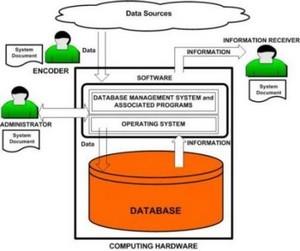
Running a database needs four core resources. These are:
- Physical Resources: The computer hardware that hosts the database and the communications hardware that provides the pathway to deliver data into the database and the information extracted out from it.
- Logical Resources: These are the principal software tools use to manage the database, mainly the Database Management System and the Operating System.
- Data Resources: The collection of data kept in the database.
- Human Resources: The personnel involved in running and administering the database.
In old configurations of the 1960s and 1970s, a database resides in a data storage device of a single host computer. Data is delivered to it from various local terminal stations or peripheral devices and information is extracted from it through the same stations or devices. The software tools used to manage the database reside in the same host computer.
In today’s configurations, a database and its software tools may reside in one or more computer hosts and data is delivered to it and information is extracted from it through local or remote stations.
The embedded diagram depicts a database within an information system infrastructure.
|


Regis