|
Whether you sobered up recently or 15 years ago, you may be wondering what to tell your kids about your past addiction and how to talk to them about their own vulnerability to using drugs and alcohol in an addictive manner.
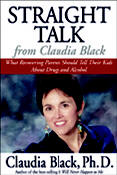
Straight Talk
The following is an excerpt from chapter one:
On December 31, 1986, the day after I got sober, the last thing I wanted to face was what I had done to my kids. Prior to sobriety, as a father, what I had going for me was the law, the Ten Commandments, and the tradition that adult men protect their kids. So when I became sober, the first thing I wanted to do was quickly reassert their respect for me based upon everything I had going for me. This might have worked when they were small and I had drank only a short period but by the time I got sober nobody could say that I deserved all the respect that the law and the Ten Commandments provided for.
I realized I was going to have to get to know the kids and vice versa. For me it meant being friends first. The kids really wanted me to be a parent, and I wanted to regain their respect. Today I have been in recovery for several years and have regained that respect, but not by asserting what I had in the first place but by “letting go” of the outcome of my relationships after I had done all I could to change, trusting that God would then do his thing. – Wally
It has always been my belief that parents truly love their children and genuinely want what is best for them, yet that message often becomes convoluted, inconsistent and sometimes nearly non-existent when addiction begins to pervade the family system. As much as parents want to correct this, the focus of early recovery is often on recovery practices, the marriage or partnership, and job or career. This is coupled with parents frequently just not knowing what to say to their children, or how best to interact with them. This confusion can be as true for the adult child as for the adolescent age or younger child. In many cases it is easy to ignore the issue of what to say or how to interact with your children if someone else, such as an ex-spouse or grandparents, predominantly raises them, or they are adults living on their own. Children can also impede the process by either pretending all is just fine between you and them because you are now clean and sober. And, in fact, for many it is better already. Or they distance themselves from you with aloofness or anger.
The inability to be intimate, to share yourself with your children, to be there for them, is one of the most tragic losses in life. Having worked with thousands of addicted parents, I’ve seen their eyes shimmer with tears and glow with love when they talk about their children. As I wrote this book I interviewed a host of parents and I was inspired by the depth of love and vulnerability shared as they talked about how their addiction impacted their children, and the hope that their recovery would provide them the positive influence and connection that they would like to have with their children.
What Do You Say To Your Children
In recovery there is a lot of wreckage of the past that needs to be addressed and there is a lot of moving forward that will happen as well. What your children want most is to know you love them. They want you to be there for them and with them. That can be hard to recognize if your children are angry or distant. It can be hard to do given the priority needed to learning how to live clean and sober. Creating new relationships or mending old relationships doesn’t happen overnight. The most important thing you can do for your children is to stay clean and sober. Yet while you are doing that there are so many little steps you can take with your children to begin to be the parent they need and the parent you want to be. It is my hope this book will help you in this journey. Thomas, a recovering parent, shared this story with me.
My daughter was grown by the time I got sober. More than anything I loved her and wanted her to know that. I wanted her to know that the parent she saw all of her growing up years wasn’t the real me—that there was this whole other me, this place of love that I had for her that I had lost control of due to my drinking and drugging lifestyle. The hardest part was being honest. Then I had to be willing to listen and not argue with her about how she saw me. I know what she saw. She saw the addict. She couldn’t see my place of love; it was too well hidden. So I listened and I didn’t need to argue, I was now in my place of love. But I really wanted her to know that the things I had said or done was not the real me. Yet it could sound like a cop out. I wasn’t trying to cop out. She had her experiences because of how I acted in my disease.
I talked; she listened. She talked; I listened. Together we have healed.
Addiction is a devastating disease. It ravages one’s physical, mental, emotional and spiritual being. The greatest pain is that it impacts those we love the most–our children. In recovery we learn that addiction is a disease, that it is not a matter of will power or self-control. We surrender to our powerlessness over alcohol and other mind-altering chemicals. We put one step in front of the other, often following the direction of other recovering alcoholics and addicts before us. We rejoice and celebrate recovery. For the first time in a long time, we begin to like ourselves. We begin to let go of our insecurities, our fears, and our angers. We begin to look beyond ourselves, and when we do, many of us are confronted with the reality that this disease is not just ours alone. Addiction belongs to the family. Confronted with that stark realization, how do we empower ourselves to make a difference in our children’s lives so that they do not repeat our history?
Most children raised with addiction vow to themselves and often to others, “It will never happen to me. I will not drink like my father, or use drugs like my mother.” They believe they have the will power, the self-control, to do it differently than their parents. After all, they have seen the horrors of addiction, and shouldn’t that be enough to ensure that they don’t become like their parents? If I were to meet with a group of children under the age of nine, raised with addiction, and ask them if they were going to drink or use drugs when they were older, it is very likely that nearly 100 percent of them would vehemently shake their heads no. If I were to come back six years later when these children are teenagers, half of them would already be drinking, using drugs or both. The majority of others would begin to drink or use within the next few years.
These children will begin drinking or using out of peer pressure, to be a part of a social group, to have a sense of belonging. Kids often start to experiment just to see what it is like, and many simply like the feeling. Some will find that alcohol and drugs are a wonderful way to anesthetize or medicate the pain of life. Alcohol and drugs momentarily allow their fears, angers, and disappointments to disappear. For some it produces a temporary sense of courage, confidence, and maybe even power. Aside from the emotional attraction that alcohol or drugs may provide, the genetic influence may be such that these children’s brain chemistry is triggered within their early drinking or using episodes and they quickly demonstrate addictive behavior.
As a recovering parent, or spouse/partner, what can you do to stop the chain of addiction? What do you say to your children about your addiction? What you say and do depends on your own story.
|