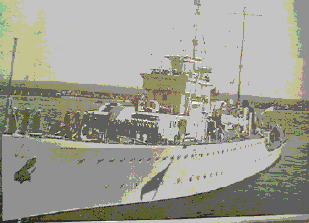
Part 2 described the progress of Archie from trainee naval signalman to a posting on the escort sloop, HMAS Parramatta. It told of how they were assigned to escort durty on the Red Sea and the disconetent among the crew because of the lack of action.
This situation soon changed when they were assigned to a much more dangerous assignment: escorting supply ships from Alexandria in Egypt to Tobruk in Libya along a sea route the sailors referred to as "The Spud Run". The newsapapers of the day referred to it as "The Tobruk Ferry". The crew of the Parramatta were now about to get a taste of adventure that would end in the lives of most of the crew, with the exception of twenty-five lucky survivors, of which Archie Miller was one!
Now read on....
Archie Miller and his shipmates were aware of the hazardous nature of the assignment handed to them when the HMAS Parramatta became part of the operation dubbed by the newspapers of the day as The Tobruk Ferry, which began in January, 1941. Their job was to escort supply ships to the Libyan port of Tobruk, which was then under siege by Rommel’s Africa Corps. Due to the precarious situation of the Allied forces, who were fighting a desperate, losing battle in Greece against the Nazis, the Allied Command had had to reduce the Allied strength in North Africa by about fifty-thousand. This meant that the main supply route was confined to the sea between Alexandia and Tobruk where Allied convoys were continually harassed by enemy aircraft, submarines and minefields.
Despite knowing of the dangers and the risks involved in this operation, Archie and his comrades were elated to be taken off duties that they considered to be boring and lacking in the action they craved. According to Archie they were all elated, excited and looking forward to getting into the big time. They did their first trip on the Tobruk Ferry –which the sailors called The Spud Run- in June, 1941. General Rommel’s Africa Corps held the territory surrounding Tobruk. The German and Italian Air Forces were in command of the air and enemy submarines were always lurking in the sea lanes.
The Navy became Tobruk’s lifeline. They ferried the troops and food supplies; brought back the wounded, escorted ammunition ships and petrol tankers that were necessary to deny the Germans a morale boosting opportunity to capture that port. Australian and British destroyers were in the forefront of this operation together with Escort Sloops such as the Parramatta, running the gauntlet on what became the most dangerous stretch of water anywhere! As Archie recalls: No fighter aircraft cover was available for our convoy. We became resigned to the fact that we were on our own.
You may remember that in Part One I recorded how Archie felt after he had completed his signals course at the Flinders Naval Depot in May, 1940 . He and his comrades had undertaken that training with youthful enthusiasm and, though they were completely in the dark as to what would follow, were motivated by a sense of great anticipation at going to sea and any adventure that went with it
In a memo written after the end of the Second World War, Archie recalled that, on the night before leaving the training depot to join a brand new Escort Sloop, HMAS Parramatta, he walked back from the Administration block to his quarters and, looking up at the night sky , saw a fairly bright star high on his left. He gazed at that star and, quite spontaneously, said a quiet prayer, asking that it would guide him safely through whatever was to come.
In his epic poem, Morte D’Arthur, Alfred, Lord Tennyson, has Arthur saying that More things are wrought by prayer than this world dreams of…. And the 18th century English poet, William Cowper expressed this view: How happy it is to believe, with a steadfast assurance, that our petitions are heard even while we are making them; and how delightful to meet with a proof of it in the effectual and actual grant of them.
It matters not which of those views was consciously in Archie’s mind when he uttered his prayer up via the evening star. What does matter is that the philosophies underlying them must surely have been the basis for the courage and resilience he would need when the strength of that prayer he sent up prior to joining the Parramatta would be put to the test: that prayerful plea for safe guidance through whatever was to come
The German U-boat U559 torpedoed Parramatta forty miles off the Libyan coast in the early hours of 27th November, 1941 while on Tobruk Ferry duty.
There were twenty-five survivors. Twenty-one were plucked from the sea by the co-escort ship, HMS Avondale. Four sailors, including Archie Miller, made it to the Libyan coast.
The rest of the crew -one hundred and thirty-seven officers and men- died. Of these, one hundred and fifteen died without a chance: trapped below decks or killed by the explosion. Twenty perished clinging to wreckage or life rafts, waiting for rescue ships that never came.
In Part 4 of this tribute to my friend, Archie Miller, I will tell how he survived this disaster to reach the Libyan coast, evade capture by the German army and live to fight another day.
TO BE CONTINUED… .in part 4
©Patrick Talty 2004
,
.