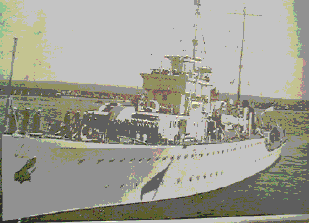
Uppermost in the minds of Archie and his mates, Alec Ladham and Fred Tysoe, was whether HMS Avondale or one of the other escorts would return to search for them. As time passed, however, they became resigned to the fact that the other ships had returned to the hazardous escort duty that was so vital to the ferrying of ammunition and other supplies to the beleaguered armies in Tobruk.
Although very disappointed, they felt that they would still be able to survive by staying in the raft even though they had no paddles, no food, no water. They would just have to go where the currents took them and wait. At that stage it was about 1000 hours, visibility was good and the sea reasonably calm, but likely to get rougher with a rising wind. They were thankful, though, for the knowledge that sharks didn’t inhabit the Mediterranean.
At about 1200 hours the sea started to get rougher. Archie and his mates had by now given up hope of being picked up. Nevertheless, they did keep a lookout for ships and were excited when they spotted a whaler in the distance. It had probably been dropped by HMS Avondale in the hope that survivors would find it. They sighted it every now and then when both the whaler and their raft topped the crest of a wave at the same time
Here’s how Archie described their reaction to this sighting:
This gave us immediate hope. If we could manage to secure that whaler and if it had sails and mast on board, we would be able to cruise around and look for those still on the water.
After about two hours they finally arrived in a position that would enable them to guide the raft directly down on to the whaler. (For the benefit of landlubbers like myself the whaler was used as a lifeboat. It was a 27 foot wooden boat, very heavy and very seaworthy. It could be rowed or sailed by up to five people or and would support about twenty people.) The three men were elated when they realized they were going to succeed in boarding her. Once they made it, however, their elation became somewhat diminished:
There were no sails or mast and the boat was half full of water. The contents of the boat consisted of a tin of Arnotts biscuits, and a case of tinned corned beef. There were also three oars, a tin hat and a hammer. At the sight of the food and the oars their spirits rose!
Archie later recorded that we didn’t know whether to laugh or cry! It was a good feeling to know that we’d made it -at least we were a little bit safer. The water level was a bit of a worry. The food and the tin hat were a plus, but no sails meant that we wouldn’t be able to do a search for our mates. Provided we could get rid of some of that water, there was only one thing to do and that was to head for the Libyan coast, which was now some twenty miles away….We got to work baling with the tin hat….After about half an hour we hadn’t made much impression.
At first we thought the planks had been sprung when HMS Avondale dropped it in a hurry, but after an inspection we discovered that the bung wasn’t in. This was fixed, but she still leaked, although not as badly. It was getting dark and cold before we had everything under control. It seemed ages since the disaster and we needed rest. So the three of us laid in the bottom of the boat. When the water came around our bottoms we took it in turn to bale. This went on all night.
It was a completely miserable night! Archie told me that he and his two mates were lying mainly in water trying to get some sleep. However, they became philosophical about their predicament when they gave thought to the shipmates who were killed or who had died in the water waiting for help that never arrived.
Dawn and daylight eventually came. They now became aware that they were much nearer to their goal: They could see the outline and hills of the Libyan coast. The sight energized them and they set to work in earnest: two of them on the oars and the other one steering and keeping the stern into the sea.
At about midday they heard an aircraft and hoped it wasn’t enemy. He came in real low and they were very relieved to see that it was an RAF Hurricane fighter plane. They put a life belt on top of an oar to attract his attention. He then swooped right alongside them, gave a wave and roared off towards the coast.
At about 1500 hours they were getting real close to land; the breakers were visible and it appeared that they might have to negotiate some reefs. Alec took the rudder and Fred and Archie cheered him on as they surfed in between the rocks and beached smoothly on the white sand.. They were now in German-held territory!
Archie again: We pulled the boat out of the water and secured it so that the tide wouldn’t float it away and took stock of our surroundings. Immediately beyond the beach were low sand hills and we decided to look over the other side. The first thing e sighted in amongst the low undergrowth were three men about a hundred yards away. They had spotted us, too, so there was no backing off. We approached them, calling out: “We’re Australian!” When we got close we could see they were Arabs.
There was no discussion, but they indicated that we should follow them. They led us to a camp about a mile inland and presented us to a person who was obviously the chief of a group of nomadic Arabs.
TO BE CONTINUED....in Part 7
©Patrick Talty 2004