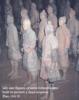
Xian, People's Republic of China...March 1974: Some peasants digging a well on land near Xian come across something that startles the world of archeology.
March 1974: some peasants are digging a well on land near the tomb of unified China’s first emperor, Qin Shi Huang. The site is about thirty-seven kilometers from China’s original capital, the ancient city of Xian and about one thousand kilometers southeast of the modern capital, Beijing. They discover something that will startle the world of archeology: the soon-to-be famous terracotta army, still guarding their emperor after more than two thousand years.
Later excavations revealed that the army was buried in three pits. At the time of my visit to Xian most of No. 1 pit had been excavated and the other two were being dug out. The whole area is now covered by an enormous building and has become a popular destination for tourists from all around the globe.In 1980 the continuing excavations led to another stunning find: on the west side of Qin Shi Huang’s tomb the excavators unearthed two full-scale bronze chariots and life-size bronze horses decorated with gold and silver. Archeologists have speculated that these magnificent relics are only part of a procession of chariots carrying images of members of the emperor’s family, concubines, members of the nobility and officials of the emperor’s court.
I was presented with the opportunity to see these remarkable finds at first hand in the northern summer of 1988 when I visited Xian, an ancient city, which served as the capital of China for twelve dynasties over eleven hundred years. These dynasties have left many priceless relics in and around Xian. The ones that made the greatest impression on me were the Banpo neolithic village, the Qin Shi Huang mausoleum with its guardian, the terracotta army, and the vanguard of the procession of bronze horse-drawn chariots and their drivers.
One early morning I picked up a “cheapie” fare on a minibus tour from Xian railway station and, after driving through some spectacularly beautiful countryside, arrived at the Banpo neolithic village. A museum had been built over the site a matriarchal clan community occupied over six thousand years ago.I was able to imagine how the people lived there, the manner of their lifestyle all those centuries ago: each part of the village and its function was clearly identifiable -the signs in English helped, of course. There was also an exhibition of primitive art from that era, and it was interesting to note the transition of style and technique over the centuries, with early literal representations changing to more impressionistic styles. Among other items, I was amazed to find re-constructions of primitive dwellings, some complete with household accessories. There was a lot more to see and reflect upon, but now we had to move on to the exhibition of the emperor’s terracotta army.
The sight took my breath away! Before me, in battle formation, stood a great army of one thousand soldiers and horses. As I walked around the gallery looking down into the pit which had been their headquarters for over two thousand years, I was intrigued to note that each soldier and officer had his own personality: some looked grim, some looked happy with expressions ranging from slight amusement to outright smiles; and each face and figure was unique.Now and again I saw soldiers kneeling on one knee with arms outstretched. I eventually came to the conclusion that these were the archers of the army. They had been dutifully kneeling at the ready for thousands of years, but time and unknown circumstances had taken away their bows and arrows. “What happened,” I pondered, “to their bows and arrows?” No answer came!
And now it was time to visit the two big Qin dynasty copper chariots and horses and their drivers. I had to push my way through a large crowd of tourists in order to get a glimpse of these fine examples of early Chinese military art. What I saw was what archeologists have speculated to be the vanguard of a ceremonial procession containing the oldest bronze chariots and horses ever found in China.At this stage it is not known how many more figures will be found to make up the ceremonial procession, which is a vault west of the emperor’s mausoleum. However, since my visit to the vault situated east of the mausoleum other pits have been excavated there. The tally to date is that of more than six thousand statues of warriors, servants and horses standing in battle formation and interred fifteen to twenty feet underground. The roofed in area that I visited now extends seven hundred feet east to west and two hundred feet north to south. Experts expect that the bronze items in the west vault will at least equal the numbers in the east vault which houses the terracotta army.
Now it was time to visit the mausoleum of Emperor Qin Shi Huang. I had been excitedly looking forward to this visit. He must have been quite a character. As ruler of the Qin dynasty he conquered the rival states in China over a period of several decades and thus made a significant mark in history by being the first to bring about unification of China. He took the title “Shi Huang-ti” or “emperor” to describe his new status.Under his rule some important decisions were made: he standardised the currency and the system of weights and measures. He also brought about the unification of a series of defensive barriers, which gradually evolved into the Great Wall of China.Still, there is a dark side to the story. Apparently he had the habit of burying alive anyone who disagreed with his policies. Another policy designed to eliminate dissent resulted in book-burnings. However, all things eventually come to an end, even dynasties. It seems that Qin Shi Huang (according to historians) thought that his dynasty would last for many centuries. In fact, his rule lasted for less than a decade and the Qin dynasty came to an end only four years after his death in 210B.C.
These historical facts circulated in my mind as we approached his mausoleum. Accordingly, I had been expecting that I would descend into a fabulous vault arrayed with all the trappings of a powerful ruler. This expectation was reinforced by some other historical facts concerning his preparations for the after-life: historical records indicate that Qin Shi Huang envisaged a tomb of incredible size and magnificence. He commenced work on its construction when he became king of the warring state of Qin at the age of thirteen (this was twelve years before he unified China and declared himself emperor). When I arrive at the site (which has not yet been excavated) I am surprised to see a steep hill covered by a flight of many steps leading to the top of a mound beneath which (a guide informs me) is the emperor’s burial chamber.
Running the gauntlet of a lively souvenir market, I climb the steps and eventually arrive at the top of a mound, about fifteen stories high, called Mount Li. The green hill on which I find myself stands unimposingly to the middle of a millet field belonging to a commune in a county known as Lin Tung. Yet, despite the unexpected simplicity of this ancient monument of earth, I feel a sense of awe at being in the presence of the spirit of the man who unified China all those centuries ago and whose spirit remains intact, thanks to the long and loyal vigil of his terracotta guardians.
|




Victoria