If you haven't already done so, please read Part 1....
It wasn’t long before he started on the journey that was to involve him in an adventure that he could never have predicted on that night when he uttered the prayer, the prayer he whispered under the light of the evening star in which he asked Providence, via that bright, shining star, to guide him safely through whatever was to come.
Soon afterwards the process of drafting the new signalmen to ships was completed and eventually Archie received a notification to join a brand new Escort Sloop, His Majesty’s Australian Ship (HMAS) Parramatta. He and a Signalman McDonough joined Parramatta one fine day in May, 1940. After completing sea trials, this ship had sailed from Sydney (New South Wales) to Melbourne (Victoria) under the command of two very experienced officers of the permanent service: Lieutenant Commander J. Walker (Captain) and Lieutenant George Langford (second-in-command). Purpose of the voyage was to pick up additional crew, including Archie Miller and his mate George Langford, and to carry out gun trials in Port Phillip Bay.
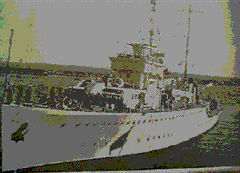
Archie was now on his way to the adventurous life that his youthful nature and character had craved. His new home, HMAS Parramatta, had been commissioned in April 1940. She was built at Cockatoo Dockyard in Sydney as an Escort Sloop. Her displacement was a little over one thousand tons and her main armament were three 4-inch high angle guns: There were also depth charges and anti-submarine detection sonar.
In June 1940 Parramatta arrived at the Western Australian port of Fremantle after an extremely rough voyage back to Sydney and then via Port Phillip and Adelaide (South Australia). At this point there was a lot of speculation as to what they were to do and where they were going, However, shortly before the ship sailed out of Fremantle the captain opened sealed orders and then advised his men that they were about to sail for Colombo (Ceylon).
The voyage to Colombo went smoothly, except for an incident that occurred as they sailed northward out from the Western Australian coast. Here is how Archie remembered it:
On the second night, about 2300 hours, we sighted a medium size Merchant Ship on our port bow traveling south. I was signalman of the first watch. Both Parramatta and another ship were blacked out and we were aware that disguised merchant enemy raiders could be operating in the area.. It would have been normal for Parramatta to challenge and identify this ship. The Captain, however, did not issue any order for a challenge and the ships passed quietly by (each other).
After spending several days in Colombo the sailing orders directed Parramatta and her crew across the Indian Ocean to the port of Aden, a British Protectorate close to the Red Sea where they became part of the Red Sea Naval Force. This involved convoy duties from the Red Sea entrance to a point off Port Sudan where other escorts took over to escort the convoy to Suez. After a while Archie and his colleagues found that these duties became monotonous. As Archie recorded in his memoirs: We were always on the lookout for real trouble, but rarely found it…The war in the Mediterranean was hotting up and all of the Parramatta crew were getting sick of our monotonous job. Other ships in our group were going to the Med and we were most envious.
Then in May 1940 they got their wish: They were ordered to set sail for the Mediterranean. Archie records that they were all elated, excited and looking forward to getting into the big time….What with the hammering our navy was taking during the fall of Greece and the evacuation of Crete, Parramatta would be quite a welcome addition. The army were having reversals in the Western Desert and Tobruk became under siege by the Afrika Korp…From this point on the Navy was going to play an important and dangerous role in the Middle East.
It was a proud day for the officers and crew of HMAS Paramatta when they sailed into Alexandria Harbour. It was also a moment of truth: The sight of battle ships, aircraft carriers, cruisers, destroyers, sloops and all sorts of support craft gave the crew food for thought and reflection: None of these ships had escaped the power of he German Air Force during the evacuation of Greece and Crete. Archie’s records of these events state that the scars of war were very obvious: big holes in the ships’ sides and all kinds of other damage.
Despite these signs of danger ahead, the men of the Parramatta were glad at last to be in a situation where they could make a significant and real contribution to the war effort instead of having to tolerate the monotony and lack of real action they had experienced during their time patrolling the Red Sea.It wasn’t very long before the perceived danger of their new role became reality.
Archie again: Parramatta did several convoys to Parmagusta in Cyprus without too much incident. (After that) we were assigned to the Inshore Squadron and escort duty on the Tobruk Ferry and did our first trip in June 1941. From that time onward s we were almost continually in action, both at sea and in harbour, fending off the German Lufftwaffe.
The bell was about to toll for the HMAS Parramatta.Archie records that, on 27th November, 1941, it all came to an end with the loss of all officers and most of the crew when the German U-boat U559 struck with a torpedo, which cut Parramatta in half some forty miles out from Tobruk.
TO BE CONTINUED....in Part 3
|




Gina