If you are a human resources professional, which of the following belief statements belong in your brain?
1) Diversity can and should be celebrated to the maximum extent possible.
2) It is not only possible for diversity and organizational effectiveness to co-exist, but also to be a win-win (i.e., for both employers and employees).
3) Pay/rewards for performance are essential to creating a high-performance organization and culture.
Are these trick questions? No. Would it not be blasphemous for any HR professional (or any leader, for that matter) to not agree with these belief statements? Of course! But ironically, while the HR profession has bemoaned the lack of a seat at the strategic table for decades, we continue to preach one thing, and practice another.
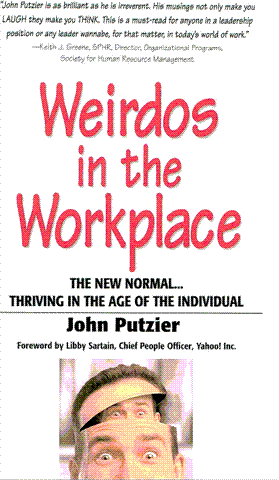
How so? What really brought this home for me is the reaction I got to my newest book, “Weirdos in the Workplace! The New Normal…Thriving in the Age of the Individual” (Financial Times Prentice Hall) from many of my HR colleagues. On the one hand, CEO’s, entrepreneurs, business owners and non-HR executives love and embrace the message, while some HR professionals (without actually reading the book) pull back and gasp. How insensitive! We can’t call people weirdos? We’re HR professionals. Please!
Before you have an HR hernia, you must understand the basic premise that “a weirdo is anyone not like you.” Hmm! That’s the point. Can you believe we are approaching the 44th anniversary of the passage of the Civil Rights Act of 1964, which was the genesis of equal opportunity, and all the laws that followed? As a former EEO Compliance Officer for a Fortune 100 manufacturer in the 70’s and 80’s, I speak with both knowledge and experience. I even agreed philosophically with the need for these laws, given the bad behavior of our society and some of its organizations.
However, for the times we are in (The Age of the Individual), it is not only simplistic and naïve to continue defining diversity in terms of government mandated protected classes, i.e., race, sex, religion, national origin, sexual preference, et. al., but it actually runs contrary to a purist philosophy of diversity. True diversity is individuality.
In fact, for a truly liberated, progressive HR professional, it should be downright insulting and even somewhat bigoted to operate from an implied assumption that all women think and act alike, or that all blacks think and act alike, and so on. Granted, there is the need to be able to categorize people for the purposes of legal compliance, reporting, etc., but it is high time we transcend these artificial barriers for the purposes of real organizational effectiveness, progress and true celebration of the individual.
Now that you understand the premise and motivation for this book, perhaps you may be more willing and able to understand some of the more controversial “weirdisms” within it.
Weirdism #1: “All workers are not created equal!”
Again, at first blush, many political correctites may hesitate to jump on this bandwagon. However, if we are in agreement with the logic thus far, one has to concur that to celebrate individuality, and to grant the rights and privileges that come with it comes the responsibility to recognize that there is no “one-size-fits-all” model for creating a performance-driven organization; or a meritocracy.
HR professionals, who continue to cry for a seat at the strategic table, must also learn to recognize when the expression and manifestation of individuality is in alignment with organizational strategies and objectives, and when it is not. Not all individuality is worthy of being celebrated. Some may be tolerated, but some may even need to be terminated. There are limits of behavior to earn the rights and privileges to live in a free society, and the workplace is a microcosm of society.
So, the whole point of Weirdism #1 is that if we accept the new definition of diversity as individuality, we have no choice but to be responsible to our organizations, and to the individuals within them, to recognize their differences (in behavior, performance, value) and to respond accordingly, which brings us to:
Weirdism #2: “Discrimination is good, it is right, and it is necessary!”
This is the real litmus test. Had we started with this principle at the beginning, many would never have made it this far. Take a breath. With the advent of the Civil Rights Act of 1964, and it’s resultant EEO, OFCCP, AAP’s, ERISA, ADA, ADEA, and all the other acronyms of “discrimination,” may organizations, and especially their HR Departments, have misguidedly evolved into a “fair is equal” mindset.
In other words, to avoid the risk (legally or perceptually) of being accused of “discrimination” we have become victims of the law of unintended consequences. Treating everyone the same can only result in institutionalized mediocrity. Giving everyone a 3% merit raise not only punishes the performers, but also rewards the slugs, and wastes valuable organizational resources. That’s a lose-lose-lose.
The word discrimination is not a bad word. But we have made it one. If someone says you have discriminating taste, you say “thank you” and take it as a compliment. If you answered “yes” to the belief statement at the beginning that “pay for performance is essential to creating a high-performance organization and culture” then you believe in the virtues of discrimination. Discrimination based on performance! Not race, sex, etc. Welcome to the Age of the Individual, and to enlightened HR!
Any manager/leader who does not discriminate is not manager/leader material. Being willing and able to make distinctions and tough decisions is a core competency of modern management and leadership. And that goes for HR management and leadership, as well. In fact, HR should be leading the charge!
Conclusion
None of this should be new to you. And it probably isn’t, now that you understand the logic and rationale. So why write a book that creates such controversy? Why use such potentially inflammatory and politically incorrect verbiage? Because it wasn’t written primarily for HR professionals.
When CEO’s, business owners, entrepreneurs and non-HR executives hear this message, they rejoice. They say they have been thinking it for a long time, and wish they could hear it from their own HR departments. And ironically, HR probably agrees. So let’s make it a win-win.
One of the hidden objectives of “Weirdos in the Workplace!” is to get the strategic HR message out to the non-HR mainstream, to the people who hold the keys to the boardroom, and to the “individuals” we must all attract, retain and motivate. HR should already get it. I shouldn’t have to preach to the choir.
But, now it’s HR’s job to shift its mental paradigm of how to position itself with its own leadership. That is, to get their leaders’ attention by speaking their language, without compromising the beliefs or principles of the HR profession. And by following the aforementioned logic, now they can.
HR cannot be seen as glorified union stewards, blindly advocating for the rights of all employees. They must be stewards of both the individual and the organization. It is not incongruous to advocate for the individual and the organization simultaneously. The greatest places to work are usually the greatest companies in all other aspects, as well (profitability, effectiveness, customer service, etc.).
But it takes backbone. It takes courage. It takes hard work and tough decisions to create a culture that both recognizes and celebrates the individual and then discriminates based on performance and value, in order to do so. You cannot have one without the other.
See? We agree after all!
John Putzier, M.S., SPHR is President of FirStep, Inc., a non-traditional HR performance improvement firm based in Prospect, PA and the author of the best seller, “Get Weird! 101 Innovative Ways to Make Your Company a Great Place to Work” (AMACOM, American Management Association). His newest book, upon which this article is based is called, “Weirdos in the Workplace! The New Normal…Thriving in the Age of the Individual” (Prentice Hall) John can be reached at john.getweird.net or by calling toll free at 1-866-GET WEIRD! (438-9347).






good luck.