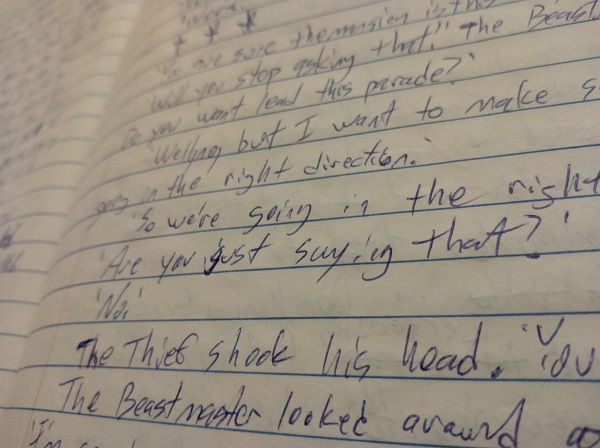
Like most writers, I think, I started off writing by hand. I have two big folders of stuff and a stack of notebooks from over the years that have been filled and/or used up from all this. Most of the longer stuff has only had notes done by hand. Most of the shorter stuff, poetry, is almost exclusively wrote by hand. This year, in 2022, I wrote most of two longish short stories by hand. I didn't write them longhand because I specifically wanted to write longhand, but because I was doing DoorDash part-time and filled the time I sat waiting on deliveries with writing work. Sometimes I'd only get a couple words or a full sentence in, other times I'd get half a page or page in before I got a run I wanted. These two stories, the first two in the Post-apocalyptic Escapades of Heroes & Scrubs, were nearly all wrote in the car between runs. Aprox 60% of the first and 80% of the second were wrote in my notebook. And not in cursive. I mean long, long hand. Block letters. This was the first time I've wrote anything substantial by hand for literally more than two decades, since the late 90s, and I was surprised by the outcome. This essay simply takes a look at what I found by doing this.
First and perhaps most importantly, this seriously slowed me down compared to typing. No longer was I typing as fast as possible to catch every thought. Instead, I had to look at the page and think. This was in pen. I couldn't erase. If I put something down, it had to be what I wanted to put down. It took a little bit to get used to this. Most of what I wrote longhand of the first story was me getting used to it and it was only towards the end of that longhand part did I get into the groove. The result of this slowed down thought process was that I tossed three sentences for each one I wrote and gone was the throwing of shit against the wall with the expectation of cutting up to a quarter of the draft during editing. Due to space constraints, not a single word wrote wasn't planned to be in the finished work.
That last thought leads into the most surprising result of this, to me anyway. Probably 80-90% of what was written longhand was used as it was originally written. Gone were the nonsense garbage sentences that had to be edited due to have no idea what was being said because of typos. Gone were all the parts that would be considered later for large scale cuts or to be used in something else. Gone were so many inconsistencies because 'you'd fix it later'. The process is slowed down so much that it's almost an entirely different process. There's no doubt they're both writing, but that's like saying that a 100 meter dash and a marathon are both 'running'. They are and they aren't. The difference is in the process and approach.
Another surprising side effect of this is that the story and details are remembered better. Not only were there less inconsistencies and general errors due to the process being slower, but the act of forming the words by hand seemed to impress the memory of the story better, reducing the need to go back and look at details. For whatever reason, a page full of handwritten text can be pulled up and pictured from memory but a page of typed text can't. Or I can and can't, respective. Perhaps some people remember the typed pages better, but I don't.
The effects of writing by hand seemed to continue even when after the story was moved to the computer. Even though two stories have been finished in the Post-apocalyptic Escapades of Heroes & Scrubs series, a third is nearly finished and it didn't have any benefit of having part of it handwritten. The differences are subtle and vast at the same time, being somewhat hard to describe. Not as 'full or vibrant' I'd suggest, but those things are subjective. Less subjective is the fact that the second story is a simpler story that ended up being the longest of the series so far. Low level writing by hand seems to be on the level of 'in the zone' writing on a computer and 'in the zone' writing by hand is basically one shot stuff, ie, you write it and use it as is and it will probably be the best of your best. The effects of me accidentally running this experiment are twofold. 1) The second story that was handwritten was for the free promotional expansion, and it's the best of the three so far because it was nearly all done longhand after I got into the groove of writing longhand. 2) I'll be writing other stuff longhand in the future to take advantage of what I found out by accident.
As a last thought. I've always railed against anything like Grammarly or even the built in grammar check in your word processor. These things speed the process up. They also edit out the errors that are unique to you as a writer. These errors that are contained within stuff that is truly written by you, no grammar check of any sort and all manual editing, are your signature as a writer. No one else will make these same series of errors and/or use of odd words. If you edit these things out, and I don't mean leaving in blatant errors or using strange punctuation that you insist is 'art' (yes, Cormac McCarthy, that shot across the bow was aimed at you), you are editing out your signature as a writer. You can argue that any word usage I present is correct or not if you want, but if something is wrong or right, it's all me and nothing but me. I use spellcheck. And sometimes not even that if the piece is short enough. The point being that ANYTHING at all that speeds up the 'process' does that at the cost of sacrificing the true voice of the writer. An extreme example of this are the content writing bots that contain no writer's voice at all (like DALL E pictures contain zero art per the definition of 'art' being from a human perspective) and are actually trained off content, like these words here, that the researchers find online.




I heard that they are no longer teaching cursive writing in schools. From the beginning I admired my mother's cursive writing that was like the writing chart on the top of the blackboards in my English classes. I strove to write as clearly as her or as consistent as Egyptian hieroglyphics that didn't change over 2000 years and were much more difficult than our writing, like Chinese and some other alphabets.
I only have my signature on my Social Security card when I was 16 for a view of it back then. When I didn't pay much attention to my writing. But when I reached my doctorate, I wanted to make sure that my cursive writing was readable, along with my signature, unlike those that choose some quickly scratched symbol as their unreadable signature.
I learned architectural lettering in high school in drafting classes. I took typing my sophomore year in high school and remain a rather poor typist. I wrote most of my school work in cursive and typed it if necessary on an ancient Royal with letters full of gunk giving it a unique look. Never thought to clean it, just typed.
When I first was paralyzed, I couldn't write at all. But when I got my right-handed hand splint, I began writing with ballpoint pens with rubber surgical tubing over the body for grip. I tried not to make errors because I couldn't erase them like I could with pencil. But I never used a dictionary and was an atrocious speller. At some point, I stopped writing cursive and started using Flair pens because they flowed so smoothly and were in color.
When I became a professor, I always had secretaries. At one point I told people that I could keep three secretaries busy with my writing. But they were always loaded with work and my work came back slowly until I started typing with one finger on my first computer in 1987. By 1993 I was seeking voice dictation systems to speed my work. By 1998, I was losing my lower abdominal muscle stability and found that while I could still type and point the mouse, I could no longer write either cursive or lettering. Making me grateful for my ability to dictate this.
Once I got Dragon, where I could dictate whole phrases and sentences, I found that my writing was much different from when I typed it one finger at a time. I know now that I write overly long sentences, use words that are not necessary, and often, words that I didn't dictate are dropped in that I need to edit out. Like you, I would love to go back to cursive writing and be able to sign my name again at book signings. To write like you do on the fly. But I'm grateful for being able to even write this long response to your article today. Now, back to my latest story…
Ron