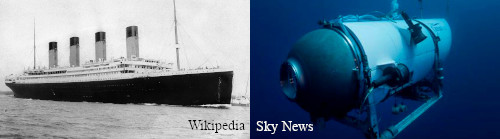
Titan and Titanic went down because of the same reason: rule breaking.
I don't think some people fully appreciate the irony of the situation with this sub called Titan. It's without a doubt, a tragedy, but not for the ones who died. They would have died as instantly as anyone could ever die outside of ground zero next to a nuke. You couldn't die faster by sitting on top of a pile of TNT. You couldn't die faster if you took a point blank shot to the head by a 110 mm cannon. 'Instantly' doesn't describe what 5,800 psi, give or take, does to the human body. Look up 'shrunken heads' if you want to have a bit of an idea, or in pure numbers, you get reduced to about 1/8 your original size. You would be killed faster than it takes for your nerves to register your death. To compare it to something closer to home, my Porter Cable air compressor doesn't go above 150 psi, has a max tank reading of 250 psi, and will burst at somewhere between 300 and 500 psi. That means that pressure that deep under the ocean is aprox x11.6 to x19.33 the psi required to burst a regular steel pressure tank. So, it's a tragedy for the people that have to deal with the result of their actions, not the ones who died. Most the rest of us will get to go out kicking and screaming to some degree, and you can bet money on it, like those in the watery grave these people were visiting.
I'll start with the Titan, just because it's the newest of these two and the one that should have been built best from the experience available. Most of what I'm about to go over has been mentioned in the news, but not all of it. Most of what hasn't been came either from The Titan Tragedy by Sub Brief or the Coast Guard's press conference on the debris field. A brief list of the known or suspected issues are as follows: 1) They used an unreinforced carbon fiber hull. If you know anything about carbon fiber, you know it doesn't bend or crack...it shatters like glass and you have no idea it's going until it goes. Therefore, if the hull went, it makes sense that the titanium end caps would be the main way to identify what happened since the rest of the hull would be little shards scattered all over. 2) They attached those titanium ends to the carbon fiber hull for use in the ocean. In doing so, they ignored the fact that in the presence of salt water, this combination is one of many combinations that can cause the titanium to undergo rapid degradation, aka, it's ate away by electrolysis. So, not only did they not have a submarine specialist involved in this, they didn't have a metallurgy specialist, or much of any other specialist, apparently. 3) No large scale testing or certification was done of the hull or any part of the sub or the sub as a whole. No one but the CEO knew exactly what had gone into the sub, and he flat out stated that he'd 'broke rules'. 4) They bolted the passengers into this thing, directly contrary to all experiences that say otherwise, like the Apollo 1 tragedy in which three were burnt to death during an O2 fire before the hatch could be removed. Even if it hadn't imploded, they would have died on the surface if not found. 5) They had no 'black box' or backup location transponder. 6) They had no way to vent the hull in case of onboard fire (they were bolted in via the one hatch). 7) No voice communications. 8) No emergency breathing apparatus. 9) No umbilical to the mothership. 10) They fired their safety person that seen red flags. The list is endless. Even if the thing hadn't imploded, it was a death trap waiting to take a group out by them getting lost and suffocating or asphyxiating due to an electrical fire. The fact that the CEO of OceanGate, Stockton Rush, was even willing to get into this thing is amazing. I can only figure that he knew he'd die if something went wrong and therefore wouldn't have to worry about it. The only other possibility is that he truly believed his own bullshit and thought the sub was safe enough. Of course, a lot more will be figured out, but everything we've heard about falls into the category of 'not good', and the stuff hinted at falls into the category of 'even worse', according to the people who claim to know it.
And talking about 'not good', that describes most of what people know about the Titanic. Everyone knows the basics. Biggest ship in the world at that time. The most expensive. Unsinkable. Sunk. Killed a lot of people. Still killing people via tourism and bad juju. Of course, that unsinkable part was hubris. People are aware that there may have been an issue with the lookout not seeing the iceberg, but fewer people know the other errors that went into its construction and maiden voyage. 1) Lack of lifeboats. Most people do know this, but that's because it is very important. The Titanic was able to carry 64 lifeboats, more than enough for everyone. Instead, the White Star Line decided that 16 plus 4 collapsible boats were good since the ship was 'unsinkable', which was enough for only 1/3 of a full ship and ½ of the people aboard the night it sank. This is the surface ship equivalent of having your hatch bolted shut. It was a completely preventable and deliberate action. 2) The Titanic was almost completely untested. It was finished on April 2, 1912 and left on its maiden voyage on April 10, 1912. It only had 12 hours of testing on April 2, 1912 before they started preparations for the maiden voyage. 3) 'Waterproof' compartments were not actually waterproof. The compartments on the Titanic did not have 'tops' on them. They had walls and floors. This was because, again, they thought it was 'unsinkable' and there was no reason to go through the extra construction and cost. It would have also reduced the carrying capacity by taking up more space in the hull. This means that when the compartments flooded, they filled up one by one like a ice cube tray going under at one end. 4) Captain Smith did not reduce the Titanic's speed, and certainly didn't stop, after receiving iceberg warnings. Again, this was a purposeful and deliberate action. He was trying to set a new speed record for an Atlantic crossing. 5) The Titanic's steel was cheap and/or faulty (and untested) and turned brittle in cold water, allowing the iceberg to cause more damage than it should have caused. Tests on steel recovered from the Titanic showed that its hull steel is x10 more brittle in freezing water than modern steel. This was caused by an excess of O2, sulfur, and phosphorous and a lack of magnesium in the metal. 6) No binoculars were available to the crow's nest lookouts. This was due to an officer accidentally taking the crow's nest locker key. Or accidentally taking the binoculars off the ship. Or taking binoculars that were his and the ship had none. There's several versions of why there were no binoculars on the Titanic. This lack of binoculars was combined with still water that night, which made the icebergs yet harder to see. So all of the things that took out the Titanic except MAYBE #6 were related directly to the construction and/or operation of the vessel by people in the company that owned it. We can be assured without a doubt that everyone believed the Titanic was unsinkable and therefore believed their own bullshit, and believing it resulted in 1,514 deaths, or the death of 68% of the people aboard the Titanic that night.
We could call the Titan tragedy a lot of things. Sad. Tragedy. Deserved. Karma. Accident. Preventable. Unsurprising. Inevitable. But what we can't call it is 'something new'. At least Stockton Rush didn't take down anyone that didn't sign a wavier (and if you want a good laugh at the wavier situation, consider: 1) Their families probably can't sue and 2) They probably can't collect on their life insurance.) and who at least on paper acknowledged they could die. However, I don't think for a second that these people thought they would, simply because there was a father/son passenger set on there. No way do you get on something with your heir if you actually think something could happen. This incident (I won't call it an accident) reminds me of that other rich guy, Zef Eisenber, that died a couple years ago trying to set a world speed record in his Porsche. Why did he die? Because he couldn't be bothered to do the work to relocate the parachute release button to the steering wheel instead of making himself take one hand off the wheel at 244 mph to deploy. That decision was also due to not thinking ahead and making prudent decisions, like what happened with the Titan and Titanic, except he just took himself out.
RIP to Stockton Rush, Shahzada Dawood, Suleman Dawood, Hamish Harding, and Paul-Henri Nargeolet. Rest assured, you taught someone something from this.
|



Also, you didn't mention that thousands of deep-sea submergence in many vessels from several countries for very long time have resulted in no fatalities until now. That is very impressive compared with the tragedies in space. I thought I heard somewhere that the Titan had been to the Titanic 13 times before. Like the two shuttle tragedies, when a piece of hardware is used in very harsh conditions, over and over again, refurbishing or preparation for the next use tends to slide over time. I have a high school friend who worked on the Air Force Shuttle Program. He quit the Air Force and retired because he knew the shuttle system was aging and not maintained like it should be anymore.
Ron