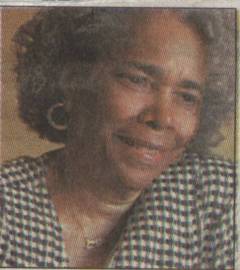
Interview with author in re her soon to be published memoir of her childhood growing up in Detroit, Michigan. From her birth in The Great Depression, through WWII and ending with the Detroit Race Riot of 1943
Southfield senior puts her life on the page
Memoir about, childhood in Detroit to land in stores in spring
By Amy Klein
Free Press Staff Writer
_________
The third time 74-year-old writer Marvin Arnett heard she was good, she believed it.
The first time was eight years ago. She paid $50 to take a creative writing class at the University of Michigan at Dearborn, procrastinated on an assignment and ended up pulling an old short story out of her dresser drawer and handing it in.
Titled The Good Reverend it told how, as a child, Arnett narrowly escaped a pedophile priest.
It is now the fifth chapter of her book, which will be published by a national publishing house and is expected to land in bookstores next spring.
Arnett has lived a long life. Born in 1928, married after high school, widowed at 24 with three small children, Arnett never went to college and took jobs washing dishes in restaurants and working at a dime store.
She took business classes in a room above the Fox Theater and worked as a receptionist for an agency that she says she later learned hired her because they wanted people to see a black employee as they walked down the corridor.
She remarried and divorced. Her children married and had six children of their own. She squirreled away money and traveled to 32 countries.
None of this is in her book. She revealed it last week at her kitchen table in her Southfield home. For someone who just wrote her memoirs, she was reluctant to share.
I try to dismiss all of that from my mind, I really do, she said.
Arnett, who has silver hair, deep eyes, and a measured voice, speaks in stories. She answers questions by saying: Now that’s an interesting thing.
What is in her book – titled Pieces from Life’s Crazy Quilt – is a sense of being blessed, as Arnett puts it. It is her childhood from 1928 until Detroit’s riot in 1943.
The book is billed as a look at racism in the North, from a child’s view. It is different from the stories of Maya Angelou and other black writers who tell about racism in the South, Arnett said. In Detroit, racism was less overt and therefore harder to identify and fight.
People really relate to what I write. Some parts they identify with, and some parts they like to think, this happened to a black child at that time. It was a real neighborhood I grew up in, Arnett said.
Sharon Stanford, chairwoman of the board of directors of the Detroit Writers Guild, said Arnett’s childhood experiences are not uncommon. What is uncommon is that she is being published.
What she did takes a lot of time, persistence and energy, said Stanford who has tried for five years to get a book published. I think the great, uncommon thing is that she sat down and took the time to write this.
Arnett was born in Detroit in 1928, just before the Great Depression. The daughter of a worldly man and a sheltered woman, she spent her childhood largely in the library on the corner of West Warren and West Grand Boulevard, she said and devoured the entire children’s section by the time she was 12.
She said she had always threatened to write a book – she envisioned one that told people how to live their lives – but never around to it. A few years after she retired from her job as a secretary of the U.S. Army Tank-automotive and Armaments Command she spotted an ad for writing classes for seniors at U-M Dearborn.
She kept on writing after the class ended, piecing together vignettes from her life. She wrote letters to agents and after a slew of rejections, she decided to self-publish her work – meaning she paid to have it published and then distributed it herself.
Arnett set up card tables in churches, at sororities and at local stores, conducting book signings and promoting her work.
She listed it online, and in all, sold about 1000 copies.
Then last summer, she won a scholarship to the Cranbrook Writers Guild Conference, a weeklong workshop for aspiring writers. Arnett said her instructor, a retired Michigan State University professor, was the second person to tell her she was good, and said she should write a book. She went to the trunk of her car and got him a copy of the self-published version.
She said the instructor stayed up all night reading the book, and the next day put her in touch with an editor at the University of Nebraska Press. This time, when the editor said she was good, Arnett believed it
This book is a little fragment of black history that’s never been written about, Arnett said. It is what I call near-history. It is old enough that a lot of people in this world know nothing about it, but it is young enough to be my past.
As for the rest of her life – the almost 60 years after her memoirs leave off in 1943 – Arnett said she is not ready to write about that, yet.
Maybe someday, though.
=====================================
For more information about Arnett and her book, visit her site at www.authorsden.com/marvinvarnett
|