“A Book at the Crossroads of History: The Early Archival Footprint of OPENAI: Oakland’s Seat at the Table”
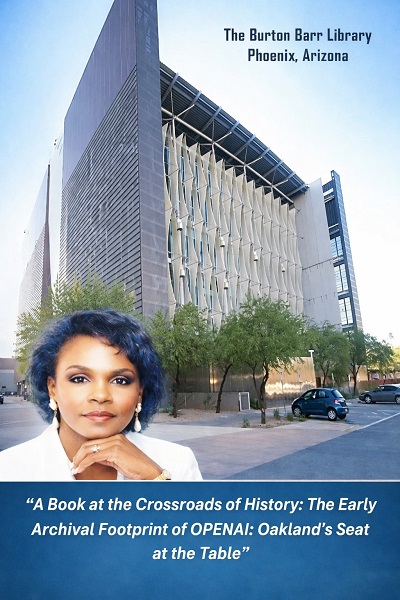
“I never knew a building like Burton Barr could exist. It’s a skyscraper so uniquely beautiful that even a homeless person feels normal inside its walls. To enter a place broke and homeless, yet feel worthy and accepted, with the utmost class, is priceless. Only an edifice so large, so tall, and so wide could open its arms to all. I am no longer broke or homeless — I am housed in a penthouse in Oakland, California — but my book’s new home is the Burton Barr Library, stored for history’s sake.”
When I published OPENAI: Oakland’s Seat at the Table, I had no expectation that this book would begin building a historical footprint of its own. I wrote it as a witness — a Black woman documenting a moment in American technological and civic history that was unfolding in real time. I did not anticipate that the book would travel into institutions, archives, and cultural spaces that preserve the stories of our era.
But that is exactly what has happened.
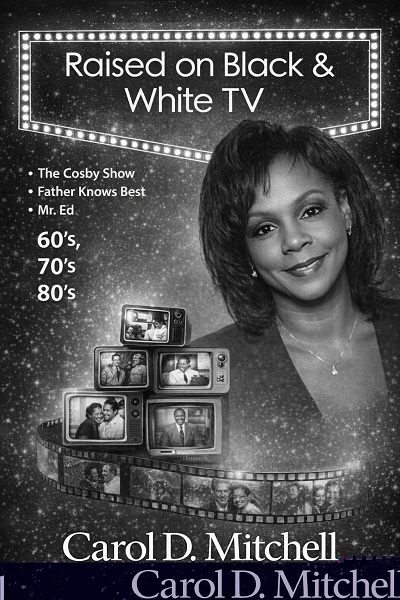
The Burton Barr Central Library in Phoenix, Arizona — one of the largest and most respected public libraries in the Southwest — will receive its copy today. This is meaningful to me not only because of the library’s stature, but because Burton Barr has a long tradition of preserving community narratives, cultural memory, and works that document social change. My earlier work was archived there years ago, and this new book now joins that lineage.
The African American Library and Museum at Oakland (AAMLO) already holds the book. AAMLO is the steward of Oakland’s Black historical record — a place where journalism, civic reporting, community voices, and cultural documentation are preserved for future generations. For this book to be included there is an acknowledgment of its relevance to Oakland’s ongoing story.
The African American Museum and Cultural Center (AAMCC) also holds the book. This institution preserves the broader arc of Black American experience, and I am honored that this work is part of that collection.
Congresswoman Barbara Lee, the former representative of California’s 12th District and a historic figure in her own right, has received her copy. Her office has long supported Oakland’s cultural and civic voices, and I am grateful that this book is in her hands.
Briana Wilson, representing AAMLO, has her copy as well — ensuring that the book is not only archived but understood within the context of Oakland’s cultural memory.
These placements are not marketing milestones. They are historical markers.
They represent the early provenance of a book that documents:
- the Musk v. OpenAI legal conflict
- the shifting identity of a major American nonprofit
- the civic and cultural implications for Oakland
- the lived perspective of a Black woman witnessing a technological turning point
I now understand that this book is not simply a publication — it is a record. And records belong in libraries, museums, archives, and community institutions that preserve the truth of a moment.
From this point forward, my work will focus on documenting the book’s historical trajectory: where it is held, who preserves it, and how it contributes to the cultural understanding of this era.
Traditional publishers may one day take interest, but they cannot recreate the footprint that is already forming. They cannot replicate the authenticity of a book that entered the world through community institutions, cultural archives, and the hands of people who recognize its relevance.
Oakland will one day appreciate its seat at the table. And this book will be part of that story.
— Carol Denise Mitchell











The original books, the ones initially signed, may become museum objects, if not in the name of the author in some museum archive, then in the general Museum of books where they may not even be able to be touched for preservation.
Ron