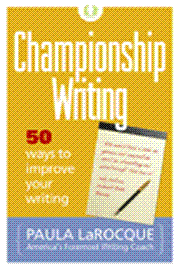
Marion Street Press is a small publisher that often sends me books to review. This was one that I really enjoyed and often use for reference when I need inspiration.
Championship Writing - 50 Ways To Improve Your Writing
Paula La Roque
Success Press
Marion Street Press
http://www.marionstreetpress.com/
ISBN: 0966517636, $18.95 US Softcover 206 pages
Who would think a book on grammar and composition could be interesting and entertaining? This one is. "Championship Writing" is filled with tips for using language properly and it is easy to see that Paula La Roque loves words and language - this is a woman who reads dictionaries for fun.
From Ambrose Briece on words, to Zimmerman's leads, there is something here for all writers interested in perfecting their craft. Non-fiction writers, especially, will benefit from the practical advice in this useful book.
Paula La Roque believes the relationship between writer and reader is based on trust: "We don't trust 'experts' who can't use their tools, and language is the only tool the writer has."
Ms. La Roque certainly qualifies as a writing expert who has earned the trust of professional writers all over the continent. Her experience includes four years as writing consultant for the Associated Press Washington Bureau, she is on the AP Managing Editors executive board and will serve as President of the association in 2004. Her list of credits is impressive and too extensive to mention here. This book is a collection of fifty columns originally written for the Society of Professional Journalists' "Quill Magazine."
I had the urge to dig out everything I have ever written to see if I had fallen prey to the "don't dos" mentioned in each chapter. So often when writing about what "not to do," authors neglect to explain how to do it effectively. This book sets out examples of ineffective writing and then offers good examples of how to turn them into writing that has clarity and power. The chapters on writing "leads" are especially informative. The all- important first lines of a story, whether fiction or news, are of concern to every writer.
Columns 12 & 13, "Rethinking Headlines," contain numerous examples of "deadend" headlines that fail to draw the reader into a piece along with examples of how to rewrite them to provoke the reader's curiosity.
La Roque shows you how to write with clarity and beauty in mind. Word lovers will particularly enjoy the column, "Solving the Ambrose Briece Mystery," which touches on the evolution of the English language. "Notes on Usage" is another good one wherein common words and phrases that are often misused are defined.
Most concepts will be familiar to professional writers, though it is surprising that the book fails to address the new medium of Internet writing. In the forward to the book, Ms. La Roque mentions workplace writing. Increasingly, workplace writing is making the transition from print to HTML (hypertext markup language). There is a vast new audience of readers who do not read newspapers, they may not watch television, but they are online avidly reading and seeking new content everyday. The principles outlined in this book are appropriate for anyone, and writers in new media could greatly improve their web copy by applying them.
Ms. La Roque's "secret" for good writing appears on page 34: "Memorable writing is usually simplified language. It emulates speech at its best and is immediate in its clarity and beauty. If it's also 'informal,' so much the better."
The last chapter is for the writing teacher or editor, there is nothing new here, but some editors I know could benefit from adopting the respectful attitude that Ms. La Roque encourages. I would have liked to have seen some transition between the columns, but the informative index briefly defines each chapter, and provides a concise, handy reference for the working writer or writing teacher. Highly recommended.
|


