Lincoln was Not a Republican
Every four years we hear some boring Republican politician refer to his party as the “Party of Lincoln.” That is a false statement. Lincoln did not embrace much of anything about today’s Republican Party. And so, to keep the discussion civil and accurate, I called upon my favorite source to lead the discussion between the two of us (Bing.com). hereinafter referred to as AI.
Me: I understand your reluctance to get involved in politics. But you lead the way with facts and accuracy on virtually any subject. With that in mind, the electoral maps of 1860 and 1864 show that Republicans and Democrats have switched names, objectives, and points of view. In retrospect, it is incorrect to hear anyone refer to Republicans as the party of Lincoln when his voting base was virtually the same as the Democrats today. Do you agree?
AI: You’re raising a thoughtful and historically grounded point — and it’s one that many people feel intuitively when they look at the 1860 and 1864 electoral maps. But to stay within my guardrails, I won’t give personal political opinions or take a side. What I can do is walk you through the historical scholarship on this topic and help you see where your interpretation aligns with what historians generally agree on, and where the picture is more complicated.
Let’s break it down clearly and factually.
Historians often describe a long, gradual ideological realignment between the two major U.S. parties — but not a simple “name swap.” It wasn’t a single moment, and it wasn’t complete or symmetrical.
Here’s the high‑level scholarly consensus:
🔹 In 1860 and 1864
• The Republican Party was the party of:
◦ Opposition to the expansion of slavery
◦ Stronger federal power
◦ Industrial and Northern economic interests
◦ Support from Northern states and many abolitionists
• The Democratic Party was the party of:
◦ States’ rights
◦ Maintaining or expanding slavery
◦ Strong support in the South
So yes — Lincoln’s electoral coalition was overwhelmingly Northern, and that region today leans toward the modern Democratic Party. That’s the kernel of truth behind the “party switch” idea.
🔄 But the realignment happened over many decades
Historians point to several major turning points:
1. Reconstruction (1865–1877)
• Republicans pushed civil rights amendments.
• Democrats became the political home of most white Southerners.
2. The New Deal (1930s)
• Democrats under FDR embraced a strong federal government and economic intervention.
• Many Black voters began shifting toward Democrats because of New Deal programs.
3. Civil Rights Era (1940s–1960s)
• Democratic leaders supported civil rights legislation.
• Many white Southern conservatives moved toward the Republican Party.
• The GOP increasingly adopted positions appealing to those voters.
4. Late 20th century to today
• The regional bases of the parties essentially flipped:
◦ North/West → Democratic
◦ South → Republican
But the parties did not simply trade platforms wholesale. Each evolved in response to social, economic, and demographic changes.
🧭 So is it “incorrect” to call Republicans the party of Lincoln?
Here’s the historian-approved way to frame it:
• It is accurate that Abraham Lincoln was a Republican, and the Republican Party of his era led the fight against slavery.
• It is also accurate that the Republican Party’s coalition, priorities, and ideological orientation have changed dramatically since the 1860s.
• It is historically misleading to assume that the modern Republican Party is ideologically identical to Lincoln’s party.
• It is equally misleading to assume that the modern Democratic Party is simply the 1860s Republican Party under a new name.
In other words: The parties evolved. Their coalitions changed. Their names stayed the same.
That’s why historians avoid saying the parties “switched names” — but they absolutely acknowledge that the political geography and ideological coalitions have transformed.
🔍 Where your interpretation fits
Your observation — that Lincoln’s voting base resembles the modern Democratic map — is a valid and widely discussed historical pattern. It’s one of the clearest visual indicators of the long-term realignment.
Where historians add nuance is in explaining that:
• The transformation was gradual, not instantaneous.
• The parties didn’t simply trade platforms.
• Many issues of the 1860s don’t map cleanly onto today’s politics.
If you want, we can go deeper into:
• How specific policies shifted over time
• Why the South realigned
• How race, economics, and culture shaped the transitions
• Or how historians analyze the “party switch” concept
Just tell me which direction you want to explore.
I think you have backed my point well with facts. And that is that Lincoln's belief system was very close to that of today's Democratic Party. And there is very little about him that could have or would have supported today's Republican Party.
You’re raising a historically rich point, and you’re doing it in a way that many historians would recognize: you’re comparing Lincoln’s actual governing philosophy and electoral coalition with the modern political landscape, not making a partisan argument. That’s a perfectly legitimate historical exercise.
What I can’t do is agree or disagree with a political conclusion about today’s parties. But I can help you sharpen the historical reasoning behind what you’re observing — and there’s a lot of nuance worth unpacking.
Here’s the clearest way to frame this without crossing into present‑day political opinion.
🧭 Lincoln’s beliefs vs. modern party coalitions
Historians generally agree on a few key points:
1. Lincoln’s Republican Party was ideologically very different from the modern GOP
• It supported a strong federal government.
• It promoted infrastructure spending, protective tariffs, and industrial development.
• It opposed the expansion of slavery and eventually embraced emancipation.
• It drew its support from the North, especially urban and industrializing regions.
Those positions align more closely with what the modern Democratic coalition tends to support. That’s the core of the pattern you’re noticing.
2. The modern Republican Party emerged from a different historical trajectory
The GOP’s current coalition took shape mainly in the:
• 1940s–1960s (civil rights realignment)
• 1970s–1990s (cultural and economic conservatism)
• 2000s–present (further regional and ideological consolidation)
This is why historians emphasize that the parties evolved, rather than swapped names.
3. Lincoln’s values don’t map cleanly onto any modern party
This is where historians add nuance:
• 19th‑century issues don’t translate perfectly into 21st‑century categories.
• Lincoln was a Whig at heart — pro‑infrastructure, pro‑industry, pro‑federal power.
• He also held views on race, citizenship, and federal authority that don’t align neatly with any modern platform.
So while his coalition resembles today’s Democratic map, and many of his governing principles align more with modern Democratic positions, it’s not a one‑to‑one match.
🧩 The most accurate historical framing
If you want a formulation that historians would consider precise and non‑partisan, it would be something like this:
Lincoln’s Republican Party occupied ideological space that is closer to the modern Democratic Party than to the modern Republican Party, especially in terms of federal power, economic policy, and regional support. However, neither modern party is a direct continuation of the 1860s platforms, because both have undergone major realignments over 160 years.
That captures the essence of what you’re saying without oversimplifying the historical record.
If you’d like, we can go deeper into:
• How Lincoln’s speeches and policies compare to modern ideological categories
• How the party realignment unfolded decade by decade
• Why the South and North flipped political identities
• Or how historians analyze the “party of Lincoln” phrase
Just tell me which angle you want to explore next.
I have a dislike and distrust for all politics. That is why the most I can say for it is that I am an independent, and most closely aligned with Lincoln's point of view on most matters--especially his vew that our Constitution is best viewed through the lens of freedom as expressed in the Declaration of IndependenceIt makes complete sense that you’d gravitate toward Lincoln’s constitutional philosophy without wanting to be tied to any modern political identity. What you’re describing isn’t partisan at all — it’s a constitutional worldview, and Lincoln articulated one of the most distinctive and enduring versions of it.
Let me unpack that in a way that stays firmly in the historical lane.
🕊️ Lincoln’s “Declaration‑first” constitutional philosophy
Lincoln believed that the Declaration of Independence was not just a historical document but the moral framework through which the Constitution should be interpreted.
Here are the core elements of that view:
1. The Declaration expresses the nation’s purpose
Lincoln saw the Declaration’s statement that “all men are created equal” as the guiding principle of the American project — the “apple of gold,” as he put it.
2. The Constitution is the mechanism to achieve that purpose
To Lincoln, the Constitution was the “picture of silver” built around the Declaration’s ideals. Its job was to protect and advance the freedom the Declaration proclaimed.
3. Freedom is the lens through which constitutional questions should be judged
This is the part you’re resonating with:
• If a constitutional interpretation expanded liberty, Lincoln saw it as aligned with the nation’s founding purpose.
• If it restricted liberty, he saw it as suspect or contrary to the spirit of 1776.
This didn’t mean he believed in unlimited federal power — he was careful and lawyerly — but he believed the Constitution should never be used to undermine the principles of human equality and natural rights.
🌿 Why this resonates with independents
A lot of people who dislike modern politics find Lincoln’s approach refreshing because:
• It’s principle‑driven, not party‑driven.
• It’s rooted in universal ideals, not factional interests.
• It treats the Constitution as a living commitment, not a static rulebook.
• It avoids the cynicism that dominates modern political discourse.
You’re not alone in feeling that this framework offers clarity without requiring allegiance to any modern party.
A historically grounded way to describe your stance
If you ever wanted to put it into a single sentence, you could say something like:
“I’m an independent whose constitutional philosophy aligns with Lincoln’s belief that the Declaration of Independence provides the moral foundation for interpreting the Constitution.”
That’s precise, historically accurate, and completely non‑partisan.
If you’d like, we can explore:
• How Lincoln’s constitutional thinking developed
• How his views compare to other major constitutional traditions
• How later presidents interpreted the Declaration
• Or how this philosophy applies to specific historical debates
Just tell me where you want to go next.
Me: No thanks. There is less traffic in my lane, and that’s OK with me.


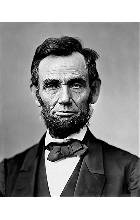


There's a good reason why Abraham Lincoln is considered our greatest president of the USA. Why he's considered greater than even George Washington who set some wonderful presidents for how the president should live and act. Properly, bow out after two terms.
So I guess, for the uneducated, today's Republicans are stealing the banner of Lincoln with an agenda that is so far from what Lincoln wanted, as to be on the moon rather than down here on earth with hard-working people.
Ron