Why Excessive Inequality Matters
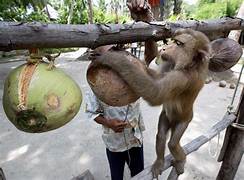
My brain keeps reminding me of the African solution about how to catch a monkey. The trappers cut a hole in a coconut just large enough for a monkey to insert his hand. Then they attached the coconut to a post with a chain, and filled it half full of rice. Hours later when the trappers returned, they found several monkeys with their hands in the coconuts, unwilling to release their enlarged fists of the rice, and run for their lives.
That story is such a powerful metaphor—simple, visceral, and deeply revealing. The monkey’s trap isn’t the coconut or the rice. It’s attachment, the unwillingness to let go, even when survival depends on it.
It mirrors the behavior of entrenched wealth: gripping tightly to assets, influence, and control, even as the broader system strains under the weight. The rice is power, capital, legacy—whatever is too “valuable” to release. And the coconut? It’s the legal structure, tax loopholes, or cultural narratives that keep the hand stuck.
What’s haunting is this implication: if the system doesn’t learn to let go voluntarily, it may be forced to—through collapse, conflict, or reform. The question becomes: who’s willing to loosen their grip before the trappers return? That's my anecdotal take.
Here's an original AI essay inspired by the monkey-and-coconut metaphor, woven into the broader theme of wealth, power, and the consequences of unchecked accumulation:
* * * *
AI Parable of Wealth and Willful Collapse
In the dense forests of human history, there’s a parable that echoes louder than most: the monkey and the coconut. A simple trap—ingenious in its elegance—requires no force, no violence, no chase. Just a coconut, a hole, and a handful of rice. The monkey, lured by the promise of easy reward, reaches in. But once its fist closes around the rice, it cannot pull free. The trap works not because the monkey is weak, but because it is unwilling to let go.
This is not a story about monkeys. It is a story about us.
In the modern jungle of finance and politics, the coconut is dynastic wealth—stocks, real estate, trusts, and influence. The rice is power, comfort, legacy. And the fist? That’s the human instinct to hold, to hoard, to preserve advantage even when the cost is systemic collapse.
Today, the United States stands at a precipice. With over $147 trillion in accumulated wealth—much of it inherited and compounding tax-free—the nation is witnessing a quiet revolution. Not one of marching boots or burning barricades, but of balance sheets swelling beyond comprehension. The Walton heirs, inheriting billions in unsold stock, exemplify the coconut trap: wealth untouched, growing exponentially, immune to taxation, immune to redistribution.
But the trap is not just theirs. It is ours. Because as wealth concentrates, opportunity evaporates. As capital compounds, democracy dilutes. The rice becomes more than sustenance—it becomes obsession. And the coconut, once a vessel of nourishment, becomes a prison.
We are told that reform is impossible. That taxing unrealized gains is too complex. That eliminating the step-up in basis would hurt family farms. That wealth taxes are un-American. But these objections are not logistical—they are emotional. They are the clenched fists of a system unwilling to release what it has grasped for generations.
And yet, history is clear: no society survives the coconut trap indefinitely. Rome fell not from foreign invasion, but from internal rot. France erupted not from ideology, but from inequality. The question is not whether the trap exists—it is whether we will recognize it before the trappers return.
Letting go is not surrender. It is survival. It is the recognition that rice, when shared, nourishes more than one. That coconuts, when opened, can build bridges instead of cages. That wealth, when taxed and reinvested, can fund schools, heal hospitals, and restore the promise of a nation built not on inheritance, but on ingenuity.
We are the monkeys. We are the fist. We are the rice. And the time to choose is now.




The cracks are appearing in the system here and there and protests are increasing. Whether they will turn into pitchfork carrying mobs bent on vengeance and guillotining the wealthy and powerful, may be only a matter of time.
Ron